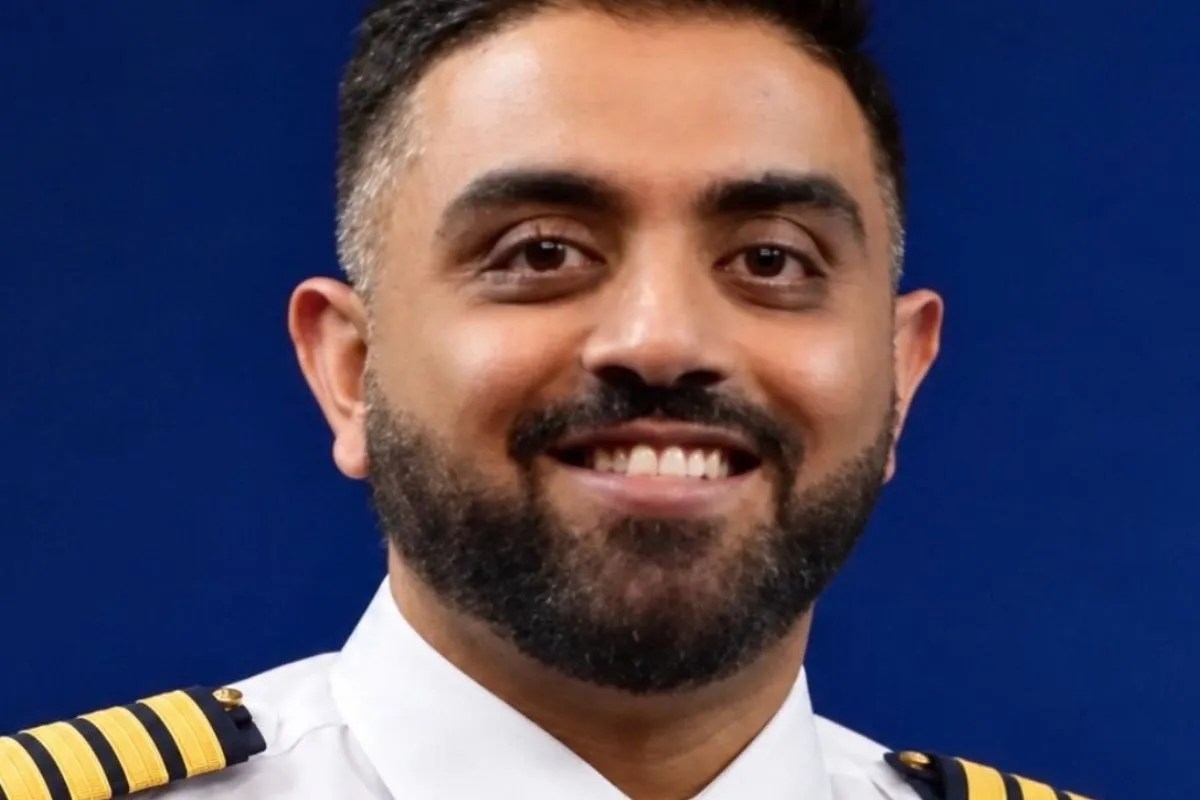
Some people spend their entire lives preparing for extraordinary moments, while others have those moments thrust upon them with terrifying suddenness. Captain Smit Machhar did not plan on becoming a headline. He expected a standard flight, a routine rotation through the upper atmospheres, and a quiet landing. Instead, he found himself locked in a desperate, blood-soaked struggle for survival inside a commercial flight cockpit.
The transition from a textile engineering background to the flight deck is already an unconventional career path. Most aviators follow a straight line from flight school to regional carriers to major airlines. Machhar took the scenic route through looms, family business expectations, and heavy machinery before looking up at the sky and deciding his future belonged above the clouds. That unusual foundational grit would soon be tested in ways no simulator manual or emergency checklist could ever anticipate.
The Anatomy of a Crisis
Commercial aviation relies on redundancy. Dual controls, backup generators, automated navigation systems, and strict cockpit security protocols exist to protect passengers from almost any mechanical or human failure. But what happens when the failure originates inside the flight deck itself, and the threat wears a familiar uniform or bypasses standard barriers?
When violence erupted on Flydubai Flight, the invisible wall of procedure shattered. A cockpit is cramped. It is a tightly packed workstation filled with switches, displays, and yoke columns, leaving very little room to maneuver during a physical assault. Machhar suddenly faced an attacker in an enclosed space where every twitch of the controls could send the aircraft into a fatal dive.
He was stabbed, bleeding, and fighting for basic oxygen and consciousness. The physical pain was immediate, but the psychological terror was far worse. In those fractured seconds, the survival of over a hundred and seventy souls depended entirely on whether a wounded man could reclaim his instruments before gravity took over.
The Engineering of Survival
People often romanticize heroism as a sudden burst of magical bravery. Real crisis management is far uglier and far more mechanical. It is about compartmentalizing trauma while your body screams at you to collapse.
Machhar later recounted lying on the flight deck floor, feeling the aircraft pitching downward as chaos threatened to consume the cabin. This is where his early technical background quietly asserted itself. Engineering teaches systems thinking. When a complex system breaks down, you do not panic; you isolate variables, check feedback loops, and restore baseline stability.
He knew the flight path. He knew the structural limits of the airframe. As chaos raged around him, his mind cut through the trauma to assess the primary objective: keep the wings level, stabilize the descent, and get the machine back under human control. It is a chilling reminder that modern aviation security is only as strong as the fragile human beings sitting in the left and right seats.
Beyond the Headlines
The media cycle loves a simple narrative. A hero rises, the public cheers, and life moves on to the next breaking story. But true investigative analysis requires looking past the ticker tape.
How vulnerable are commercial flight decks to internal breaches? What are the psychological screening processes for modern commercial pilots navigating grueling long-haul schedules? The incident involving Machhar forces international aviation authorities to re-examine cockpit security protocols that have remained largely unchanged since the early 2000s. External threats were locked out, but the industry spent decades assuming that the people cleared to fly would never turn the weapons inward.
When world leaders like Indian Prime Minister Narendra Modi and international passengers later praised Machhar's composure, they were celebrating a rare outcome. A tragedy was averted by millimeters and milliseconds. If Machhar had lost consciousness a fraction of a second earlier, history would have recorded a catastrophic accident rather than a miraculous recovery.
The Unforgiving Sky
Flying remains statistically the safest form of mass transportation ever devised. Yet, that safety is an illusion maintained by constant, exhausting vigilance. It rests on the shoulders of individuals who strap themselves into aluminum tubes and trust that humanity will behave itself at thirty thousand feet.
Captain Smit Machhar walked away from that cockpit battered, traumatized, and forever changed. The textile engineer who traded fabric for flight paths proved that true resilience is forged not in training academies, but in the dark, quiet moments when everything falls apart and you refuse to let go of the yoke.