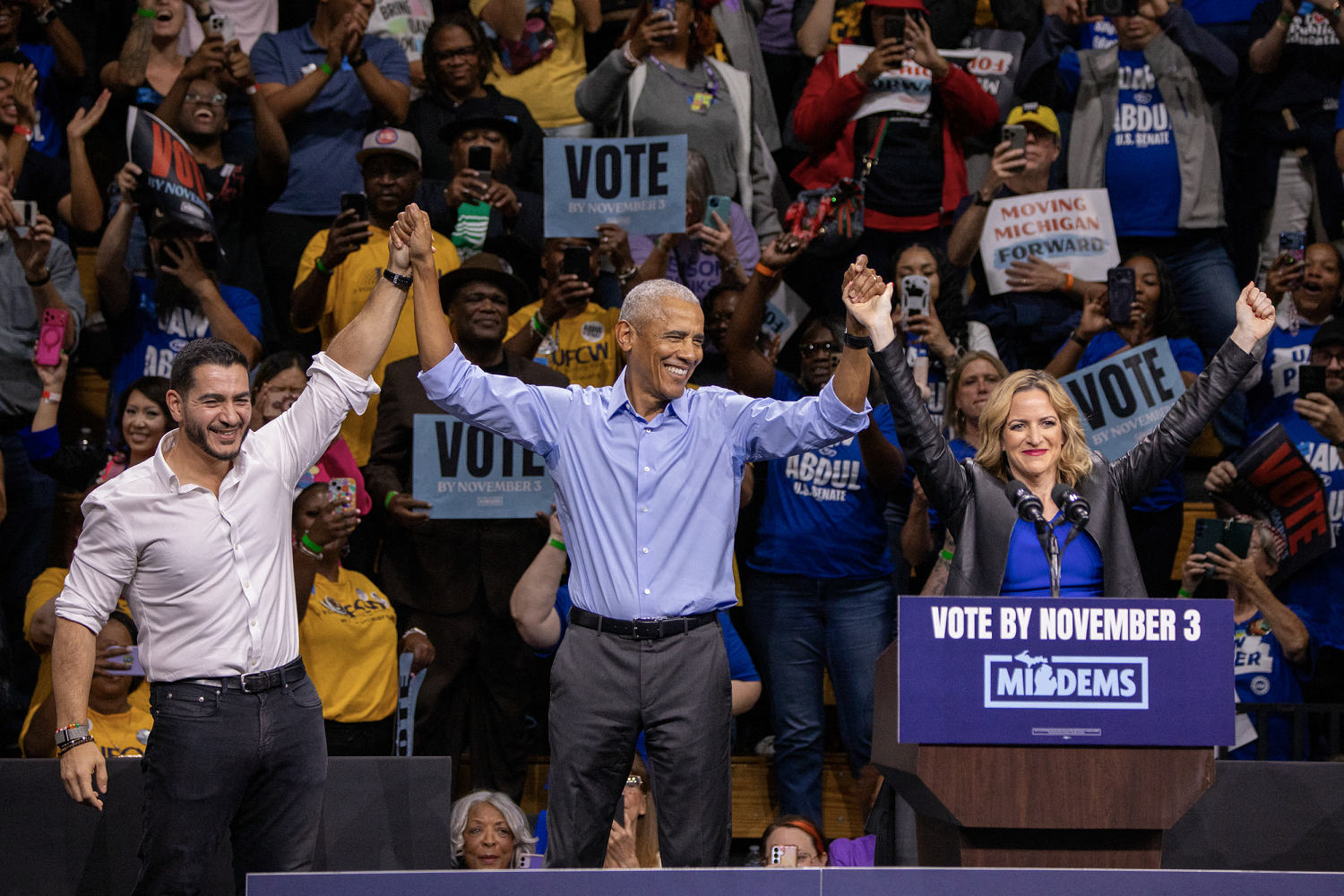
Political endorsements in high-stakes primary elections rarely operate as simple, frictionless transfers of voter loyalty; rather, they function as targeted capital injections designed to resolve specific demographic deficits within a candidate’s existing coalition. When former President Barack Obama campaigns alongside Abdul El-Sayed in Michigan to consolidate support among Black voters, the strategic objective is not merely visibility, but the mitigation of structural friction between distinct Democratic voting blocs. Understanding whether this intervention succeeds requires analyzing the mechanics of surrogate credibility, historical primary coalition dynamics in Michigan, and the behavioral conversion rates of low-propensity versus high-propensity primary electorates.
The Structural Deficit in Michigan Democratic Primaries
Winning a statewide Democratic primary in Michigan requires assembling a geographically and demographically bifurcated coalition. Historically, this coalition relies on three distinct engines: high-density urban Black turnout concentrated in Detroit and Wayne County, organized labor hubs across Macomb and Genesee counties, and progressive, college-educated voters clustered in university centers such as Ann Arbor (Washtenaw County) and East Lansing (Ingham County).
A candidate emerging primarily from the progressive, anti-establishment wing—as Abdul El-Sayed has throughout his political career in Michigan, from his tenure as Detroit Health Director to his statewide runs—typically exhibits high initial velocity in university towns and among younger, ideologically motivated voters. However, this specific ideological profile frequently encounters structural resistance among older, pragmatic Black primary voters.
This resistance is driven by risk aversion rather than purely ideological disagreement. In a statewide primary, Black voters in Detroit and surrounding suburbs often prioritize perceived general-election viability and institutional stability over ideological purity. When an insurgent or progressive candidate lacks deep, multi-decade roots within traditional Black civic and religious institutions, an endorsement deficit emerges. The competitor's coverage frames Obama's rally appearance as "shoring up" support; in operational terms, the campaign is attempting to bridge a trust gap by importing institutional validation from the Democratic Party's most durable consensus figure.
The Mechanics of Surrogate Capital Transfer
An endorsement from a former president operates through two distinct mechanisms: information signaling and social proof. Neither mechanism guarantees vote conversion, and both degrade rapidly if not paired with ground-level organizational infrastructure.
1. Heuristic Information Signaling
Primary elections suffer from severe information asymmetry. Unlike general elections, where partisan labels provide an immediate cognitive shortcut, primaries force voters to differentiate between candidates sharing identical party platforms on core issues. For voters who do not closely track internal party factions, a high-profile surrogate acts as a heuristic filter. Obama’s presence signals to risk-averse Democratic voters that El-Sayed is an acceptable, viable standard-bearer rather than a destabilizing outlier. This lowers the perceived cost of defecting from a more traditional establishment alternative.
2. Asymmetric Credibility Across Demographics
Surrogate capital is not uniformly liquid across all voter segments. Within the contemporary Democratic electorate, Barack Obama retains exceptionally high approval ratings among older Black voters—precisely the demographic cohort that turns out most reliably in non-presidential primary cycles and exhibits the highest skepticism toward progressive challengers.
The strategic calculation behind deploying Obama in Michigan relies on asymmetric credibility:
- High-Impact Zone: Older Black voters (ages 50+) who view Obama as a generational benchmark of Democratic governance and pragmatism. Here, the endorsement directly counters narratives that a progressive candidate is unelectable in a swing state.
- Low-Impact Zone: Younger progressive activists and Arab American voters in Dearborn and Wayne County, whose political alignment is driven by specific policy commitments—particularly healthcare reform and foreign policy—rather than party-establishment signaling. For this cohort, Obama’s appearance is largely redundant or neutral, as their commitment to El-Sayed predates institutional validation.
Why Rallies Fail Without Turnout Architecture
A common analytical error in political reporting is equating rally attendance and media saturation with electoral conversion. A single high-profile event creates a temporary spike in earned media, yet its direct impact on ballot totals is constrained by the conversion funnel of primary campaigns.
To alter an election outcome, a surrogate appearance must move a voter through four sequential stages:
- Awareness: The target voter registers that the endorsement occurred.
- Persuasion: The voter updates their preference based on the surrogate's credibility.
- Registration/Eligibility: The voter meets state-specific primary participation requirements.
- Mobilization: The voter physically casts a ballot or returns an absentee ballot.
Rallies excel at stage one and modestly influence stage two, but they contribute almost nothing to stage four unless the campaign executes rigorous data capture and follow-up. In Michigan, where primary turnout regularly drops below 25% of registered voters in non-presidential cycles, persuasion without mobilization yields zero net votes. If a campaign brings thousands of supporters into an arena in Detroit or Flint without capturing contact metadata, integrating those attendees into a field-organizing database, and deploying canvassers to verify ballot submission, the rally functions merely as an expensive morale exercise.
Historical Friction in Endorsement Transfers
Empirical evidence from prior Michigan primary cycles demonstrates that even the highest-tier endorsements encounter strict limits when colliding with local political realities. During the 2018 Democratic gubernatorial primary, Abdul El-Sayed secured high-profile progressive endorsements from figures such as Bernie Sanders and Alexandria Ocasio-Cortez. Those appearances generated massive crowd sizes and national media coverage, yet El-Sayed finished second to Gretchen Whitmer by more than 20 percentage points, carrying almost none of Detroit’s precincts.
The failure of those endorsements to penetrate Detroit resulted from two structural factors:
- Local Gatekeeper Alignment: Whitmer had already secured the backing of key local elected officials, labor unions, and community ministers who control precinct-level turnout operations in Wayne County. National media figures cannot easily override local gatekeepers who maintain year-round constituent relationships.
- Candidate-Surrogate Mismatch: Sanders and Ocasio-Cortez appealed strongly to the exact demographic El-Sayed had already won (college-educated progressives), producing an echo-chamber effect rather than expanding his demographic reach.
Deploying Barack Obama represents an explicit attempt to correct the 2018 strategic error. Unlike progressive surrogates who reinforce a candidate’s existing base, Obama is deployed specifically to penetrate the demographic wall that previously blocked El-Sayed from competing effectively in Wayne County.
Strategic Risks and Structural Limitations
Relying on a singular, high-wattage surrogate introduces specific operational vulnerabilities into a campaign’s closing stretch. Strategists must account for three primary limitations:
The Cannibalization of Field Resources
Organizing a presidential-level rally consumes disproportionate staff bandwidth, security coordination, and financial capital. During the final weeks of a primary, every hour field organizers spend managing event logistics, credentialing, and crowd-building is an hour subtracted from direct voter contact—specifically door-knocking and phone-banking targeted at infrequent primary voters. If the earned media generated by the rally fails to reach disengaged households, the opportunity cost degrades overall turnout efficiency.
Ideological Cross-Pressure
Aligning closely with a former president inevitably tethers the candidate to that administration’s policy record. While Obama’s brand boosts credibility among moderate and older Black voters, it can simultaneously create friction within a progressive candidate’s core base. Voters motivated by sharp critiques of mainstream Democratic governance—including dissatisfaction with domestic healthcare compromises or Middle East foreign policy—may experience cognitive dissonance when their preferred insurgent candidate embraces the party's central institutional figure. Campaigns must carefully calibrate messaging so that consolidation of the center-left does not depress enthusiasm on the left flank.
The Absentee Ballot Timing Trap
Michigan’s expansion of no-excuse absentee voting has fundamentally altered the temporal window of primary campaigns. A substantial percentage of older Black voters in Michigan cast their ballots via mail weeks before Election Day. Consequently, a late-cycle rally has a rapidly shrinking addressable market. If a surrogate event occurs after 40% to 50% of the target demographic has already returned their absentee ballots, the endorsement cannot mathematically alter those locked-in votes, regardless of how persuasive the speech may be.
Evaluating the Tactical Execution
To determine whether Obama’s intervention genuinely alters the trajectory of the race rather than simply generating favorable headlines, analysts must track concrete operational indicators in the days immediately following the event rather than relying on crowd estimates.
First, examine media market penetration within local Detroit television broadcasts and Black-owned radio networks (such as WGPR or WCHB). National cable coverage has negligible impact on Wayne County primary turnout; the endorsement only achieves persuasion scale if it dominates local evening news cycles and drive-time talk radio where older primary voters consume political information.
Second, track paid media amplification. An unamplified rally decays in voter memory within 72 hours. Effective campaigns immediately cut footage from the surrogate’s remarks into targeted digital and broadcast advertisements, running them specifically in zip codes with high concentrations of older Black voters who voted in two of the last four primaries.
Third, monitor local surrogate co-signing. Watch whether Detroit city council members, state representatives, and prominent clergy share the stage or immediately follow the rally with unified endorsements. Obama’s appearance often serves as a permission structure for local officials who were previously hesitant to break with establishment frontrunners. If local gatekeepers pivot following the rally, the campaign gains access to genuine precinct-level turnout machinery.
The Definitive Strategic Play
A high-profile endorsement rally is an opening gambit, never a closing argument. For the El-Sayed campaign to convert Barack Obama’s institutional credibility into actual primary ballots, it must immediately shift resources away from earned-media spectacle and execute a hyper-localized, three-week field conversion operation across Wayne, Oakland, and Genesee counties. Specifically, the campaign must strip audio and video from the rally within 24 hours, deploy it exclusively into targeted direct-mail and local radio buys aimed at Black voters over age 50 who have not yet returned absentee ballots, and dispatch paid canvassers to those exact households to facilitate ballot completion before the window closes. Without that mechanical follow-through, the rally will remain a high-visibility media event that fails to move the underlying precinct math.