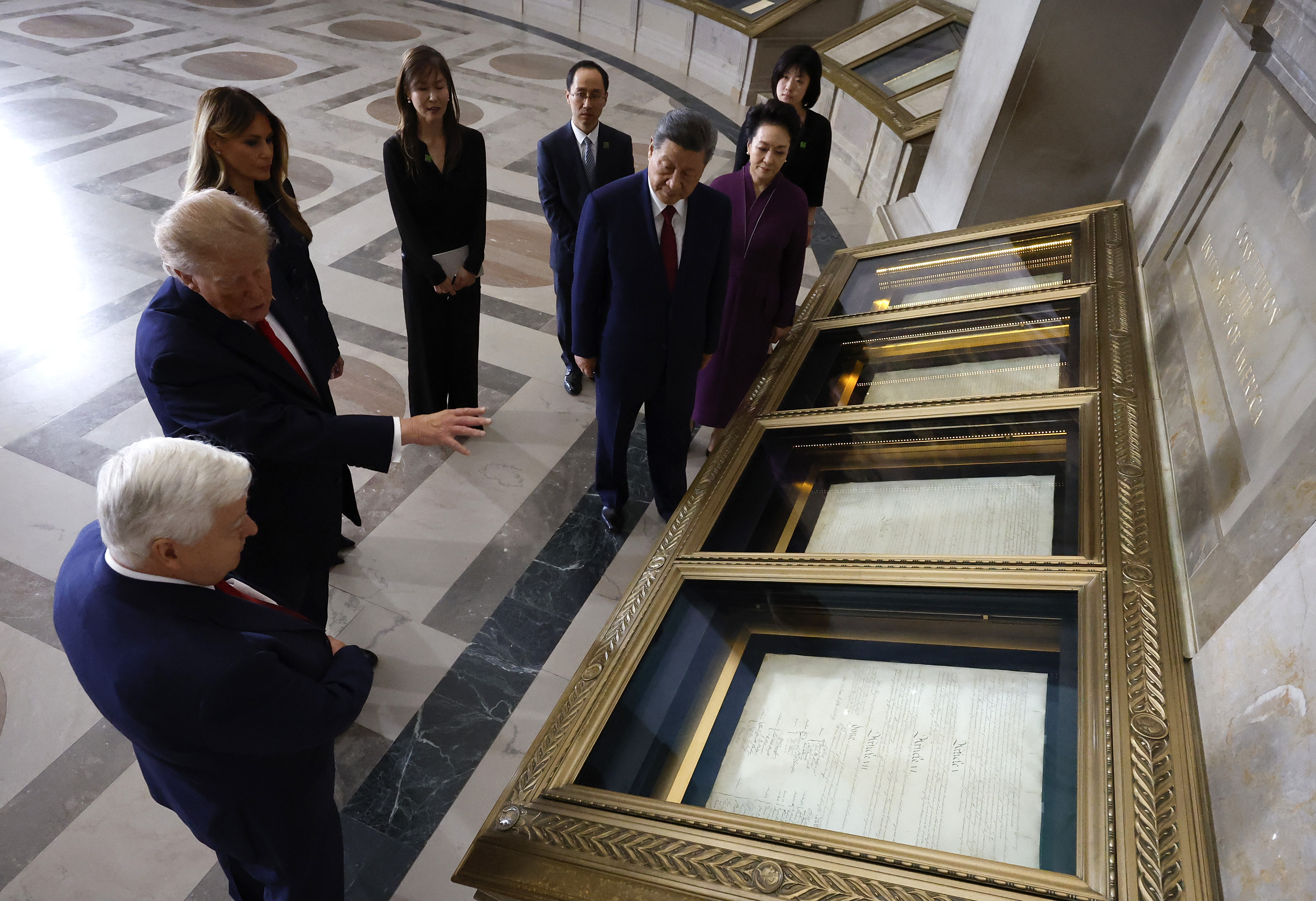
Diplomatic choreography rarely survives contact with reality. When the schedules for high-stakes geopolitical summits are locked in, thousands of operational hours have already been burned by advance teams, security details, and protocol officers. Every handshake is rehearsed. Every motorcade route is mapped to the second. Yet, when Donald Trump and Xi Jinping crossed paths, the carefully planned itinerary for a visit to the National Archives experienced an abrupt, last-minute rerouting. The immediate culprit whispered through diplomatic corridors was lingering tension over Taiwan, but the operational reality of high-level statecraft reveals a much more complicated mechanics of friction between Washington and Beijing.
Diplomatic cables and national security insiders point to a fundamental truth of modern great-power competition. Symbolic locations matter. When a foreign head of state visits a sovereign nation's historical repository, the choice of venue carries immense semiotic weight. The National Archives houses the foundational documents of American democracy, including the Declaration of Independence and the Constitution. For a Chinese leader to stand in that specific hall is to engage in a quiet psychological negotiation over governance, legitimacy, and historical narrative. When the plans shifted at the eleventh hour, it was not merely because of a disagreement over protocol. It was a collision of opposing strategic narratives regarding sovereignty, regional flashpoints, and the optics of superpower parity.
The Anatomy of a Last-Minute Protocol Failure
To understand why a venue change happens on the eve of a presidential summit, one must understand how diplomatic delegations negotiate optics. Every square foot of a facility is scrutinized for its political signaling. If leader A stands beneath a document that underscores democratic self-determination, and leader B represents a state that views sovereignty through an uncompromising, indivisible lens, friction is guaranteed.
The underlying friction regarding Taiwan was never far from the surface. In the weeks leading up to the encounter, military posturing in the Taiwan Strait had reached a localized fever pitch. Cross-strait incursions by aircraft and naval vessels had become routine, pushing the baseline of operational risk higher than at any point in recent memory. When national security advisors review the backdrop for a summit, they look at the imagery through a domestic and international lens. A picture is worth a thousand words, but in geopolitics, a poorly chosen backdrop can trigger an immediate market reaction or a hostile editorial in state-run media.
When the National Archives itinerary began to unravel, it exposed the fragility of bilateral engagements when structural distrust outweighs personal diplomacy. The logistical pivot required hundreds of secret service agents, protocol officers, and foreign ministry officials to rewrite security perimeters overnight. Such friction does not happen because of a minor scheduling conflict. It happens because a red line was approached, recognized, and managed through evasion rather than confrontation.
The Burden of Symbolic Real Estate
Venues like the National Archives are chosen precisely because they project historical permanence. They are designed to project stability. However, when the present political reality is volatile, historical permanence becomes a liability.
Consider what the National Archives represents to an international audience. It is an altar to constitutional governance. For Beijing, whose leadership operates under a strictly centralized system that explicitly rejects Western models of separation of powers, standing in that specific rotunda offers zero domestic political utility. In fact, it poses a messaging challenge for state media outlets that must project strength and equality to a domestic audience. If the optics suggest a visiting leader is touring a shrine to a competing political philosophy, the propaganda apparatus must work overtime to reframe the narrative.
Conversely, the American side faces its own domestic political constraints. In an era of intense bipartisan consensus on the necessity of countering China's rise, any administration hosting Beijing's top official faces immediate scrutiny from congressional hawks. Every photo-op is picked apart for signs of appeasement. A venue that highlights core American founding principles can be interpreted by domestic critics as either a strong assertion of values or an awkward juxtaposition depending on how the meeting is managed.
When Taiwan entered the conversation as a non-negotiable point of contention, the symbolic weight of the Archives became too heavy to bear. The risk of a diplomatic snub, an awkward press exchange, or an unwanted historical parallel forced planners back to the drawing board.
Beyond the Teleprompter
The public narrative presented by spokespeople during major summits often bears little resemblance to the chaotic reality backstage. While press secretaries speak of candid discussions and mutual respect, the actual work of diplomacy at this level resembles high-stakes crisis management.
When the decision was made to alter the visit, it signaled that the guardrails protecting the relationship were fraying. In healthier diplomatic eras, symbolic visits serve to reinforce common ground despite disagreements. In the current climate, symbolism is weaponized. Every venue, every seating arrangement, and every joint statement is treated as a zero-sum game.
The Taiwan issue functions as the ultimate stress test for these interactions. It is not just another diplomatic dossier. It is viewed by Beijing as a matter of core national survival, and by Washington as a critical test of international rules-based order and deterrence. When these two non-negotiable positions collide, administrative details like museum tours and archival visits become collateral damage.
The New Baseline of Superpower Friction
The eleventh-hour pivot away from the National Archives should not be dismissed as a minor scheduling footnote. It is a symptom of a deeper structural decoupling where physical proximity between the world's two largest economies is increasingly managed with maximum caution and minimum genuine warmth.
As geopolitical fault lines harden, the margin for error in diplomatic protocol shrinks to zero. Future encounters between Washington and Beijing will likely feature even more tightly controlled environments, fewer spontaneous moments, and an obsessive focus on managing risk over achieving breakthroughs. The story behind the canceled Archives visit is a reminder that when trust is scarce, even a simple walk through history becomes an impossible diplomatic minefield.


