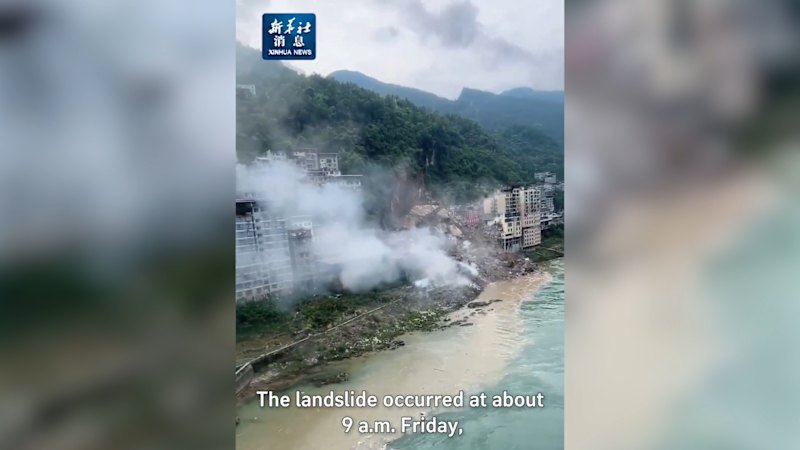
A mountain doesn't give you much warning before it falls apart. On Friday morning in southwestern China, a massive slab of hillside did exactly that, collapsing directly onto a cluster of residential buildings in Chongqing's Pengshui county. It sounded like cannon fire.
Seconds later, homes were crushed under dirt and shattered concrete.
Initial reports from state broadcaster CCTV and local authorities confirmed that emergency teams pulled seven survivors from the wreckage along a steep stretch of the Wujiang River. A rescue operation like this is a race against suffocation and unstable ground, but the real story in Pengshui isn't just about the frantic digging that followed the collapse. It's about a crucial, split-second decision made an hour before the mountain gave way.
The Hour That Saved Sixty Lives
We often look at disasters in rural China as sudden, unavoidable tragedies. The steep, rain-soaked topography of Chongqing Municipality makes it one of the most landslide-prone regions on earth. But what happened in the Hanjia subdistrict of Pengshui county on July 17, 2026, proves that local vigilance actually works.
Around 8:00 AM, community workers noticed something small but terrifying. Tiny rocks were trickling down the mountainside.
To an untrained eye, it’s just gravel. To anyone living in the shadow of these mountains, it’s a death warning.
The workers didn't wait around for official geological surveys. They sounded an emergency alarm immediately. Local authorities ordered a rapid evacuation of the immediate danger zone, hustling more than 60 residents out of their homes.
At 9:08 AM—almost exactly one hour later—the hillside gave way.
Timeline of the Pengshui Landslide:
08:00 AM - Small rocks spotted falling; emergency warning issued.
08:15 AM - Rapid evacuation of over 60 residents begins.
09:08 AM - Massive mountainside collapse buries residential buildings.
09:30 AM - Search and rescue teams arrive at the Wujiang River site.
If those community workers had hesitated, or if residents had argued about leaving their possessions behind, we would be looking at dozens of fatalities instead of a dramatic rescue.
Inside the Wujiang River Rescue Effort
Even with the evacuation, some people couldn't escape the impact zone in time. The landslide struck with enough force to bury several homes and trap a number of individuals under heavy, compacted debris.
The physical environment of Pengshui Miao and Tujia Autonomous County complicates any rescue effort. It sits in a rugged, heavily dissected karst landscape. The homes here cling to the narrow banks of the Wujiang River, flanked by towering limestone cliffs.
When dirt collapses in these conditions, it creates a dangerous mix of unstable mud and heavy rock. Rescuers cannot simply bring in heavy bulldozers immediately. Doing so risks shifting the rubble and crushing any survivors clinging to air pockets beneath the collapsed walls.
Emergency crews had to use specialized acoustic sensors and search dogs to pinpoint signs of life beneath the dirt. Hand tools and small cutters did the delicate work of clearing paths to the trapped residents. By Friday afternoon, seven people had been pulled alive from the mud and ruins, transported to nearby medical facilities for treatment. Search teams continue to scour the area to ensure no one else remains unaccounted for under the soil.
The Larger Problem of Southwestern China's Moving Earth
You have to look at the broader geography to understand why this keeps happening. Chongqing, along with neighboring Guizhou and Sichuan provinces, sits on highly active tectonic and geological terrain. The combination of steep slopes, fragile shale and limestone, and heavy seasonal monsoons creates a perfect environment for slope failure.
Climate data shows that intense, localized rainstorms have become more frequent and erratic across southwest China. Water saturates the topsoil, increasing its weight while lubricating the boundary layer between the soil and the bedrock. Once the friction threshold is crossed, gravity does the rest.
While early warning systems and watchful local spotters can save lives, they are a temporary fix for a systemic problem. Millions of people in southwestern China live in villages nestled tightly against high-risk slopes.
Moving entire towns isn't realistic. Instead, the focus has shifted toward building retaining walls, installing deep-anchored steel mesh on cliffsides, and deploying automated tilt-sensors that can detect microscopic earth movements.
Until those high-tech systems are universal, the safety of these communities relies entirely on the sharp eyes of local spotters and the speed of rescue crews digging through the dirt with their bare hands.