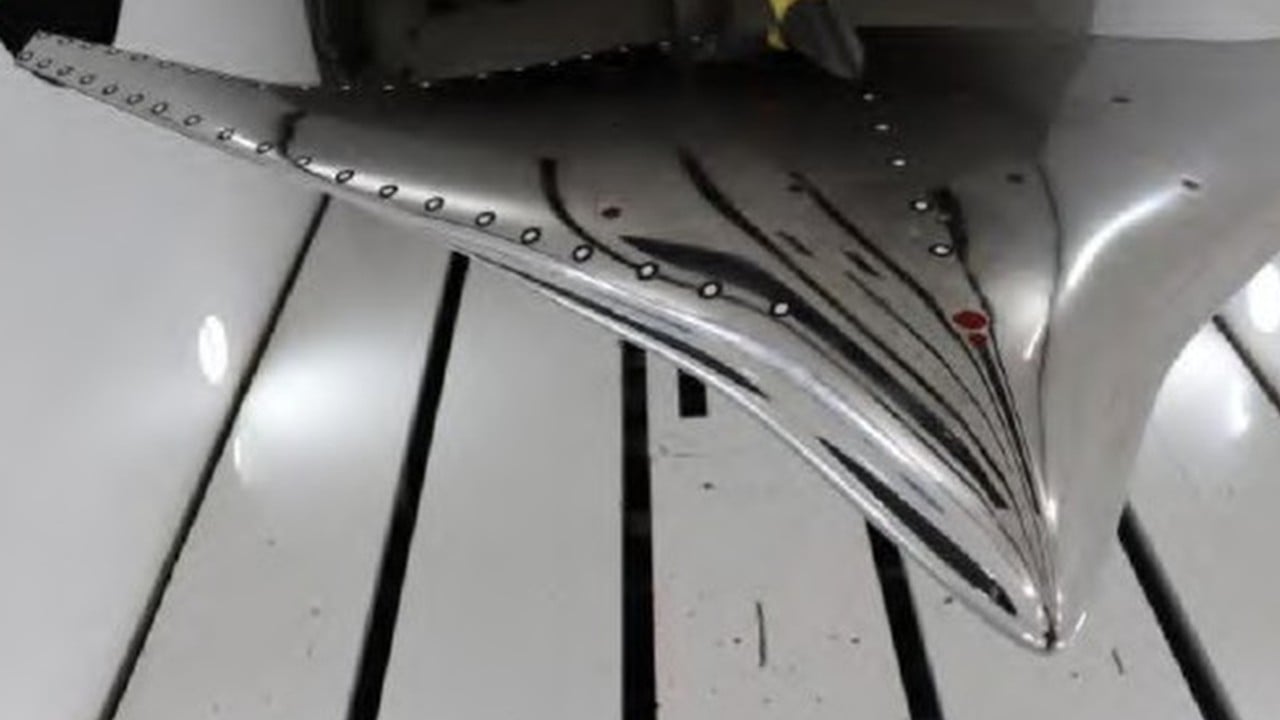
The aerospace industry is currently nursing a collective delusion. A Chinese research team just unveiled an aerodynamic model for an 800-passenger flying wing aircraft, and the headlines are predictably frothing at the mouth about "revolutionary design" and "redefining commercial aviation."
Stop. Take a breath.
I’ve watched companies burn nine-figure sums chasing "radical" configurations that look incredible in a wind tunnel and absolutely wretched on a balance sheet. The flying wing—a concept as old as the B-2 Spirit—is the aviation equivalent of a beautiful, non-functional sports car that explodes if you try to put groceries in the trunk. China’s proposal isn't a breakthrough; it is a fundamental misunderstanding of what a commercial aircraft actually does.
The Physics Of The Problem
The fundamental appeal of the flying wing is reduced drag. By removing the fuselage and tail, you theoretically have a cleaner lifting body. That is the theory. The reality is a geometry lesson in failure.
To house 800 humans, you need volume. To get volume without a tube-and-wing structure, you are forced to thicken the wing to absurd proportions. This creates a massive frontal area. You end up trading the "clean" aerodynamic profile for a brick-like wing that requires enough thrust to launch a small moon just to maintain cruise velocity. You aren't cutting drag; you are just moving the penalty from the fuselage to the airfoil.
Then there is the structural integrity of a pressurized cabin. Aerospace engineers discovered in the mid-20th century that the cylinder is the perfect shape for pressurization because it distributes stress evenly. A flat or irregular wing shape—especially one spanning 85 meters—is a nightmare for stress distribution. It’s like trying to inflate a balloon that’s been folded into a square. You will either face catastrophic fatigue cracks or you will add so much reinforcing weight that your "efficient" flying wing becomes heavier than the traditional jets it's supposed to replace.
The Human Cost
Let’s ignore the engineering for a moment and look at the passenger experience. If you sit near the wingtip of an 85-meter-wide aircraft, every time the plane rolls, you are moving through a massive arc. Imagine being at the end of a playground seesaw that’s 40 meters long. The physiological toll of that motion on passengers—the motion sickness alone—would turn every flight into a horror show of in-flight cleaning.
And the windows? Good luck. The "middle seat" problem in current wide-body jets is a minor grievance compared to the "windowless cavern" reality of a flying wing. You’re essentially asking 800 people to sit in a flying windowless basement for twelve hours.
Infrastructure: The Silent Killer
Even if the physics miraculously worked, the aviation industry isn't just the plane; it’s the airport. Our entire global infrastructure—gates, jet bridges, maintenance hangars, baggage belts, and emergency evacuation standards—is built for the tube.
To accommodate an 85-meter-wide behemoth, you would need to rebuild half the world’s international airports. Gate spacing, turn-around times, and emergency evacuation clearance are regulated with religious fervor by the FAA and EASA. Current regulations mandate that no passenger can be more than a few seats from an aisle. In a flying wing with a massive internal cabin, you lose that efficiency immediately. You’d need miles of extra aisles, which eats into your passenger capacity, further negating the "economies of scale" argument.
The Real Intent
So, why is this happening? Follow the money. This isn't a serious commercial bid; it’s a standard-model test platform for high-level aerodynamic research. The China Aerodynamics Research and Development Centre is doing exactly what they should be doing: stretching computational models to their limits to see where the air fails.
The industry press sees a "flying wing" and screams "future." The engineers see a "flying wing" and identify it as a tool for verifying wind tunnels.
If you want to lead in aviation, you don't build a circus act. You focus on materials science, engine efficiency, and regional connectivity. China is doing the grunt work of research, which is commendable, but they are miles away from a viable product. Do not mistake a test model for a prototype, and do not mistake a physics curiosity for a market disruptor.
The tube-and-wing design has dominated for nearly a century for a reason. It is the cheapest, lightest, most stable way to transport humans through a fluid medium at high speed. It isn't boring; it’s optimized. Until the laws of physics rewrite themselves, the tube is winning. Everything else is just a conversation piece for people who don't have to manage the maintenance budget.