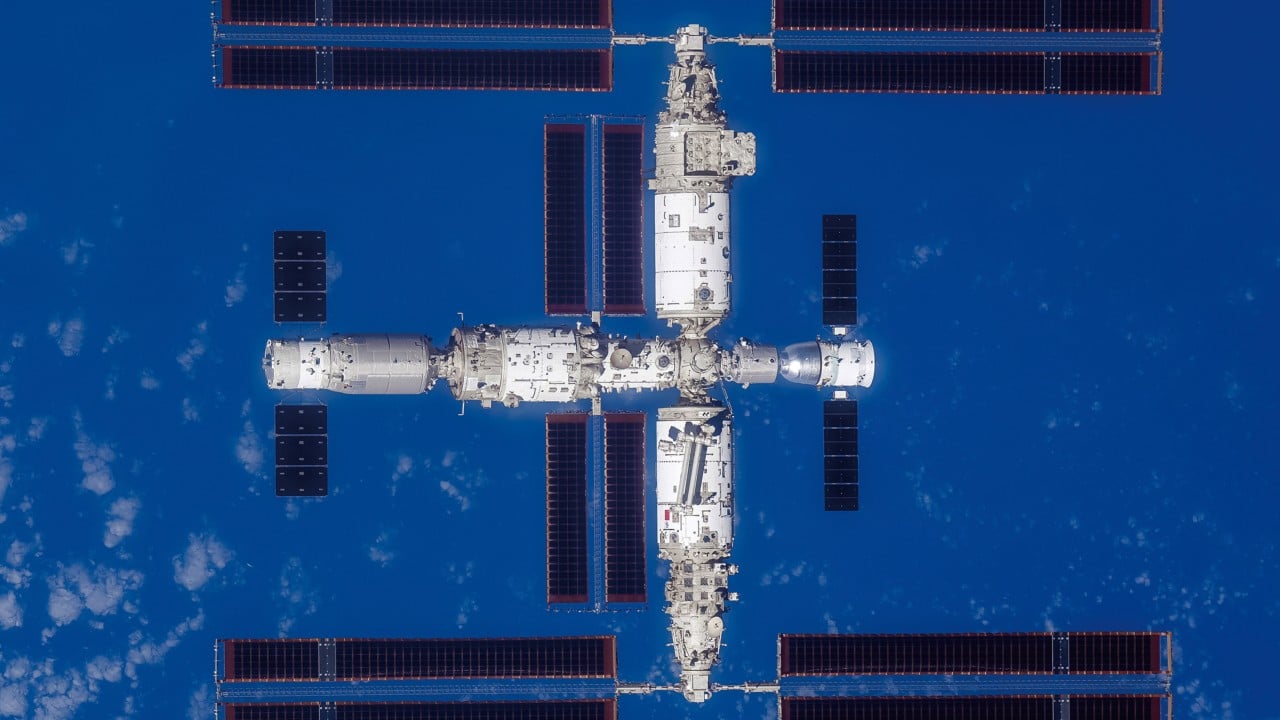
Aboard the Tiangong space station, Chinese physicists cooled a cloud of rubidium atoms to ten billionths of a degree above absolute zero—a temperature far colder than the deepest voids of interstellar space. By utilizing an all-optical trapping method inside the Mengtian laboratory module, the team achieved an ultra-low temperature of roughly 10 nanokelvin, setting an orbital record for cold atom physics and proving that complex quantum experiments can run reliably in microgravity without massive magnetic coils.
Cold atom headlines usually get buried in science digests, treated like academic trivia for people who spend their lives staring at laser tables. That is a mistake. When a space agency figures out how to freeze matter to a near standstill in orbit, they aren't just chasing a Guinness World Record. They are building the guts of next-generation navigation systems that do not need GPS, submarine-detecting gravity sensors, and atomic clocks so accurate they won't lose a second over the lifespan of the universe.
To understand why this matters, you have to look past the press releases and examine the brutal physics of trying to hold an atom still while hurtling around the Earth at 17,500 miles per hour.
The Gravity Problem on Earth
Temperature, at the atomic level, is just a measure of how fast particles are jiggling. Room temperature air molecules bounce around at hundreds of meters per second. To study quantum mechanics properly, physicists need to stop that motion. They use intersecting laser beams to batter the atoms from all directions, slowing them down until they form a Bose-Einstein condensate—a bizarre fifth state of matter where individual atoms lose their identities and behave like a single, unified quantum wave.
Down here on the ground, gravity ruins the party.
The moment you slow an atom down enough to see its quantum behavior, Earth's gravitational pull yanks it downward. It falls right out of your laser trap. You get a fraction of a second—maybe a couple of seconds if you build a hundred-meter-tall vacuum drop tower—before the atoms slam into the bottom of your glass chamber and warm right back up.
To fight gravity on Earth, labs have to crank up intense magnetic fields or blast the atoms with high-powered lasers just to hold them suspended in mid-air. That extra energy injects heat and noise back into the system, putting a hard ceiling on how cold you can actually get.
Space removes the floor. In the free-fall environment of low Earth orbit, those rubidium atoms simply float. You can turn down the trapping lasers to a whisper, allowing the cloud of atoms to expand gently and cool down to temperatures that are physically impossible to sustain in a terrestrial lab.
How Tiangong Pulled Off the All-Optical Trick
NASA beat everyone to the punch back in 2018 when it launched the Cold Atom Lab (CAL) to the International Space Station. The American facility proved that you could make Bose-Einstein condensates in orbit, eventually pushing temperatures down into the picokelvin range using an atom chip and magnetic traps.
China took a different engineering route inside the Mengtian module, which docked with Tiangong in late 2022. Instead of relying heavily on complex magnetic atom chips, the Chinese Academy of Sciences team used a two-stage all-optical trap.
Think of an optical trap as tweezers made of focused light. Atoms are naturally drawn toward the brightest part of a laser beam under specific wavelengths. By crossing two laser beams inside an ultra-high vacuum chamber, researchers create an energy well—a tiny dimple in space where atoms gather and sit.
To drop the temperature down to the 10-nanokelvin mark, the team performed a technique called evaporative cooling. It works on the exact same principle as blowing across a hot cup of coffee. You slowly lower the intensity of the trapping lasers, weakening the walls of the light cage. The fastest, "hottest" atoms have enough kinetic energy to escape over the edge, leaving behind only the slowest, coldest atoms in the center.
Doing this with pure optics rather than magnetic fields carries a massive practical advantage. Magnetic fields are notoriously finicky; they get thrown off by stray electrical currents in the spacecraft, solar storms, or the Earth's own magnetosphere as the station sweeps across different latitudes. An all-optical setup is cleaner, far more immune to electromagnetic interference, and much easier to miniaturize for future satellites.
Why Space Agencies Are Obsessed With Cold Atoms
Nobody spends hundreds of millions of dollars putting vacuum chambers and stabilization lasers into orbit just to confirm Einstein's equations from 1924. The real driver behind orbital cold atom research is quantum sensing.
When atoms are cooled to nanokelvin temperatures, their wave-like nature stretches out. They become absurdly sensitive to the tiniest external forces—gravity, acceleration, and rotation.
Submarine Hunting and Underground Mapping
A traditional accelerometer uses a physical mass on a spring or a vibrating silicon crystal. Over time, mechanical parts drift, warp, and lose calibration. A cold atom interferometer replaces that mechanical mass with a cloud of free-falling atoms. By splitting the atomic wave with laser pulses and recombining it, scientists can measure microscopic changes in gravitational pull.
In practical terms, a quantum gravimeter flying in orbit can map shifts in Earth's water tables, track melting ice sheets, and spot underground mineral deposits without digging a single hole. On the defense side, the same physics allows naval vessels or aircraft to detect the tiny gravitational signature of a submerged submarine hiding beneath thermoclines where standard sonar goes blind.
Navigation Without Satellites
Modern militaries and commercial shipping are dangerously dependent on GPS, BeiDou, and Galileo. Those signals are weak and trivially easy to jam or spoof, as recent conflicts in Eastern Europe and the Middle East have demonstrated on a daily basis.
If you pack a cold atom gyroscope and accelerometer into a submarine, an aircraft, or a spacecraft, you get an inertial navigation system that knows exactly where it is without ever looking at the sky or talking to a ground station. Current mechanical gyroscopes drift by kilometers over a few weeks. Quantum inertial sensors built on ultra-cold atoms promise to cut that drift down to mere meters over months of travel.
Timekeeping at the Edge of Physics
Tiangong already houses a cold atom clock, which uses laser-cooled atoms to tick at a frequency far more stable than the standard microwave atomic clocks riding aboard GPS satellites. Pushing those atoms to even lower temperatures eliminates the Doppler shift—the blurring effect caused by atoms moving around while you try to measure them. Better clocks don't just keep trains running on time; they improve deep-space tracking and allow physicists to test whether fundamental constants of nature actually stay constant across different gravitational fields.
The Messy Reality Behind the Milestone
If you read state-backed media coverage of the Tiangong experiment, it sounds like operational quantum satellites are six months away. They aren't. Having covered aerospace and defense R&D for decades, I have seen plenty of lab breakthroughs stall out when forced to survive outside a climate-controlled cleanroom.
First, there is the duty cycle problem. Cooling a cloud of atoms to 10 nanokelvin, running a measurement, and resetting the trap takes seconds. During those dead seconds, a fighter jet or missile moving at Mach 2 travels miles completely blind. For quantum navigation to replace traditional hardware, engineers have to figure out how to run continuous cold atom beams or pair them seamlessly with classical sensors to bridge the gaps.
Second, power and volume remain brutal constraints. The rack inside the Mengtian module is a marvel of miniaturization compared to a university basement lab, which usually looks like a sprawling rat's nest of mirrors, optical fibers, and water-cooled chillers. Still, it takes up an entire payload cabinet and draws hundreds of watts of power. Shrinking that down to fit inside an autonomous underwater vehicle or a tactical aircraft without vibrations shaking the lasers out of alignment is an unsolved engineering nightmare.
Even the achievement itself requires context. Reaching 10 nanokelvin in an all-optical trap is a genuine milestone for China's space program, demonstrating tight control over laser frequency stability and vibration isolation in orbit. Yet NASA's Cold Atom Lab has already pushed Bose-Einstein condensates down below 100 picokelvin—roughly a hundred times colder—by using a different technique called delta-kick collimation, where a brief magnetic pulse acts like a lens to halt the expansion of the atomic cloud entirely.
A Quiet Bifurcation in Orbital Science
The deeper story here isn't a neck-and-neck temperature race between Beijing and Washington. It is the fact that China now possesses a fully operational, sovereign orbital laboratory capable of running bleeding-edge quantum physics experiments independently—and it is moving fast to iterate on them.
Because Congress passed the Wolf Amendment in 2011, barring NASA from bilateral cooperation with Chinese space agencies, the two programs have evolved in complete isolation. While the International Space Station approaches its scheduled retirement at the end of the decade, Tiangong is just getting broken in. Chinese engineers didn't copy the ISS architecture; they built a smaller, newer station with standardized payload racks designed specifically for rapid hardware swaps and automated experiments.
Every time a Shenzhou crew rotates through Tiangong, they aren't just maintaining life support. They are upgrading laser modules, swapping vacuum cells, and feeding terabytes of quantum telemetry back to ground stations in Beijing and Hefei.
When you strip away the geopolitical posturing and the dense quantum jargon, what happened inside the Mengtian module comes down to basic engineering discipline. Mastering the coldest temperatures in the universe isn't about studying the deep freeze of space—it is about building the sensors that will quietly run the next century of navigation, surveillance, and deep-space exploration.