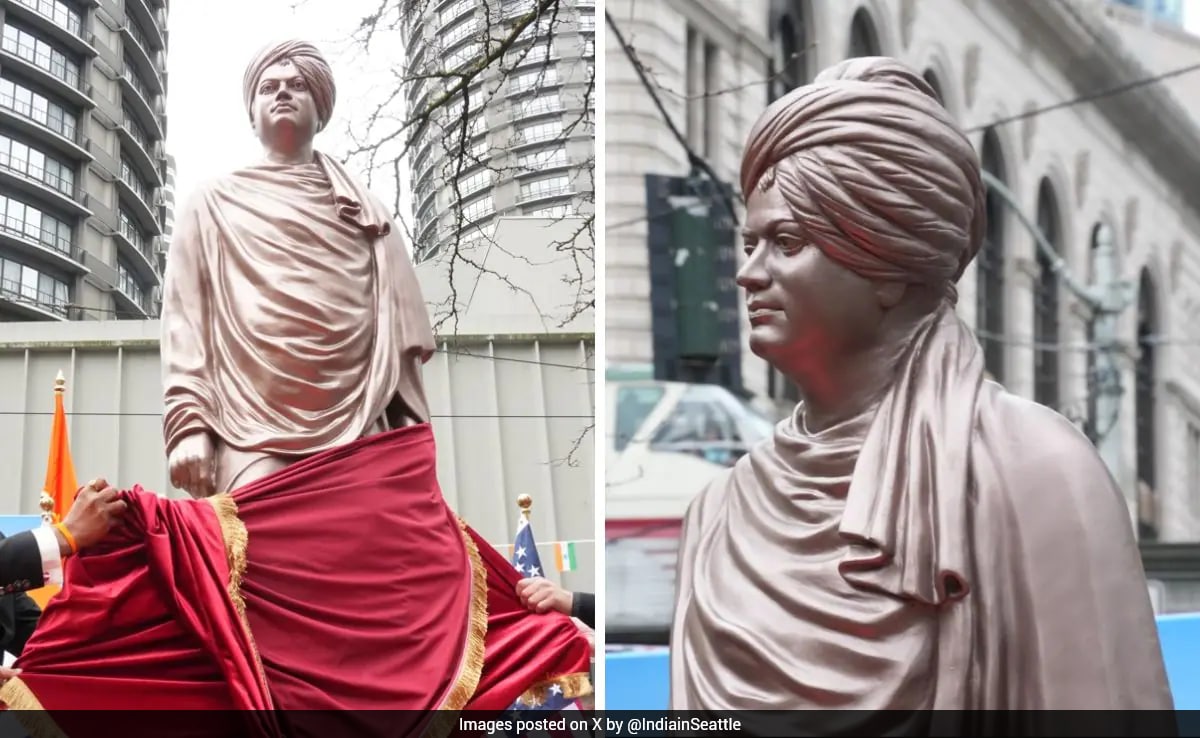
The installation of a Swami Vivekananda statue in Seattle represents more than a cultural milestone. It is a calculated recognition of a philosophical lineage that began in 1893 and has now found a permanent anchor in the Pacific Northwest. This move connects the historic Chicago Parliament of Religions to the modern technological hub of Seattle, signaling a shift in how Indian heritage is cemented within the American social fabric. It is not just about bronze and granite. It is about the institutionalization of an idea that has survived over 130 years of migration and geopolitical shifts.
The Geographic Shift of Cultural Power
For decades, the epicenters of Indian cultural influence in the United States were the traditional gateways: New York and Chicago. Chicago held the historical claim because of the 1893 World’s Columbian Exposition. That was where Vivekananda famously addressed the "Sisters and Brothers of America." However, the center of gravity has drifted toward the West Coast.
Seattle is no longer just a city of rain and coffee. It is a global powerhouse of innovation, housing the headquarters of companies that dictate the flow of modern life. By placing this monument here, the organizers are making a specific statement. They are claiming a space for ancient thought within a city defined by the future. This isn't a museum piece tucked away in a basement. It is a public assertion of identity in a region where the Indian diaspora has moved from the periphery to the very core of the economic engine.
The Mechanics of the 1893 Legacy
To understand why a statue in 2026 matters, one must look at the mechanical failure of the 19th-century religious status quo. In 1893, the West viewed Eastern thought through a lens of curiosity or condescension. Vivekananda’s intervention was a disruption of that specific frequency. He didn't come to convert; he came to provide a framework for universalism that lacked a specific Western equivalent at the time.
The current move in Seattle seeks to replicate that disruption. In an era of extreme polarization, the "Chicago model" of pluralism is being revived as a stabilizing force. The statue serves as a physical reminder that the dialogue between the East and the West is not a recent development fueled by H-1B visas, but a deep-rooted intellectual exchange that predates the digital age by a century.
Beyond the Bronze and Pedestal
Critics often dismiss statues as empty symbols. They see them as relics of a past that distract from the pressing issues of the present. But this perspective misses the logistical and social effort required to plant such a marker in a major American city. Securing the permits, the funding, and the political willpower to install a religious and philosophical figure in a public or semi-public space involves navigating a complex web of local governance and community relations.
This isn't just about art. It's about footprint.
The Seattle unveiling was attended by diplomats and community leaders, which adds a layer of soft power to the proceedings. When a Consulate General participates in such an event, the statue becomes a diplomatic asset. It serves as a permanent "soft" embassy. It anchors the local diaspora to their roots while simultaneously signaling to the host city that this community has arrived and intends to stay.
The Contrast of Two Cities
Chicago was the introduction. Seattle is the integration.
In 1893, Vivekananda was a guest. He was a traveler who arrived with almost nothing, relying on the hospitality of strangers. In 2026, the community erecting his likeness consists of industry leaders, engineers, and educators. The power dynamic has completely inverted. The community is no longer asking for a seat at the table; they are building the table itself. This transition from "guest" to "stakeholder" is the hidden narrative behind the Seattle monument.
The Intellectual Resistance to Modern Noise
There is a gritty reality to why Vivekananda’s message still resonates in a city like Seattle. The tech industry is currently grappling with a massive identity crisis. The relentless pursuit of efficiency has left a vacuum in terms of mental well-being and ethical grounding.
Vivekananda’s core tenets focused on the strength of the individual and the necessity of self-reliance. This is the "hard" side of his philosophy that often gets overshadowed by the more "peace and love" interpretations. He spoke about "muscles of iron and nerves of steel." In a high-pressure environment like the Seattle tech corridor, this brand of vigorous, action-oriented spirituality finds a very specific, very pragmatic audience. It is a philosophy of performance, not just meditation.
Avoiding the Trap of Nostalgia
The danger of these commemorations is the slide into pure nostalgia. If the statue only serves as a reminder of a speech made in 1893, it fails. Its success depends on whether it can provoke a modern conversation about what pluralism looks like in a secular, data-driven society.
We have to look at the hard data of the diaspora. The Indian-American population is one of the most highly educated and high-earning demographics in the United States. With that economic power comes a responsibility to contribute to the cultural landscape. The Seattle statue is a down payment on that responsibility. It is an attempt to move beyond the "model minority" myth and into the role of cultural architects.
The Logistics of a Lasting Icon
Designing and shipping a monumental work of art involves more than just aesthetics. The Seattle statue had to be crafted with precision to ensure it could withstand the specific environmental conditions of the region. The choice of materials and the scale of the work are intended to ensure longevity.
- Materiality: The use of high-grade bronze ensures that the statue will weather the damp Seattle climate without losing its structural integrity.
- Symbolism: The posture chosen for the statue—usually the confident, cross-armed stance—is a direct callback to the Chicago photographs. It is a visual brand that has remained consistent for over a century.
- Placement: The specific location within the Seattle area reflects the community’s desire for visibility. It is placed where it can be seen, not hidden in a private garden.
This level of planning shows that this was not a spontaneous gesture. It was a multi-year project that required coordination across international borders. It represents a triumph of logistics as much as a triumph of faith.
The Counter-Argument of Secularism
Every public monument in the modern West faces scrutiny. There are those who argue that religious or semi-religious figures have no place in public squares. However, the defense for the Vivekananda statue usually rests on his status as a philosopher and a bridge-builder rather than a sectarian leader.
He didn't advocate for a single dogma. He advocated for the underlying unity of human experience. In a city as diverse as Seattle, this nuance is the key to public acceptance. By framing Vivekananda as a historical figure who contributed to the American intellectual tradition—specifically influencing figures like William James—the organizers bypass the typical "church and state" friction that often stalls such projects.
The Real Impact on the Next Generation
For the children of the diaspora growing up in the shadows of the Space Needle and the Microsoft campus, this statue provides a different kind of data point. It tells them that their heritage is part of the American story, not an addendum to it.
The 1893 Chicago event was a flash in the pan—a brilliant moment that faded into history books. The Seattle unveiling is an attempt to make that moment permanent. It is about creating a physical touchpoint for identity in an increasingly digital world. When a young student sees a figure who looks like them, honored in a city that leads the world in innovation, the psychological impact is profound. It validates their presence in the rooms where decisions are made.
Why This Matters for Seattle’s Future
Seattle is currently reinventing itself. As the city deals with the aftermath of the pandemic and the shifting realities of remote work, it is looking for new ways to define its community spaces. The inclusion of diverse cultural markers like the Vivekananda statue is part of a broader trend toward a more globalized urban environment.
The city is realizing that its strength doesn't just come from its software, but from the people who write it. By honoring the philosophical roots of a significant portion of its workforce, Seattle is essentially "patching" its social contract. It is acknowledging that the contributions of the Indian community are not just technical, but foundational to the city's future.
The bridge from Chicago to Seattle is now complete. One city introduced the man; the other has enshrined the movement. This is the evolution of an immigrant story that has moved from the lecture hall to the public square, proving that ideas, when sufficiently grounded, can travel across centuries and continents without losing their edge.
Build the monument, but remember the man was a firebrand who demanded action over observation.