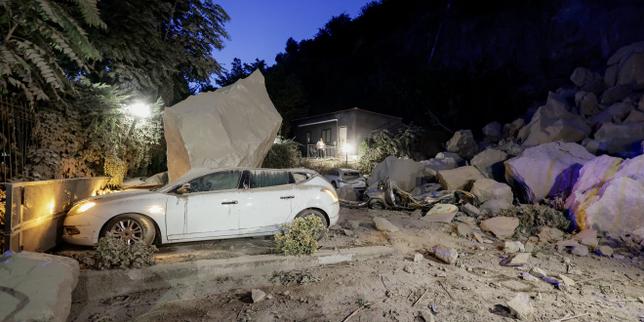
The earth beneath the Bay of Naples does not merely rest; it breathes, swells, and occasionally snaps. When a magnitude 4.2 earthquake struck the western suburbs of Naples, injuring 21 people and sending masonry tumbling onto narrow residential streets, the immediate response followed a familiar, exhausting script. Sirens wailed, families fled into the damp midnight air, and municipal authorities issued cautious statements urging calm.
Beneath the bureaucratic reassurances lies an uncomfortable truth. This was not an isolated seismic hiccup. It was another violent convulsion of the Campi Flegrei, a massive supervolcano hidden largely underwater and beneath dense urban neighborhoods where more than half a million people make their homes.
Journalists covering the initial tremor focused heavily on the cracked plaster of Pozzuoli and the broken tiles of Agnano. They counted the injured, cataloged the superficial damage, and moved on to the next daily news cycle. That approach misses the entire story. The structural damage to older buildings is merely a symptom of a deeper, far more dangerous geological mechanism known as bradyseism. The ground itself is shifting upward, pushed by rising magma and superheated fluids trapped kilometers beneath the surface.
The Mechanics of Rising Ground
To understand why a moderate tremor near Naples causes disproportionate panic, one must look at how the earth moves in this specific caldera. Unlike a traditional conical volcano that erupts vertically from a central vent, Campi Flegrei is a collapsed depression spanning twelve kilometers. It is a vast subterranean engine room.
Bradyseism is the continuous slow lifting or lowering of the earth's crust, driven by the expansion and contraction of underground hydrothermal systems. Over the past decade, the ground beneath Pozzuoli has risen by centimeters every year. That might sound negligible to an outside observer, but cumulative strain on brittle surface rock tells a different story.
When the crust stretches beyond its elastic limit, it fractures. Those fractures release energy, producing swarms of hundreds of small earthquakes over a matter of weeks. The recent injuries and structural failures were caused by the upper crust failing under this relentless, upward pressure.
Engineering reports compiled over the last twenty years indicate that a significant percentage of the housing stock in the red zone consists of older masonry buildings constructed long before modern seismic codes existed. These structures have low ductility. When the ground shakes laterally even for a few seconds, unreinforced brick and stone crack along structural joints. The falling debris that injured twenty-one people last week was entirely predictable. It was a mathematical certainty waiting for the right threshold of stress to be crossed.
Living Inside a Supervolcano
The human element of the Campi Flegrei crisis creates a complex social and logistical puzzle. Evacuating half a million people is not a simple matter of deploying a fleet of buses. Entire communities have grown organically over generations inside the caldera, anchored by employment, family ties, and deep cultural roots in the Neapolitan landscape.
Residents face a daily psychological burden. Every time a sharp jolt rattles coffee cups on a kitchen table, families must instantly calculate whether this tremor is just another minor release of pressure or the precursor to something catastrophic.
Local civil protection agencies conduct regular drills, distribute emergency guides, and map out evacuation corridors heading north away from the coast. Yet, interviews with residents reveal widespread skepticism regarding the practicality of these plans. Traffic bottlenecks on the congested coastal roads leading out of Pozzuoli are legendary during normal rush hours. During an emergency evacuation order involving hundreds of thousands of panicked citizens, those roads would freeze solid within minutes.
The Italian government has updated contingency plans and categorized risk tiers with meticulous precision. Scientists monitor ground deformation through GPS networks, tiltmeters, and continuous geochemical sampling of fumaroles, measuring the ratio of carbon dioxide to sulfur dioxide escaping from the earth at the Solfatara crater.
Science has advanced significantly since the bradyseismic crisis of the early 1980s, when tens of thousands of residents were abruptly evacuated from Pozzuoli under emergency conditions. Today, volcanologists possess real-time data streams that map underground magma movement with unprecedented clarity.
Yet, knowing where the magma is moving does not stop the ground from rising. It does not reinforce an aging concrete apartment block built on reclaimed land.
The Economics of Chronic Uncertainty
Real estate markets in the Phlegraean Fields reflect this perpetual state of anxiety. Property values fluctuate wildly depending on seismic activity. When a quiet year passes without significant tremors, buyers return, drawn by the dramatic coastline, rich historical ruins, and proximity to Naples. When a swarm hits, listings surge and prices stall.
Insurance companies operating in the region face an intractable actuarial challenge. Standard policies rarely cover subterranean volcanic risk comprehensively, leaving homeowners exposed to the financial fallout of structural repairs. Local small businesses, heavily reliant on tourism and regional commerce, absorb the immediate losses whenever a seismic event deters visitors from exploring the ancient Roman amphitheaters and thermal baths of the area.
Municipal authorities find themselves caught in a policy trap. Spending vast sums on urban renewal and seismic retrofitting makes complete logical sense from a safety perspective. However, investing heavily in infrastructure inside an active volcanic hazard zone can also be interpreted as encouraging long-term habitation in a place where authorities simultaneously warn that a future evacuation might become necessary.
Government subsidies for structural reinforcement have moved forward incrementally, but progress crawls at a bureaucratic pace. Thousands of buildings remain vulnerable to moderate ground acceleration.
Confronting the Inevitable
The events near Naples are not an anomaly. They are a preview of how human populations will increasingly have to manage chronic geological hazards in densely populated regions. Campi Flegrei is not currently showing definitive signs of an imminent eruption, according to the Vesuvius Observatory. Magma is accumulating at shallow depths, but the physical barriers holding it back remain intact for now.
However, looking only at the binary choice between complete calm and catastrophic eruption ignores the creeping danger of ongoing seismic wear and tear. Every magnitude 4 quake weakens the structural integrity of the surrounding towns. Every centimeter of uplift stretches gas lines, water mains, and foundations to new limits.
The twenty-one injuries reported from the latest tremor are a warning label written in stone and plaster. Ignoring the underlying structural vulnerabilities of the region while waiting for definitive signs of volcanic activity is a gamble with high stakes and poor odds. The ground beneath Pozzuoli is awake, and it is not going back to sleep anytime soon.