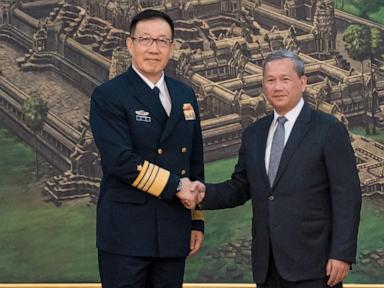
The standard geopolitical analysis of the recent "2+2" dialogue between China and Cambodia reads like a tired script. Beijing's foreign and defense ministers meet their counterparts in Phnom Penh, and right on cue, Western analysts start screaming about "vassal states" and the "death of ASEAN neutrality." They see a map turning red and assume it’s a conquest. They are wrong.
This isn't a story of Cambodian submission. It is a story of Cambodian leverage.
If you think Prime Minister Hun Manet is simply taking orders from Xi Jinping, you haven’t been paying attention to the cold, hard math of Southeast Asian survival. While Washington offers lectures on democratic values and "rules-based orders," Beijing offers concrete, steel, and deep-water ports. To call this a loss of sovereignty is to misunderstand what sovereignty actually looks like for a small nation wedged between giants.
The Ream Naval Base Myth
Every major outlet focused on the "2+2" talks inevitably pivoted to the Ream Naval Base. The consensus? It’s a secret Chinese military outpost designed to slice through the Gulf of Thailand.
Let’s dismantle that.
From a purely tactical perspective, a fixed naval base in Cambodia is a sitting duck in any high-intensity conflict. If China wanted to project power in the South China Sea, it wouldn't rely on a shallow-water port easily blockaded by Vietnam or monitored 24/7 by US satellite intelligence.
The upgrade at Ream isn't a military masterstroke; it’s an insurance policy. For Cambodia, it's about modernization they don't have to pay for. For China, it’s about a symbolic footprint that forces the US to stay at the negotiating table. I’ve watched defense budgets get burned on "strategic outposts" that offer zero actual utility in a real shooting war. Ream is a signaling tool, not a carrier strike group hub.
Diplomacy Is the New Debt
The "Debt Trap Diplomacy" narrative is the laziest trope in modern reporting. It suggests that Cambodian leaders are too dim to understand their own balance sheets.
The reality is far more cynical and efficient. Cambodia uses Chinese investment to bypass the bureaucratic nightmare of World Bank and IMF loans. When you need a bridge today to move goods tomorrow, you don't wait three years for an environmental impact study mandated by a committee in D.C.
Critics point to the $10 billion in debt Cambodia owes, much of it to China. What they miss is the velocity of capital. That money is being pumped into the Funan Techo Canal—a project that will allow Cambodia to bypass Vietnamese ports entirely. This isn't "selling out" to China; it’s using Chinese money to gain independence from its immediate neighbors.
The Cost of Independence
- Infrastructure over Ideology: Roads and power grids are non-negotiable for 7% GDP growth.
- Diversification: Cambodia is simultaneously courting Japanese and South Korean investment to ensure they aren't 100% dependent on Beijing.
- Regional Hegemony: By strengthening ties with China, Cambodia forces Thailand and Vietnam to treat them as an equal, rather than a junior partner.
The 2+2 Dialogue Is a Hedge, Not a Marriage
When defense and foreign ministers sit in a room, the West sees a military alliance. They should see a price negotiation.
By institutionalizing these "2+2" meetings, Cambodia is formalizing its value. They are telling the world: "This is the cost of our friendship." If the US wants to compete, they have to beat the price. Currently, the US is trying to buy a house with "good vibes" while China is showing up with a suitcase full of cash and a construction crew.
Western policy currently relies on punishing Cambodia through sanctions and EBA (Everything But Arms) trade withdrawals. This is strategic malpractice. You don't pull a country away from a superpower by making them poorer. You do it by becoming a better business partner.
Stop Asking the Wrong Questions
The media keeps asking, "How do we stop Cambodia from sliding into China's orbit?"
That is the wrong question. It assumes Cambodia is a passive object.
The real question is: "How does a small nation maximize its profit during a Cold War?"
Cambodia is playing the "multi-alignment" game better than almost anyone in the region. They take the Chinese ships, they take the Chinese dams, and then they turn around and invite US businesses to invest in their special economic zones. They are not a puppet; they are a broker.
The Transparency Trap
There is a loud demand for "transparency" regarding the agreements signed during these dialogues. While transparency is a noble goal in a textbook, it’s a death sentence for a small state trying to balance two nuclear-armed superpowers.
Ambiguity is Cambodia’s greatest asset. As long as the West isn’t quite sure how deep the military cooperation goes, they stay engaged. As long as China isn't sure how much Cambodia is talking to the West, they keep the aid flowing.
The moment everything is transparent, the leverage disappears.
The Brutal Reality of the Mekong
If you want to understand why these "2+2" talks matter, look at the water. China controls the headwaters of the Mekong. For Cambodia, the relationship with Beijing isn't just about money; it’s about existential security. If the upstream dams close, the Cambodian economy dies.
No amount of "democracy promotion" from a Western capital can fix a dried-up river. The "2+2" dialogue is a recognition of this physical reality. It is the diplomacy of the inevitable.
We need to stop viewing Southeast Asian diplomacy through the lens of a 1950s spy novel. There are no "sides" here—only interests. Cambodia has identified its interests with ruthless clarity. The West’s refusal to see that isn't a Cambodian failure; it's a Western one.
If you’re waiting for Cambodia to "pivot" back to a pro-Western stance because of a few sternly worded editorials, you’ll be waiting forever. They’ve already moved on. They are building a future with whoever shows up with a shovel and a checkbook.
Stop looking for a "conspiracy" in the 2+2 talks. It’s just business.