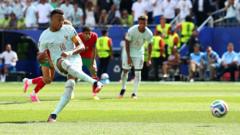
Football is losing its mind over 12 yards. The penalty kick, once a straightforward test of nerve between a striker and a goalkeeper, has mutated into a psychological circus. At the center of this breakdown is the "stutter" run-up—the halting, hopping, rhythm-breaking approach that leaves goalkeepers looking foolish and fans feeling cheated. Critics scream for a ban, calling it a mockery of fair play. Yet, the game's lawmakers refuse to act.
The real reason the stutter penalty endures isn't because it's impossible to police, but because football’s governing bodies have fundamentally redefined the power dynamic from the spot. By starving goalkeepers of their historical advantages through strict line-enforcement rules, authorities have intentionally tilted the scales toward maximum goal scoring. The stutter isn't a loophole. It is the logical conclusion of a system designed to ensure the ball hits the back of the net.
The Psychological Warfare of the Modern Stop-Start
To understand why the stutter works, we have to look at the mechanics of human reaction time. A standard penalty kick travels at roughly 70 miles per hour, reaching the goal line in less than half a second. Goalkeepers cannot wait for the ball to be kicked; they must read physical cues and dive half a beat ahead of time.
The stutter destroys this entire predictive framework. When a penalty taker like Robert Lewandowski or Neymar approaches the ball, their sudden deceleration forces a physiological choice on the keeper. The human brain is wired to anticipate movement. When that movement abruptly changes, the goalkeeper's muscles either lock up to reset their balance, or they commit to a dive based on false momentum.
It is an inherently unfair advantage, but it is entirely legal under the current International Football Association Board (IFAB) Laws of the Game.
Law 14 states that a kicker may feint during the run-up, but cannot feint once the run-up is completed. Feinting at the kick itself is an offense. The gray area, however, is wider than the goalmouth. What constitutes the end of a run-up? If a player stops dead a millimeter before striking the ball, is that a continuous motion? Referees are left to make split-second definitions of "continuity" under immense pressure. They almost always side with the attacker.
The Systematic Neutralization of the Goalkeeper
The anger surrounding the stutter run-up cannot be viewed in isolation. It must be paired with the absolute lockdown of goalkeeper positioning over the last decade.
Goalkeepers are now heavily restricted. They must keep at least part of one foot on or behind the goal line until the ball is kicked. No forward movement. No early jumping. If a keeper leaves the line early and saves the shot, the penalty is retaken, and the keeper faces a yellow card.
Consider the mathematical reality of this setup.
| Goalkeeper Restrictions | Penalty Taker Freedoms |
|---|---|
| Must remain stationary on the line until the strike | Can alter speed, hop, and stall during the approach |
| Cannot advance to narrow the shooting angle | Can react dynamically to the keeper's weight shift |
| Enforced strictly via Video Assistant Referee (VAR) review | Granted immense leniency regarding "continuous motion" |
This asymmetry has turned the penalty shootout from a duel into an execution. When a kicker can stop their run-up, wait for the keeper to be forced onto their heels by the letter of the law, and then slot the ball into the opposite corner, the spirit of the sport is compromised.
The Myth of the Easy Fix
The most common argument from pundits is simple: ban any deceleration during the run-up. Force players to maintain a continuous forward stride. If they stop, flag it as an illegal feint and award an indirect free kick to the defending team.
It sounds perfect on television. In practice, it would create a refereeing nightmare worse than the current handball rule.
Imagine a hypothetical scenario where a player stumbles slightly due to a poor pitch surface during their approach. Is that a deliberate stutter or a loss of footing? What about players who naturally have a short, choppy stride length? If a referee has to measure the exact velocity of a player's hips to determine if they slowed down by more than 20% mid-run, the game will descend further into bureaucratic chaos.
VAR has already stripped football of its spontaneous joy. Adding a "run-up velocity check" to the monitor review list would cause mutiny in the stands.
Furthermore, the stutter is not a foolproof cheat code. It requires an elite level of technical precision. If a kicker halts their momentum, they lose the power generated by a standard run-up. They must rely entirely on placement and hip flexibility to direct the ball. When a goalkeeper refuses to bite on the stutter—standing completely still until the very last millisecond—the pressure shifts instantly back to the kicker. A stuttering player who meets a stationary keeper often delivers a weak, unconvincing shot that is easily saved.
Entertainment Value Trumps Pure Meritocracy
Football authorities know exactly what they are doing. The sport is no longer just a competition; it is a global entertainment product that thrives on high scores and dramatic, high-stakes moments.
Goals sell the game. Millions of fans tune in for the drama of a penalty shootout, and the governing bodies have zero incentive to lower the conversion rate. The current conversion rate for penalties in major European leagues hovers around 75 to 80 percent. If the stutter were banned and goalkeepers were given more freedom, that number would drop.
By allowing attackers to manipulate their run-up while anchoring keepers to the line, the lawmakers have insured that penalties remain highly efficient scoring opportunities. It creates viral social media clips, fuels fan arguments, and keeps the scoreboards moving.
The modern penalty is no longer about who can kick the ball hardest or dive the fastest. It is an exercise in psychological manipulation where one side has been stripped of its armor. Expecting IFAB to ban the stutter to preserve the "purity" of the sport ignores the economic realities of modern football. The theater of the stop-start penalty is exactly what the lawmakers want, and it is here to stay.