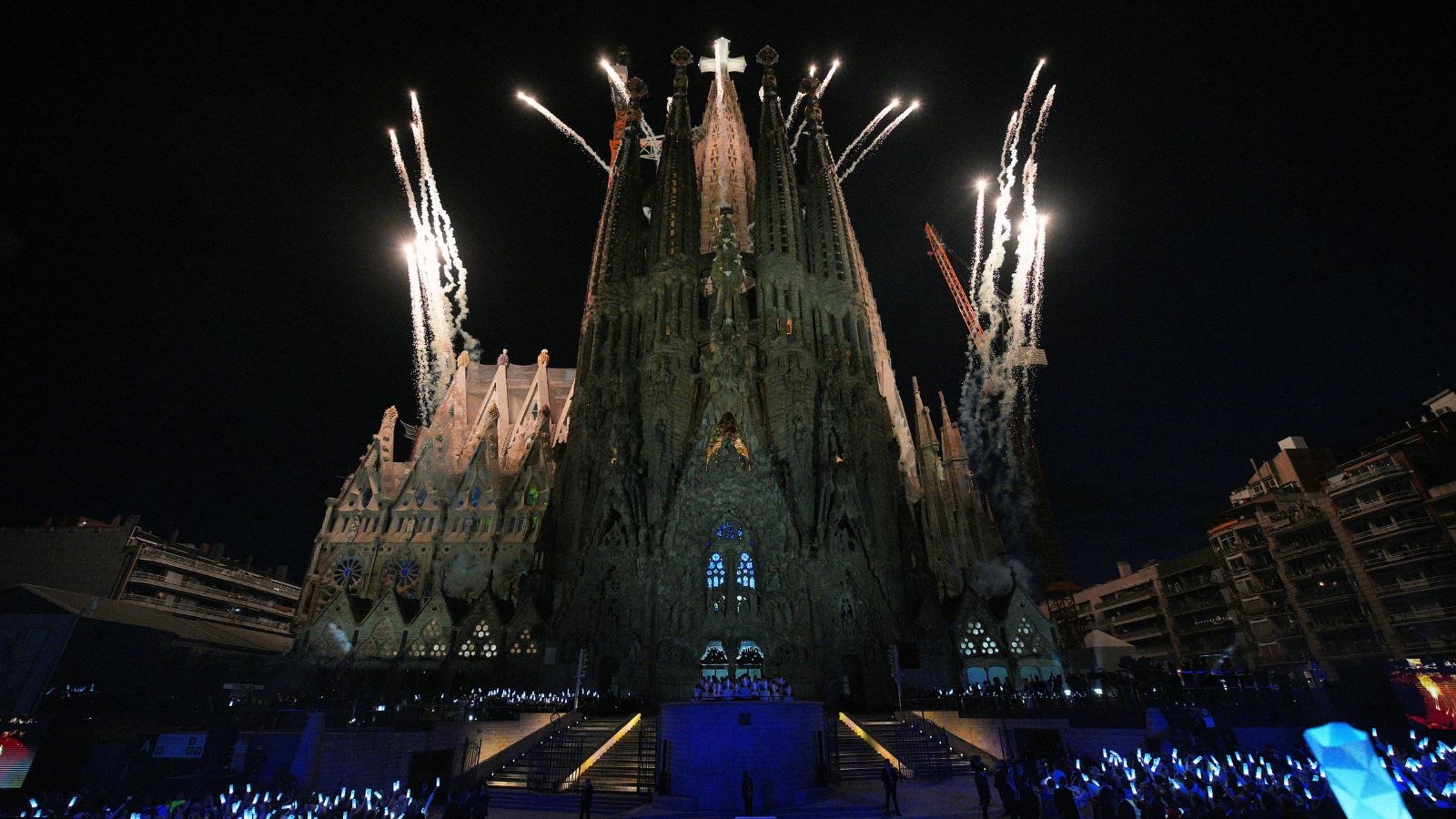
Antoni Gaudí knew he would never see it finished. What the Catalan architect likely did not foresee was how his unfinished masterpiece, the Sagrada Família, would become an ideological battleground, an engineering lab, and a massive tourist engine that alters the very fabric of Barcelona. While standard travelogues focus entirely on the mesmerizing stained glass and the tree-like stone columns, the real story of the basilica lies in its survival. It is a story of anarchist fires, missing blueprints, fierce neighborhood resistance, and a radical shift from traditional masonry to 3D printing and aerospace engineering software.
The building was never just about faith. It was, and remains, a highly political statement wrapped in stone.
The Myth of the Unbroken Line
Walk into the nave today and you are struck by a sense of cohesive genius. The light spills through hyper-vibrant windows, reflecting off geometric pillars that branch out toward the ceiling. It feels like an organic whole, a direct line from Gaudí’s mind to the present day.
That line is an illusion.
In 1936, during the Spanish Civil War, anarchists stormed Gaudí’s workshop inside the unfinished church. They set fire to his papers, smashed his plaster models, and scattered his meticulous geometric notes. Gaudí did not use traditional architectural drawings; he relied on three-dimensional models because his shapes—hyperboloids, paraboloids, and helicoids—were too complex to represent on a flat piece of paper. When those models shattered, the true design DNA of the building was lost.
What we see today is a massive, decades-long game of reverse engineering. Subsequent architects had to piece together the fragments like a forensic puzzle. Critics, including prominent Catalan architects over the years, have argued that the continued construction is less a preservation of Gaudí’s vision and more a pastiche. They claim the current structure is a modern interpretation that lacks the soul of the original builder. The tension between authentic preservation and contemporary execution is baked into every stone lifted into the Barcelona sky.
High Tech Salvaging a Medieval Craft
The sheer physics of the Sagrada Família present a nightmare for structural engineers. Gaudí wanted a church that would out-scale anything in Christendom, but he refused to use traditional gothic flying buttresses. He found them ugly, calling them "crutches." Instead, he designed a system of inclined columns that act like the trunks of trees, transferring the immense weight of the roof directly down into the foundations.
To build this without the master present, modern engineers had to abandon traditional drafting tools. They turned to aeronautical software—the kind used to design fighter jets—to calculate the stress points of the complex geometric surfaces.
From Chisels to 3D Printers
For the first century of construction, progress was painfully slow. Stonecutters shaped blocks by hand in on-site workshops, a process that meant towers took decades to rise. The introduction of computer-aided design and advanced manufacturing changed everything.
- Plaster Prototype Replacement: The workshop now utilizes industrial 3D printers to reconstruct the shattered remains of Gaudí’s original 1:10 and 1:25 scale models. Engineers can test structural integrity in hours rather than months.
- Off-Site Prefabrication: The massive towers are no longer built stone by stone in the open air. Instead, they are assembled as pre-stressed stone panels in a factory dozens of kilometers outside Barcelona. These massive blocks, reinforced with hidden stainless steel rods, are trucked into the city and craned into place with mathematical precision.
- Material Shifts: Purists object to the use of modern concrete inside the stone pillars. The operators argue it is a necessity for longevity and seismic safety. This compromise keeps the building standing but distances it further from the 19th-century craft Gaudí championed.
This technological pivot accelerated the timeline drastically, turning a centuries-long medieval endeavor into a fast-paced assembly line. But speed introduces its own complications.
The Neighborhood Under Siege
While tourism boards celebrate the rapid progress, the residents of the surrounding Eixample district face a much grimmer reality. The Sagrada Família is a victim of its own success, drawing millions of visitors a year to a dense, residential neighborhood.
The most explosive conflict centers on the proposed Grand Staircase on the Mallorca Street facade. Gaudí’s original, sprawling vision included a massive monumental entrance approached via a wide avenue. The problem is that during the decades when construction languished, the city allowed apartment buildings to be constructed directly across the street.
If the church board proceeds with Gaudí’s full design, these residential blocks will have to be demolished. This would displace hundreds of families and local businesses. Neighbors have organized fierce protests, taking the fight to the courts. They argue that a modern private foundation should not have the power to expropriate homes to fulfill a century-old plan that was never officially approved by the city's urban planning departments until a construction license was finally issued in 2019.
The basilica is no longer an isolated house of worship. It is a massive corporate entity competing with everyday citizens for physical space in an overcrowded city.
| Construction Phase | Primary Method | Funding Source | Speed of Progress |
|---|---|---|---|
| 1882–1936 | Hand masonry, local stone | Private donations | Extremely slow |
| 1940–1980s | Fragment reconstruction, basic concrete | Modest alms, early tourism | Slow and sporadic |
| 1990s–Present | CNC milling, 3D printing, aerospace software | Mass tourism ticket sales | Rapid acceleration |
The Economics of Holy Ground
The financial engine behind the construction is self-sustaining and staggering. The Sagrada Família is an expiatory church, meaning it cannot legally be funded by the government or the Catholic Church hierarchy. It must rely entirely on private donations.
In the early days, work often ground to a halt when money ran out. Today, the funding problem is solved by the sheer volume of global tourism. Millions of tickets sold each year generate tens of millions of euros in revenue. This massive influx of cash funds the advanced technology, the off-site factories, and the army of international specialists working on the site.
This creates a strange paradox. The building requires massive crowds of tourists to fund its completion. Yet, the presence of those same crowds has transformed a space designed for quiet, spiritual contemplation into a chaotic, hyper-commercialized zone. The interior acoustic design, intended to elevate choral music and prayer, must now compete with the low hum of thousands of shuffling feet and the whispers of tour guides.
Tourism as an Architectural Catalyst
The architecture itself has adapted to the tourist economy. Elevators run up the insides of towers that Gaudí envisioned climbing only by spiral stone stairs. High-security barriers and ticket booths are integrated into the entryways, altering the flow of movement around the sacred portals.
The church must balance being a functioning basilica and a high-yield tourist attraction. Mass is held regularly, but the vast majority of people passing through the doors are there to consume a visual spectacle rather than participate in a religious ritual. The building has effectively become a museum that funds its own expansion.
The completion of the central Tower of Jesus Christ will mark the highest point of the structure, making it the tallest church in the world. It will stand exactly one meter shorter than the nearby Montjuïc hill. Gaudí believed his work should not surpass the work of God. Yet the machinery, the corporate structure, and the logistical muscle required to get it to that height are entirely human, driven by modern capitalism and technological brute force. The stone facade tells a story of ancient faith, but the bones of the structure are a testament to modern industrial power.