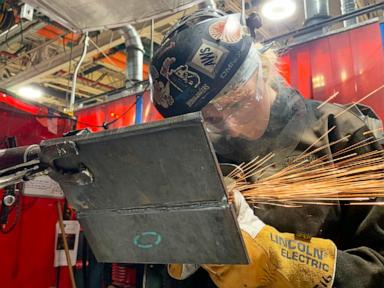
Mikala Sposito, a 21-year-old student from Washtenaw Community College in Michigan, has become the first woman selected to represent the United States in welding at the international WorldSkills Competition in Shanghai, China. Sposito secured her place by winning the grueling USA Weld Trials in Huntsville, Alabama, marking a historic shift in a heavily male-dominated sector. Her upcoming campaign requires an intensive 80-hour work week of precise technical training under international standards, highlighting both the high-stakes evolution of vocational education and the changing demographics of the American industrial workforce.
Beneath the celebratory headlines of a demographic breakthrough lies a harsher reality of grueling endurance, structural educational advantages, and a critical domestic labor deficit.
The Eighty Hour Crucible
To understand how a community college student out-welded the top trade talent in the nation, look at the brutal preparation regimen. Sposito is burning rods and balancing torches for 80 hours every single week at the Washtenaw Community College (WCC) lab in Ann Arbor. This is not casual homework. It is a grueling, repetitive, and physically exhausting marathon designed to build the exact muscle memory required to fuse exotic alloys under extreme scrutiny.
The WorldSkills Competition is frequently called the Olympics of skilled trades. It evaluates competitors on technical execution, meticulous craftsmanship, and stringent time constraints. At this level, a fraction of a millimeter or a microscopic pocket of porosity can mean the difference between a podium finish and elimination.
The physical toll of this routine is immense. Welding is often mischaracterized as a job requiring raw, brute strength. In reality, elite competitive welding functions more like high-stress surgery performed with a miniature lightning bolt. It requires keeping a completely steady hand while wearing thick leather, resisting intense radiant heat, and breathing through a respirator for ten to twelve hours a day.
Sposito, who discovered her passion for fusing metal at just ten years old, dismissed the notion that her gender presents a physical disadvantage in the lab. Welding does not require brute power. It requires fine motor control, patience, and a deep understanding of metallurgy.
The preparation schedule includes an international tour spanning from Canada to Australia. These pre-competitions expose her to different gas mixtures, varying electrical frequencies, and unfamiliar regional steel compositions. It is an expensive, exhausting gauntlet designed to break a competitor before they ever set foot in Shanghai.
The Institutional Pipeline
Sposito achievement is impressive, but it did not happen in a vacuum. She is the sixth student from WCC to qualify for the WorldSkills team, establishing the institution as a dominant force in American vocational education. While major four-year universities invest heavily in tech incubators and sports stadiums, this Michigan community college built an elite pipeline for specialized manufacturing.
The secret to this pipeline is institutional memory. Sposito coach and mentor, Alex Pazkowski, placed second globally at the 2013 WorldSkills competition. He knows exactly how judges evaluate a root pass on a pipe weld, how to manage stress when a machine malfunctions mid-test, and how to read the puddle when the lighting in an international arena is substandard. This cycle of elite alumni returning to teach creates an compounding advantage that standard technical schools cannot match.
WCC WorldSkills Pipeline:
[Elite Alumni Competitors] ──> [Return as Dedicated Mentors] ──> [Train Next-Gen Competitors]
This structural advantage raises a critical question about the state of American industrial education. Why are so few institutions capable of producing workforce talent at this level? The answer comes down to funding and priority. Elite welding programs require significant capital investments. Modern pulse-TIG machines, advanced multi-process power sources, heavy-duty ventilation systems, and specialized testing equipment cost hundreds of thousands of dollars.
Most community colleges operate on razor-thin margins. They lack the corporate partnerships and alumni networks required to fund a world-class training lab. WCC succeeded by treating its welding program like a high-performance athletic department, securing the funding, materials, and elite coaching staff necessary to compete on a global scale.
The Industrial Reality
Sposito historic selection comes at a critical moment for the American manufacturing landscape. The domestic industrial sector faces a massive, looming structural crisis. The average age of a certified welder in the United States is currently hovering around 55 years old. The older generation is retiring far faster than technical schools can replace them.
The American Welding Society projects an imminent shortage of several hundred thousand welding professionals. This deficit threatens infrastructure projects, aerospace manufacturing, defense production, and shipyards. To fill this gap, the industry must recruit from populations it traditionally ignored.
Women make up less than 7% of the American welding workforce. This single digit figure represents a massive, untapped labor pool for a sector desperate for precision talent. Sposito achievement offers a powerful case study for recruiters, proving that specialized talent is not gender-dependent.
The industrial sector cannot rely solely on symbolic breakthroughs to solve its systemic labor shortage. Changing public perception requires a fundamental re-evaluation of blue-collar careers. For decades, high school guidance counselors pushed students toward four-year degrees and white-collar office jobs, often dismissing the skilled trades as a fallback option for underachievers.
That outdated perspective ignores the modern reality of advanced manufacturing. Sposito short-term goal is to complete a bachelor degree in welding engineering at Wayne State University in Detroit. Elite modern welding is an academic and technical pursuit, combining metallurgy, robotics, automated programming, and structural engineering. The workers operating these torches are highly skilled technicians managing complex thermal dynamics.
The Economic Reward
The financial reality of the trade further challenges old stereotypes. While entry-level production welding jobs often offer modest hourly wages, elite-level technicians command premium compensation. Specialized industrial welders working on critical infrastructure, aerospace components, underwater pipelines, or nuclear facilities can easily earn six-figure incomes, frequently out-earning peers with standard four-year liberal arts degrees.
The path to those lucrative roles requires a level of dedication that few are willing to endure. The 80-hour work weeks Sposito logs are a preview of the demanding schedules required at the highest levels of the industrial sector. It is a demanding environment characterized by tight deadlines, remote locations, and zero margin for error.
Pazkowski openly acknowledges the grueling nature of this preparation, noting that it is a long, hard road ahead for his student. However, he emphasizes that international success opens invaluable professional opportunities. A strong showing at WorldSkills functions as an elite passport in the industrial sector, catching the attention of global aerospace firms, defense contractors, and advanced research laboratories.
Sposito intends to bring her career full circle by eventually returning to teach at WCC, ensuring her hard-earned expertise remains within the educational ecosystem. Her immediate focus, however, remains fixed on the upcoming competition in Shanghai, where she will face elite competitors from nations that heavily subsidize vocational training from early childhood. The upcoming international event is a direct test of whether America focused, community-college-driven model can beat the world best.