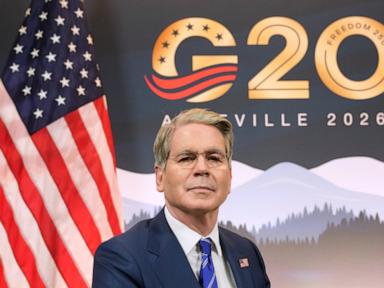
The coffee in the glass-fronted conference rooms of international summits always tastes of bureaucratic compromise. It is lukewarm, served in heavy porcelain cups that have absorbed a thousand secret conversations, and it smells faintly of old paper and suppressed panic.
Around one such table sits Scott Bessent. The man charged with steering the financial machinery of the United States does not look like a warrior preparing for battle, yet he carries the weight of an invisible war. Before him lie briefing books thick enough to stop a bullet, filled with projections of currency flows, inflation metrics, and the jagged, unpredictable lines of oil futures. Outside these soundproofed walls, the world keeps spinning on a knife-edge. Inside, the air is thin, recycled, and heavy with the smell of shifting loyalties. Meanwhile, you can explore other stories here: Nepal Flood Disasters The Structural Failures Driving Mass Casualties And Missing Populations.
Bessent is heading to the Group of Twenty meetings with a singular, fragile mission: to convince old friends to act like friends again, even as Washington hands them a bill they never asked for.
Consider what happens next when economics and geopolitics collide at high velocity. To explore the full picture, check out the recent report by NPR.
For months, the transatlantic dialogue has frayed. Trade policies forged in domestic political fires have begun to warp the steel beams of traditional partnerships. European capitals look across the Atlantic with a mixture of exhaustion and resentment. They see an administration wielding tariffs not merely as a tool of economic adjustment, but as a blunt instrument of leverage, striking friend and adversary alike. And now, into this tense parlor steps the Treasury Secretary, carrying a portfolio that demands an impossible cognitive dissonance. He must ask these same bruised allies to stand shoulder-to-shoulder with America against a resurgent Tehran, to lock arms on crippling economic sanctions against Iran, while simultaneously digesting the financial indigestion caused by American trade protectionism.
It is a difficult pitch. Try asking a neighbor to help you paint your house while you are actively stacking bricks across their driveway.
To understand why this mission matters, you have to step away from the macroeconomic abstractions and look at the reality on the ground in places like Seoul, Frankfurt, and Tokyo. Let us walk through a hypothetical morning in the life of a mid-sized German manufacturing exporter—call him Hans—who has spent forty years building supply chains that span continents. Hans does not care about geopolitical posturing until it arrives on his loading dock in the form of a tariff invoice that instantly eats his profit margin. His company employs three hundred people in a town where everyone knows everyone else's name. When American trade policies squeeze his margins, Hans does not curse Tehran. He curses Washington.
Now, imagine walking into Hans’s office and telling him that he must also absorb higher energy shipping costs because the global oil market is convulsing under the pressure of escalating tensions with Iran. You tell him that the free world needs unity. You tell him that the shipping lanes of the Strait of Hormuz must be secured, that sanctions must be tightened, and that financial compliance must be absolute.
Hans looks at his ledger. Then he looks at you.
The disconnect is staggering. This is the chasm Bessent must bridge.
The historical parallels are uncomfortable. When nations attempt to wage economic nationalism at home while demanding collective security abroad, they invariably discover that trust is not a renewable resource. It depletes quietly, transaction by transaction, until the ledger is entirely empty. During the Cold War, the architecture of the West was built on a simple, unspoken bargain: America provided the security umbrella and open markets, and in exchange, allies aligned their geopolitical strategies with Washington. That bargain worked because the economic benefits flowed both ways.
Today, those flows are being dammed by protectionist walls.
When Bessent steps up to the microphones or enters the closed-door bilateral sessions at the G20, he is not just negotiating with foreign finance ministers. He is negotiating with the ghost of that broken bargain. He has to persuade European and Asian counterparts that a nuclear-armed or regionally dominant Iran poses an existential threat to global stability that transcends short-term trade grievances. He has to argue that a fractured Western alliance benefits only the autocracies in Beijing and Moscow, who watch these transatlantic squabbles with quiet, predatory amusement.
The logic is sound. The execution is an absolute nightmare.
Look at the numbers. Iran’s economy has been battered by years of maximum pressure campaigns, yet it persists, adapting through clandestine shadow banking networks, oil smuggling via ghost armadas, and strategic alignments with eastern powers. When the United States tightens the screws, Tehran adjusts its tourniquet. But the sanctions only bite effectively if the global financial system acts as a unified wall. If Europe or Asian allies carve out exemptions, or simply grow weary of enforcing compliance because their own exporters are being punished by American tariffs, the wall develops cracks. Through those cracks slip the billions of dollars that fund proxy militias from the Gulf of Oman to the shores of the Mediterranean.
This is the invisible architecture of modern power. It is written not in treaties, but in SWIFT codes, shipping manifests, and compliance checklists managed by tired mid-level analysts in banking compliance departments.
Bessent knows this machinery intimately. His background is in navigating the chaotic, fast-moving currents of global capital markets, where sentiment can turn in a heartbeat and leverage is everything. But markets operate on rational pursuit of profit; geopolitics operates on pride, fear, and historical memory. You cannot short-sell a nation's historical grievance. You cannot hedge against a Prime Minister's domestic political survival.
When the meetings conclude and the communiqués are drafted—full of diplomatic code words like "constructive dialogue" and "shared commitment"—the real test will happen away from the cameras. It will happen when a European bank decides whether to block a suspicious transaction tied to Iranian front companies, knowing full well that American regulators are watching, even as American trade representatives slap another punitive duty on European steel.
The stakes are terrifyingly high. A fractured coalition cannot contain a determined adversary. If the allies cannot find a way to decouple their justified frustration over trade friction from the urgent necessity of geopolitical containment, the international order will continue to splinter. Not with a sudden, dramatic explosion, but with the quiet, grinding friction of gears running without oil.
The coffee gets cold. The briefers pack their bags. The motorcades idle in the courtyard, their engines humming a low, impatient bass note against the asphalt.
Somewhere over the horizon, tankers move silently through dark waters, carrying oil that fuels both economies and conflicts. In the conference room, the men and women holding the levers of global power must decide whether their temporary political victories at home are worth the permanent loss of the world they inherited.
Bessent takes a breath, straightens his tie, and pushes open the heavy doors.