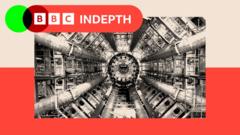
Britain loves to brag about its scientific triumphs. Government ministers routinely remind everyone that UK minds helped discover the Higgs boson, the subatomic particle that explains why everything in the universe has mass. We celebrate the late Peter Higgs as a national treasure. We point to CERN in Geneva and highlight the outsized role British engineers and theorists played in building the Large Hadron Collider. It makes for fantastic political rhetoric.
The daily reality inside British physics labs tells a completely different story.
While politicians chase headlines about turning the UK into a global science superpower, the actual infrastructure supporting British physics is facing quiet, systemic destruction. Decades of structural underfunding, compounded by rampant inflation and short-sighted budget cuts, have pushed university physics departments to a breaking point. We are watching a slow-motion wreck. The country that unlocked the secrets of mass is now pricing its own researchers out of the lab.
The illusion of the science superpower
The gap between political messaging and financial reality is staggering. If you look at the raw numbers, the UK science budget seems stable on paper. But paper stability doesn't pay for liquid helium or electricity bills. High-energy physics requires immense amounts of power and highly specialized equipment. Over the last few years, the cost of running a world-class physics lab in the UK has skyrocketed far beyond the standard measures of inflation.
University departments depend on grants from the Science and Technology Facilities Council, known as the STFC. When inflation peaked, these grants didn't scale up to match the true cost of doing business. The result was an immediate, invisible cut to research capacity. Labs had to make impossible choices. They shortened research projects, delayed upgrading critical equipment, and hired fewer postdoctoral researchers.
You can't run a top-tier research program on good vibes and historic prestige. When funding drops in real terms, the experimental output drops with it. The UK is effectively coasting on the momentum of past achievements. We are still dining out on the Higgs boson breakthrough from 2012, but we aren't investing in the people or the tools required to make the next major discovery.
What happens when the money dries up
The crunch hits hardest at the ground level, affecting the early-career researchers who do the actual heavy lifting in labs. Landing a permanent academic job in physics has always been notoriously difficult. Today, it feels practically impossible.
Most postdocs survive on short-term contracts lasting anywhere from twelve to twenty-four months. They spend half their time doing research and the other half applying for their next temporary gig. This constant state of instability kills long-term scientific risk-taking. If your contract ends in a year, you cannot pursue a radical, complex idea that might take five years to yield results. You play it safe. You publish minor, incremental papers just to keep your resume alive. This is a recipe for scientific mediocrity.
The funding squeeze also means the success rate for STFC grant applications has plummeted. Brilliant, highly rated research proposals are routinely rejected simply because the pot of money is empty. When a lab misses out on a core grant, the consequences are immediate. Research tracks disappear. Specialized technicians, the people who actually know how to build and maintain incredibly complex experimental setups, get laid off. Once that institutional knowledge leaves, you don't get it back.
The international talent trap
British physics has always relied on a steady influx of global talent. Science thrives when the brightest minds move across borders freely, bringing different perspectives to complex problems. But the UK immigration system has transformed into a massive financial barrier that actively deters international scientists.
The cost of UK visas and the associated National Health Service surcharges have become astronomically expensive compared to Europe or the United States. A researcher moving to the UK with a partner and children faces thousands of pounds in upfront fees just to step foot in the country. For a young physicist on a modest academic salary, this is a financial non-starter.
I regularly hear from lab heads who say their top international candidates are turning down job offers because they simply cannot afford the visa costs. These scientists are choosing Germany, Switzerland, or the US instead. We are effectively locking ourselves out of the global talent pool. The UK used to be a primary destination for the world's best physicists. Now, we are increasingly viewed as a costly bureaucratic headache.
The university deficit crisis
To understand why physics is in danger, you have to look at the broader financial crisis engulfing British higher education. Domestically, undergraduate tuition fees have been frozen for years, meaning their real value has been severely eroded by inflation. Universities have historically covered this deficit by recruiting international students who pay much higher fees.
Recent changes in immigration policy have caused international student enrollment to drop sharply across the country. This has left massive holes in university budgets. Because physics is an expensive, space-heavy, equipment-intensive subject to teach and research, it becomes an easy target for university administrators looking to cut costs.
We are already seeing institutions restructure or downsize their physical science departments. When a university needs to plug a multimillion-pound deficit quickly, expensive labs are viewed as liabilities rather than assets. This commercialized approach to higher education completely ignores the long-term value of fundamental research. You don't get commercial spinoffs or new industries without first funding the basic, curiosity-driven science that reveals how the world works.
How to stop the decline
Reversing this downward trend requires more than just minor budget adjustments. It demands a fundamental shift in how the nation values long-term scientific endeavor. The current approach of treating science as a short-term business expense is failing.
First, the government must commit to stabilizing the core budgets of the research councils. Grants must be indexed to the actual inflationary costs of scientific infrastructure, not just standard retail price indexes. If the equipment and power required for physics cost more, the funding must reflect that reality immediately.
Second, the migration policy for researchers needs a complete overhaul. If the goal is truly to lead globally, international scientists should be welcomed, not heavily taxed before they even earn their first paycheck. Waiving or significantly reducing the upfront visa fees for academic researchers would instantly make the UK competitive again in the global market.
Third, we must fix the precarious nature of academic employment. Funding councils should shift their focus toward longer-term grants that guarantee four or five years of security for researchers. This stability gives scientists the breathing room to tackle hard, transformative problems instead of rushing out safe, low-impact publications.
University funding structures also need a firewall to protect high-cost, high-value strategic subjects like physics from temporary tuition-fee shortfalls. The government cannot leave the survival of fundamental physics to the whims of international student markets or university management boards chasing quick financial fixes.
The UK physics community has the talent, the history, and the ambition to lead the next generation of discovery. But talent alone cannot overcome a systemic lack of resources and a hostile bureaucratic environment. We can't keep celebrating the Higgs boson while starving the very laboratories that made it possible. It is time to fund the future of British science, or explicitly admit that we are ready to step down from the global stage.