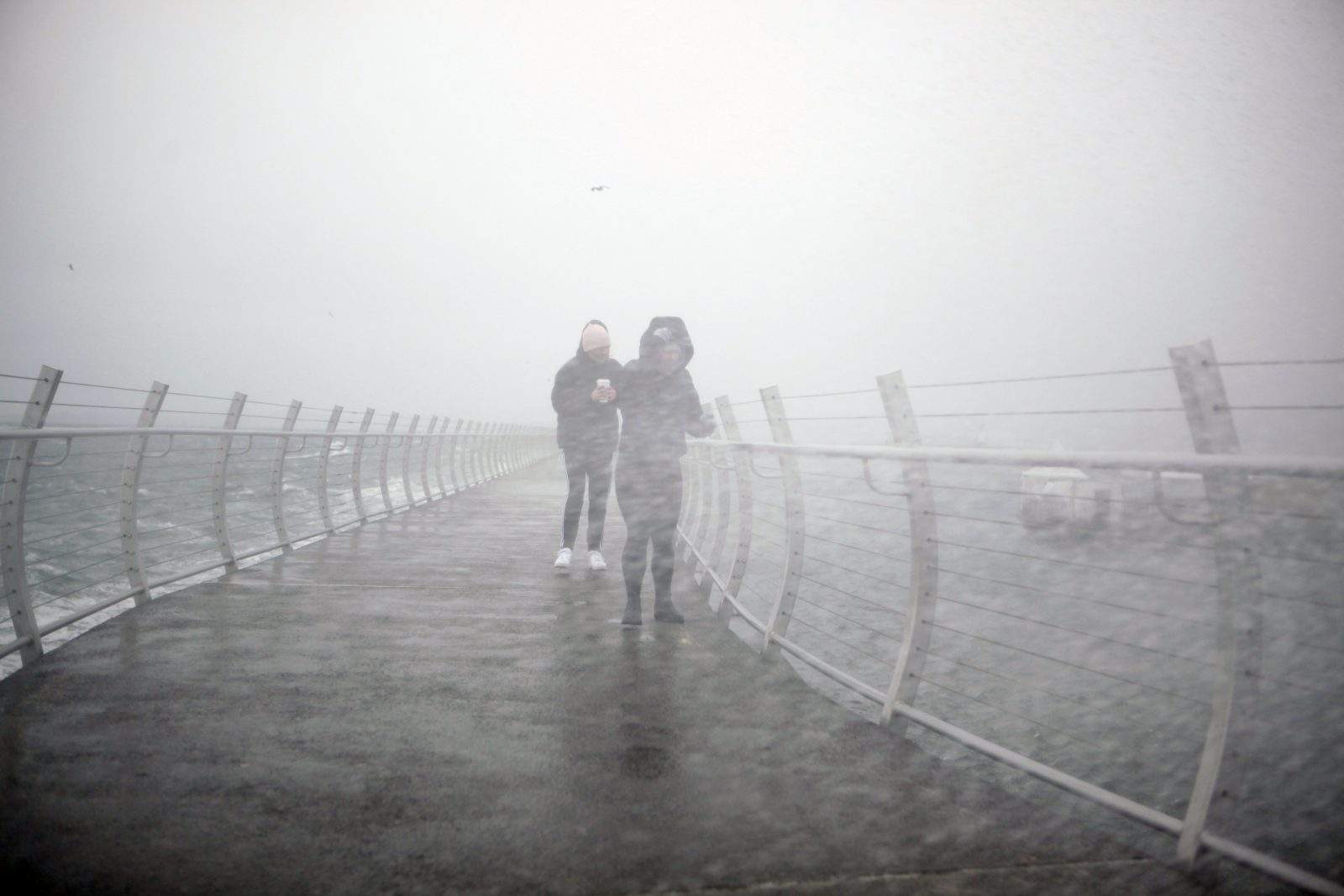
Every October, the same headline rolls off the wires across British Columbia. The first autumn storm makes landfall on the South Coast, knocks out power to tens of thousands of BC Hydro customers, floods a handful of low-lying intersections in Metro Vancouver, and gets dismissed by officials and local press alike as minor. That word does a lot of heavy lifting. Calling these recurring autumn storm outages and localized floods minor masks a structural vulnerability in British Columbia's coastal infrastructure that worsens with every dry summer and every wet fall.
If you live anywhere from Victoria to Chilliwack, you know the drill by now. The wind picks up off the Strait of Georgia around dinner time, the lights flicker twice, and by midnight you are staring at a dark ceiling while a digital outage map lights up like a Christmas tree. By morning, crews have restored most feeders, municipal workers have cleared the storm drains, and the public is told the province weathered the system with minimal disruption.
That framing is comfortable, and it is wrong.
The Anatomy of a "Minor" Coastal Blow
Meteorologically, the first major rain and wind event of autumn along the Pacific Northwest coast is rarely an anomaly. It is the seasonal flip of the atmospheric switch. After months of high-pressure ridges keeping the coast dry from July through September, the jet stream sags south and begins funneling Pacific frontal systems directly into Vancouver Island and the Lower Mainland.
When these systems arrive, they hit a landscape that has been primed to fail in very specific, predictable ways.
Start with the trees. British Columbia's coastal urban centers are defined by their canopy—massive Douglas firs, western red cedars, and bigleaf maples growing in dense proximity to overhead distribution lines. During a prolonged summer drought, these trees experience significant hydraulic stress. Root systems dry out, soil loses its cohesive grip, and limbs become brittle. When the first heavy October rain saturates the topsoil and 70-to-90-kilometer-per-hour gusts hit a canopy still heavy with late-season foliage, the physics are unforgiving. Leaves act like sails. Saturated soil turns to grease. Trees do not merely drop branches; entire root plates heave out of the ground and take primary distribution circuits down with them.
Then look at the asphalt. Metro Vancouver and Greater Victoria have spent decades paving over permeable forest floor and peat bog. During dry months, hydrocarbons, brake dust, and organic debris accumulate on road surfaces, while early-falling leaves gather along curbs. The first sustained downpour flushes all of that material straight into catch basins at the exact moment storm sewers are asked to handle peak runoff.
A single clogged grate at the bottom of a hill in Burnaby or Saanich turns a four-lane arterial into a retention pond within twenty minutes. The water does not need to breach a river dike to cause millions of dollars in vehicle damage, basement seepage, and transit gridlock. It just needs six inches of standing water over a choked drain.
Overhead Wires in a Rain-Forest Climate
To understand why BC Hydro's outage numbers spike so aggressively during routine autumn storms, you have to look at how the provincial grid was built and how it is maintained.
Unlike newer suburban developments that mandate underground ducting, vast stretches of Vancouver, Burnaby, New Westminster, Surrey, and Victoria rely on aging overhead wood-pole distribution networks strung directly through mature urban forests. Burying existing overhead lines is extraordinarily expensive—often costing several million dollars per kilometer in dense urban corridors where water, gas, and fiber-optic utilities already crowd the subsurface. Ratepayers balk at the capital cost, and regulators hesitate to approve the rate hikes required to fund wholesale undergrounding.
So the province relies on vegetation management—pruning corridors around lines and identifying hazard trees before they fall.
Here is the catch. You cannot prune your way out of drought-induced root failure outside the right-of-way. A healthy-looking cedar standing fifteen meters off the road on private property falls completely outside BC Hydro's standard trimming zone. When that tree topples in an autumn windstorm, it crosses the entire roadway and snaps the primary conductors anyway.
Field crews perform heroics during these events, working in horizontal rain around live high-voltage lines to splice conductors and replace snapped crossarms. Yet the metric used to judge success—how fast the lights come back on—obscures the real question. Why does a moderate seasonal storm still knock out power to the equivalent of a mid-sized city every single year?
The Compounding Toll of Drought and Deluge
In the past, British Columbia's coastal climate operated on a gentler rhythm. Wet springs tapered into warm, mildly dry summers, followed by a gradual return of autumn rain that slowly rehydrated the soil column before the heavy winter gales arrived in November and December.
That buffer has eroded.
Multi-year summer moisture deficits have become a recurring feature of the Pacific Northwest climate. Arborists and municipal foresters across the South Coast have documented widespread crown dieback in native western red cedars and bigleaf maples—two species poorly adapted to prolonged summer heat and soil dryness. Dead tops and weakened limbs remain standing in the canopy until the first autumn wind event acts as a mechanical stress test, snapping them off onto residential feeders and transit overhead trolley wires.
At the same time, baked, hydrophobic soils repel the initial surge of autumn rainfall rather than absorbing it. Instead of soaking into parks, greenbelts, and residential lawns, the first two inches of rain sheet off the surface almost immediately, overloading municipal stormwater systems designed around twentieth-century rainfall intensity curves.
Consider a hypothetical example of a typical suburban cul-de-sac in Coquitlam or North Vancouver. In 1985, the storm sewer pipe beneath that street was sized for a once-in-ten-year rainfall event based on historical precipitation records, surrounded by yards with deep, porous topsoil and modest house footprints. Forty years later, half the lots on that street have been redeveloped into larger homes with expanded concrete driveways and patio pavers, shrinking the permeable surface area by thirty percent. Meanwhile, the autumn storms arriving off the Pacific carry higher concentrations of subtropical moisture, dumping two hours' worth of rain in forty-five minutes. The pipe under the street has not grown an inch. When the first October storm hits, water backs up through the catch basins onto the road, not because the storm was historic, but because the margin for error disappeared years ago.
The Illusion of "Minor" Disruption
When emergency managers and news broadcasts label an event minor, they are usually measuring against catastrophic benchmarks—the November 2021 atmospheric river that severed every highway connecting the Lower Mainland to the rest of Canada, or the devastating 2006 windstorm that tore through Stanley Park and left hundreds of thousands without power for days.
Measured against total infrastructural collapse, thirty thousand customers in the dark for six hours and a few flooded underpasses look trivial.
In practice, the cumulative cost of these routine failures is anything but small.
- Small Business Spoilage and Downtime: A six-to-twelve-hour outage in a commercial corridor forces restaurants, grocers, and specialty food retailers to discard perishable inventory or rent emergency generators at surge rates. Most commercial insurance policies carry deductibles high enough that owners eat the loss directly.
- Medical Vulnerability at Home: Thousands of seniors and chronically ill residents rely on electrically powered oxygen concentrators, home dialysis machines, and refrigerated medications. Every "minor" outage triggers a wave of non-emergency calls to paramedics and municipal fire halls from residents whose backup batteries are running down.
- Traffic Signal Blackouts: When intersection signals go dark during the evening rush hour in Surrey or Richmond, collision rates spike immediately. Police resources get pulled away from active incidents to manually direct traffic at major arterial crossings.
- Transit Bottlenecks: Water pooling on low-lying rail corridors or downed branches across trolley bus wires stalls commuters across the regional network, rippling into lost productivity long after the rain stops.
Calling these impacts minor normalizes a steady decline in baseline infrastructure reliability. It conditions the public to accept that basic utilities—electricity and passable roads—are fair-weather services.
Where Municipal and Utility Budgets Fall Short
Fixing chronic autumn vulnerability does not require futuristic engineering. It requires boring, unglamorous capital spending that rarely wins elections.
On the drainage side, municipalities across the South Coast face a massive infrastructure deficit in aging stormwater pipes, culverts, and pump stations. Many coastal communities still operate combined or undersized drainage networks built in the mid-twentieth century. Upgrading trunk mains and separating storm from sanitary lines requires tearing up major roads for months at a time—a guaranteed trigger for constituent complaints and merchant backlash. As a result, cities often opt for reactive maintenance: sending vacuum trucks out once the water is already pooling, rather than upsizing the pipes underneath.
Some jurisdictions have begun installing green infrastructure—bioswales, permeable pavements, and rain gardens designed to capture and filter runoff where it falls before it ever reaches a storm drain. Where implemented at scale, these features measurably flatten peak runoff surges during early autumn rains. Yet across most of the region, they remain pilot projects tucked onto a few showcase blocks while standard concrete curbs and asphalt remain the default.
On the electrical side, BC Hydro has invested heavily in automated switching technology—smart grid devices that detect faults, isolate damaged sections of a feeder, and reroute power to unaffected customers within seconds. That technology is genuinely effective at shrinking the footprint of an outage once a tree hits a wire. What it cannot do is stop the tree from hitting the wire in the first place.
True hardening of the distribution grid requires a combination of targeted undergrounding along critical arterial corridors, wider vegetation clearance zones, and aggressive removal of drought-stressed hazard trees on both public and private land. Every one of those steps runs straight into political and financial friction. Homeowners fight the removal of mature shade trees on their property lines. City councils resist utility requests to widen trimming corridors because residents hate the look of heavily pruned street trees. And nobody wants to see the double-digit rate increases needed to bury vulnerable lines.
The Warning Hidden in the First Storm
Seasoned emergency planners in British Columbia do not look at the first autumn storm for the damage it causes today. They look at it as a diagnostic test for what will happen in November and December.
The first blow strips away the weakest branches, exposes the most clogged catch basins, and reveals which pump stations have mechanical issues after sitting idle all summer. When that initial storm knocks out tens of thousands of customers and floods major roadways despite moderate wind speeds and unremarkable rainfall totals, the grid and the drainage network are flashing a clear warning light.
If a routine October frontal system can buckle local distribution circuits and overwhelm urban intersections before the soil is even fully saturated, the margin left for a true winter windstorm or a stalled atmospheric river is razor-thin. Dismissing the early damage as minor simply ensures nobody asks why the system keeps breaking in the exact same places every single fall.