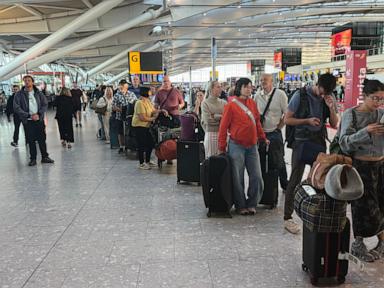
When 1,750 flights evaporate from British airspace within a single operational cycle, the public narrative invariably settles on a singular, convenient villain. A software glitch. A corrupted database. A routine vendor patch gone sideways. Passengers sleeping on terminal floors across Heathrow, Gatwick, and Manchester are handed identical vouchers and boilerplate explanations about technical difficulties beyond carrier control.
They are being fed a polite fiction.
Modern commercial aviation does not collapse because a single line of code fails. It collapses because critical infrastructure has been systematically hollowed out by decades of outsourced engineering, lean staffing models, and legacy software patches stacked precariously on top of systems designed during the Cold War. The recent wave of cancellations sweeping British carriers is merely the visible symptom of a deeper, structural rot within European air traffic management and airline operational control centers.
The Architecture of Fragility
To understand why British air travel breaks under pressure, one must look past the sleek mobile apps and automated check-in kiosks into the windowless operations rooms where dispatchers manage the sky. Most major airlines operating out of the United Kingdom rely on core operational software that predates commercial internet infrastructure. These scheduling engines, weight-and-balance calculators, and crew-rostering platforms were written in older programming languages by developers who retired twenty years ago.
Airlines treat IT as a cost center to be minimized rather than the central nervous system of their enterprise.
When an update is forced onto these brittle systems, the margin for error is razor-thin. Unlike consumer tech companies that can push buggy code and fix it with a quick reboot on a Tuesday morning, an aviation software crash halts physical multi-ton assets distributed across thousands of miles. If the flight planning system goes offline for ninety minutes, aircraft cannot legally depart. Crew legalities—dictated by stringent UK Civil Aviation Authority regulations regarding maximum duty hours and rest periods—cannot be verified.
The cascading delays do not add up linearly; they compound exponentially. A thirty-minute ground stop in the morning creates a displacement domino effect that leaves flight crews stranded out of position by evening, triggering mandatory rest limits that legally bar them from flying home. The software may have caused the initial glitch, but corporate efficiency models ensured the system had zero shock absorption.
The Outsourcing Illusion
For the past fifteen years, legacy carriers have aggressively outsourced their software development and maintenance to third-party tech vendors. This shift promised lower overhead and access to global talent pools. In practice, it severed the direct line between the operational realities of the flight deck and the engineers writing the code.
When a software engineer in Bangalore or Dublin is tasked with updating a module for British airspace management, they are working from abstract requirements documents, not living experience of a fog-bound morning at Manchester Airport or an air traffic flow restriction over the channel. The feedback loop between an operational crisis and a software patch is agonizingly slow. By the time a vendor understands the nuance of UK air traffic control protocols, the contract has often been re-tendered to the lowest bidder under a new procurement cycle.
This fragmentation creates invisible chokepoints. When a system update triggers a widespread outage, airlines discover that their internal IT teams no longer possess the deep systems knowledge required to diagnose the root cause independently. They must wait for Tier-2 or Tier-3 support desks from external vendors to wake up, diagnose, and push a fix. Every minute of vendor latency translates directly into hundreds of grounded passengers and millions of pounds in compensation claims under UK 261 regulations.
The Human Cost in the Control Room
While automated dispatch screens flash red, the human element inside airline operations centers tells an equally grim story. Staffing levels in flight operations, maintenance control, and customer coordination have been squeezed to bare minimums.
During the pandemic, airlines shed experienced operational staff through early retirement schemes and redundancies. The institutional memory of how to handle a catastrophic system failure manually walked out the door. When the recent technical breakdown occurred, remaining staff were immediately overwhelmed.
Manual dispatching—calculating flight plans by hand, communicating via backup radio frequencies, and manually re-booking thousands of passengers—requires a level of veteran expertise that simply cannot be scaled up overnight. Modern operational staff are trained to be exception handlers for automated systems, not autonomous decision-makers. When the automation fails entirely, the operational machinery freezes because the humans running it have been conditioned to trust the green lights on a dashboard that has suddenly gone dark.
The Regulatory Blind Spot
The UK Civil Aviation Authority wields immense power over safety in the physical sky, but its oversight of digital infrastructure remains troublingly reactive. Current aviation regulations audit physical maintenance logs down to the individual rivet on an Airbus wing, yet software architecture audits are treated as compliance checkboxes rather than rigorous stress tests.
Airlines are required to have business continuity plans, but these plans often assume localized failures—a power outage at a single hub or a localized radar fault. They do not game out systemic, multi-airline software lockouts caused by shared vendor dependencies or centralized cloud infrastructure bottlenecks.
When a cloud provider suffers an outage or a core third-party scheduling API chokes on corrupted data, the entire British aviation ecosystem wobbles because carriers rely on a shockingly small oligopoly of software vendors. There is no national digital redundancy built into the UK skies. If the primary scheduling engine stumbles, there is no hot-swap secondary network waiting to take the load.
Beyond the Spin
Corporate communications departments will continue to frame these disruptions as unprecedented black swan events. They will point to unforeseen technical anomalies and reassure passengers that investments are being made in digital transformation.
Do not believe them.
These cancellations are the predictable economic byproduct of running a high-frequency, low-margin transport network on outdated, outsourced software systems operated by skeletal, overstretched teams. Until aviation executives treat software resilience with the same gravity they accord to jet turbine maintenance, British airspace will remain one software patch away from total gridlock. The planes are modern, but the digital foundations holding them up are fracturing beneath the weight of their own complexity.