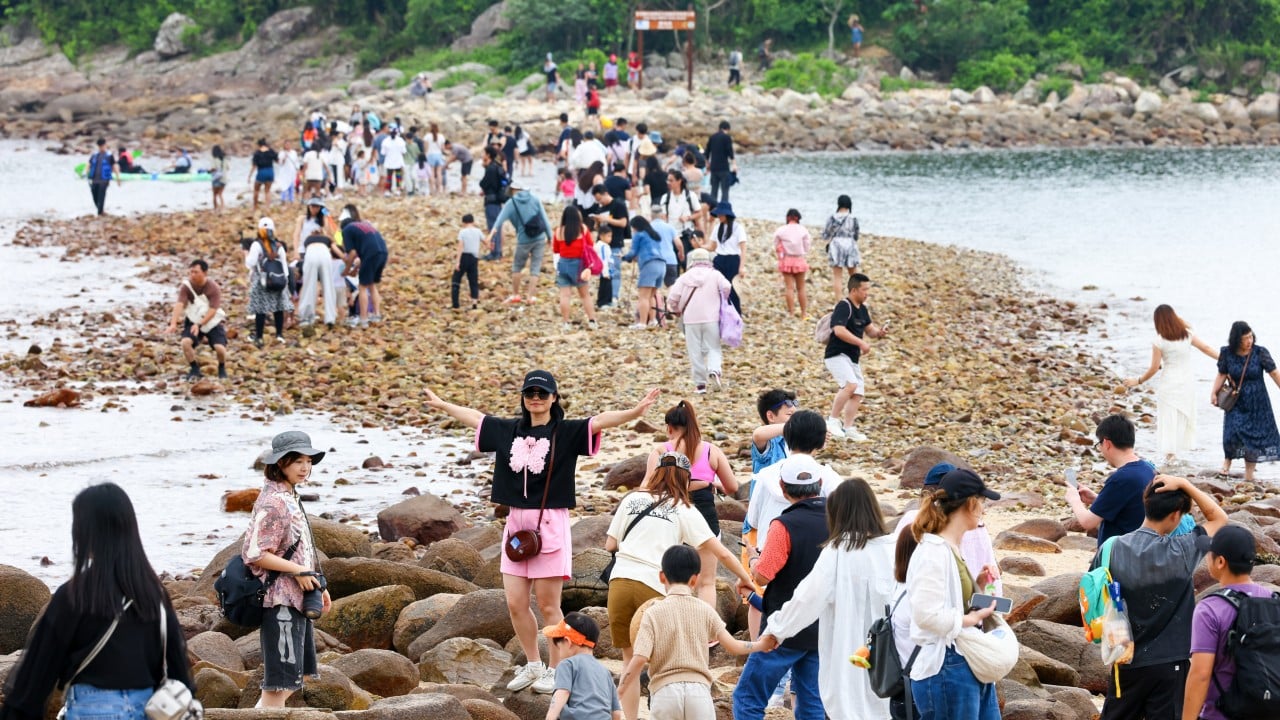
The salt air in the South China Sea doesn't just smell like brine; it smells like survival. For decades, the tourists descending upon China’s southern coasts during the Labour Day "Golden Week" saw the ocean as a backdrop for selfies—a flat, turquoise stage for jet skis and colorful cocktails. They looked at the water. They didn't look into it.
This year, the tide shifted.
Underneath the churning wake of excursion boats, a silent, calcified forest is fighting for its life. Corals are not rocks. They are not plants. They are complex, communal animals that build the very architecture of our oceans. When they die, the sea goes quiet. And when the sea goes quiet, the coastal economies that depend on it—the hotels, the seafood markets, the dive shops—begin to crumble like sun-bleached bone.
Consider a traveler named Chen. He is a middle-manager from a landlocked province, someone who saved for six months to bring his young daughter to the coast. In years past, Chen might have grabbed a piece of dried coral from a gift shop or stood on a reef to adjust his goggles, unaware that a single footstep can shatter decades of growth. But this May, Chen found himself standing before a government-sponsored exhibit on a pier, staring at a microscopic feed of polyps feeding at night.
He saw something that looked less like a vacation destination and more like a nursery. Suddenly, the "scenery" became a living entity.
The Invisible Infrastructure
We often treat the environment as a luxury good—something to protect only when our bellies are full. This is a fundamental misunderstanding of the stakes. Coral reefs occupy less than one percent of the ocean floor, yet they support twenty-five percent of all marine life. They are the shock absorbers of the planet. When a typhoon barrels toward the shoreline, a healthy reef can absorb up to ninety-seven percent of the wave’s energy.
Without them, the luxury resorts lining the beach are just expensive sandcastles waiting for the next big storm.
During this latest holiday surge, the push from the Ministry of Natural Resources wasn't just about "awareness" in the abstract sense. It was a massive psychological pivot. By deploying interactive displays, VR goggles that simulated reef bleaching, and literal "coral doctors" at popular dive spots, the initiative aimed to turn every tourist into a temporary steward.
The strategy worked because it tapped into a basic human instinct: the desire to protect what we understand.
A Fragile Renaissance
The math of coral growth is heartbreakingly slow. Most species grow at a rate of roughly ten millimeters a year. Imagine trying to rebuild a skyscraper where the bricks only appear once a year, and every time a snorkeler touches the wall, a floor collapses.
For the "Coral Reef Restoration Project" teams working in areas like Hainan and the Xisha Islands, the Labour Day crowds used to be a source of anxiety. Thousands of fins kicking up silt can suffocate a reef, blocking the sunlight the symbiotic algae need to photosynthesize. Silt is a silent killer. It settles on the polyps, forcing them to expend their limited energy cleaning themselves rather than growing or reproducing.
This season, the narrative changed from "Don't Touch" to "Observe and Report."
Tourists were encouraged to participate in citizen science, using their waterproof cameras to document reef health and uploading the images to a central database. This converted the act of "taking a photo" from a selfish souvenir-gathering exercise into a contribution to a national scientific effort.
The stakes are high. Global warming has led to more frequent "bleaching" events—where the water gets too warm, the coral gets stressed, and it ejects its colorful algae, turning white and starving to death. To see a bleached reef is to see a ghost town. It is haunting, skeletal, and profoundly lonely.
The Economics of Awe
There is a cold, hard business logic behind this emotional appeal. Ecotourism is no longer a niche market for backpackers; it is the future of the high-end travel industry. Modern travelers are increasingly looking for "meaningful" experiences. They want to tell a story about how they helped plant a coral nursery, not just how much they spent on a buffet.
By shifting the focus toward reef health, the government is essentially protecting its long-term assets. A dead reef leads to a dead beach, which leads to a dead city.
But the real transformation happens at the individual level.
Think back to Chen and his daughter. As they sat in a glass-bottomed boat, the guide didn't just point out "pretty fish." The guide pointed out the Acropora—the staghorn corals—and explained how they provide a home for the very fish the family would eat for dinner that night. He explained that the white sand on the beach was often the result of parrotfish grazing on the reef and "processing" the calcium carbonate.
The daughter pressed her face against the glass. She didn't see a backdrop. She saw a city. She saw a miracle.
The Weight of a Single Step
The success of these promotion pushes isn't measured in brochures handed out, but in the silence of a diver who chooses to hover three feet higher. It’s measured in the shopkeeper who refuses to sell shells harvested from live reefs.
We are currently in a race against the thermometer. Scientists are experimenting with "super corals" that can withstand higher temperatures, and 3D-printed reef bases that give larvae a place to latch onto. But all the technology in the world cannot save an ecosystem if the three hundred million people visiting the coast every year don't care.
Awareness is a weak word. What we are seeing is the birth of a collective conscience.
As the Labour Day crowds pack their bags and head back to the steel and glass of the interior provinces, they carry more than just sand in their shoes. They carry the knowledge that the ocean is breathing. They know that every time they dive into that blue expanse, they are entering a delicate, ancient world that doesn't belong to them, but depends on them.
The ocean has a long memory. It remembers the decades of neglect, the anchors dropped on delicate branches, and the chemical runoff from the shore. But it also responds to the quiet. It responds to the protection.
If you listen closely when the tide comes in, past the noise of the tourists and the hum of the boats, you can almost hear the reef growing—one millimeter, one polyp, one breath at a time.