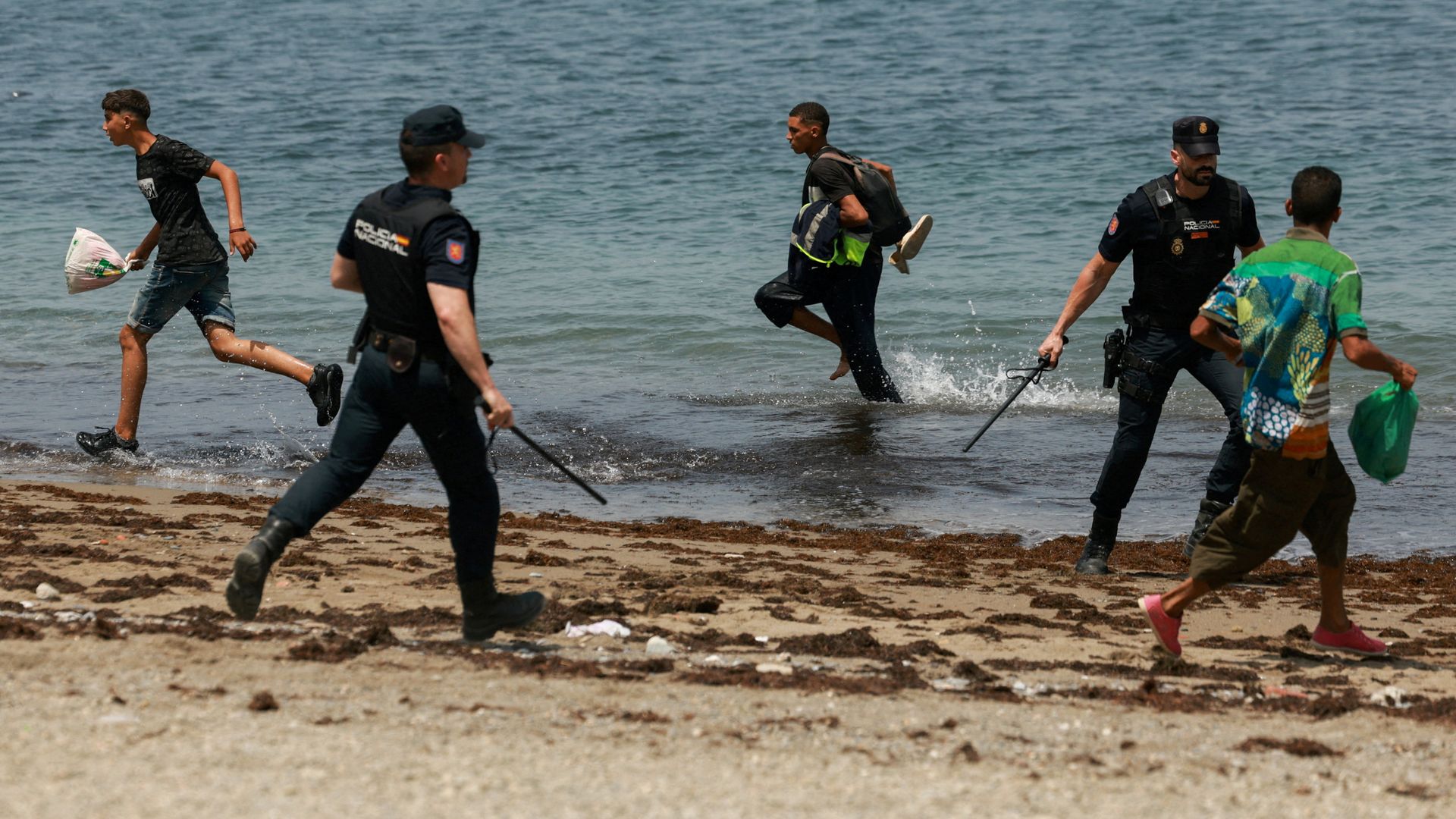
Every time a handful of desperate human beings breaches a fence in Ceuta or Mellissa, the political theater follows a predictable script. Cameras roll. Officials in Rome and Madrid furrow their brows. Emergency border extensions are announced with grave, theatrical urgency. The lazy consensus in every newsroom across Europe treats these tit-for-tat passport checks as a functional security measure.
It is not. It is expensive, performative placebo politics.
If you talk to anyone who has actually managed logistics or intelligence at a European frontier, the truth is stark. Temporary internal border controls within the Schengen area do nothing to stop irregular migration. Instead, they choke commerce, penalize legitimate travelers, and distract voters from structural policy failures while providing a convenient punching bag for politicians who lack the backbone to fix immigration at its root.
The Arithmetic of Illusion
Let us look at the mechanics. When Italy or Spain slaps temporary checks on internal borders or tightens up perimeter surveillance in response to a localized surge, what actually happens?
Traffic backs up for miles at commercial transit hubs. Supply chains—already bruised by global volatility—absorb friction costs that get passed straight down to consumers. Fresh produce rots in trucks idling on highways because an officer needs to visually inspect a passport that was already scanned by a digital manifest system hours prior.
Yet, human movement does not stop. Smuggling networks do not rely on standard highway checkpoints or official pedestrian crossings. They rely on corruption, concealment, coastal blind spots, and bureaucratic inertia.
I have watched billions of euros flow into perimeter hardening over the past decade. The result? A cat-and-mouse game where every euro spent on concrete walls yields a marginal return for border agencies while driving smuggling cartels into more dangerous maritime routes. The migrant surge at Ceuta is not a failure of border length; it is a failure of bureaucratic agility.
Dismantling the Myth of Deterrence
The core premise of the mainstream narrative is that stricter border controls act as a deterrent. This assumes that a person risking everything to escape systemic poverty, violence, or climate collapse in the Sahel is calculating risk the same way a commuter decides whether to speed on the highway.
They are not.
When you increase friction at official ports of entry, you do not decrease migration volume. You simply redirect it into unregulated channels. The trade-off is grim: fewer people processed legally through structured reception systems, and more people funneled into the hands of criminal syndicates operating across the Mediterranean.
Politicians love these measures because they are visible. A checkpoint with flashing blue lights looks like action. It projects authority on the evening news. But governance based on optics rather than mechanics is a tax on everyone stupid enough to obey the law.
The Real Cost of Security Theater
If you want to understand why European migration policy remains trapped in a loop of permanent crisis, look at the incentives. As long as every localized surge is treated as an existential emergency requiring emergency border suspensions, regional cooperation degrades into mutual finger-pointing.
Italy blames Spain for lax southern maritime patrols. Spain blames northern European neighbors for failing to share the relocation burden. Meanwhile, the administrative machinery designed to handle asylum claims legally is choked by performative bureaucratic delays.
The honest solution is counter-intuitive to the political class: tear down internal friction, streamline labor-market pathways for legitimate economic migration, and invest heavily in swift, efficient processing systems at the true points of entry rather than stalling traffic between Paris, Rome, and Madrid.
Treating human mobility as a police logistics problem rather than an economic and humanitarian reality guarantees failure. Stop buying the theater. The border is already porous where it matters, and closed where it hurts the wrong people.