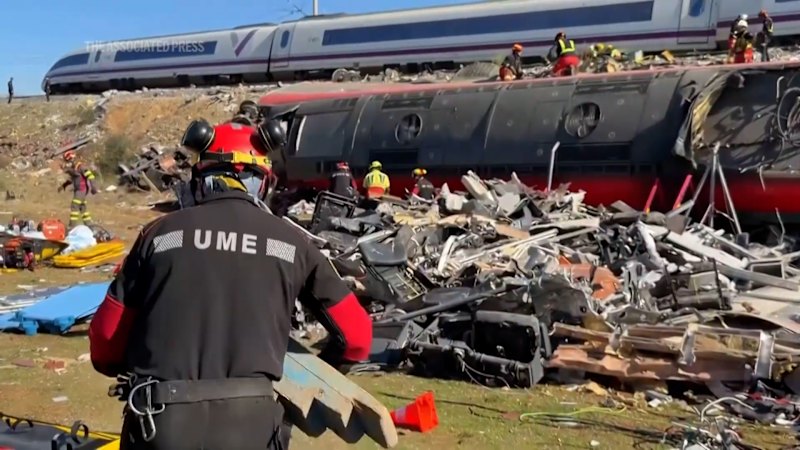
The travel press loves a tidy villain. Give them a stranded backpacker, a missed connecting flight, and a tragic headline about a train derailment in Spain, and they will hand you a neat, dramatic narrative: everything was running like clockwork until one catastrophic accident broke the machine.
That story sells clicks. It is also completely backwards.
When a tourist tells a reporter that "everything started falling apart" after a deadly rail crash, they are describing the exact moment they finally noticed a systemic fracture that industry insiders have been warning about for years. The crash did not break Spain’s rail network. It merely stripped away the illusion of perfection that kept millions of casual travelers from seeing how brittle the system had become.
If you book high-speed rail across Europe assuming the glossy brochures reflect operational reality, you are setting yourself up to get burned. Here is what actually happens behind the curtain when a flagship transit network collides with rapid deregulation, aging infrastructure, and a tourism boom that outpaced track capacity a decade ago.
The Myth of the Invincible High-Speed Network
For twenty years, Spain’s Alta Velocidad Española (AVE) served as the poster child for modern European transit. Politicians cut ribbons. Tourism boards boasted about moving millions of visitors from Madrid to Seville or Barcelona in under three hours. The public bought into a simple, comforting lie: high-speed rail is immune to the messy delays of commercial aviation.
In reality, high-speed rail operates on razor-thin margins of tolerance. Unlike a highway, where a stalled semi-truck blocks one lane while traffic crawls past on the shoulder, a dedicated high-speed corridor is a single-track bottleneck in each direction. When steel meets steel at 300 kilometers per hour, there is no shoulder. There is no detour around the block.
I have spent fifteen years auditing European transit logistics and advising corporate travel desks, and I have watched operators blow millions trying to market speed while quietly starving maintenance budgets. When a major incident occurs on a Spanish corridor—whether it is a fatal collision at a grade crossing, a suburban commuter derailment outside Barcelona, or a signaling failure near Córdoba—the disruption is not an anomaly. It is the inevitable mathematical result of running more trains on fixed iron without proportional upgrades to rolling stock redundancy and dispatch protocols.
The tourist quoted in the mainstream coverage claimed the system collapsed overnight. Look at the operational data from Adif, Spain’s state-owned railway infrastructure manager, and Renfe, the national operator, over the last five years. Punctuality rates on flagship routes have been steadily eroding long before any single headline-grabbing wreck. Track works, rolling stock shortages caused by delayed deliveries from manufacturers like Talgo, and bottlenecks at Madrid’s Atocha and Chamartín stations had already pushed the network to the brink. The accident was simply the spark that lit a room full of dry timber.
Deregulation Without Infrastructure Is a Trap
To understand why a single localized emergency cascades into nationwide chaos within ninety minutes, you have to look at what happened when Spain opened its passenger rail market to foreign competition.
On paper, liberalization was supposed to be a triumph for the consumer. French state operator SNCF launched Ouigo; the Italian-backed consortium Iryo entered the fray. Ticket prices plummeted. Seat capacity exploded. Travelers cheered as €90 tickets dropped to €19 overnight.
Nobody asked where those extra trains were going to go when something went wrong.
Think of a major rail artery like a plumbing pipe pressurized to its absolute structural limit. Under a monopoly, the single operator holds spare trainsets in reserve and leaves buffer windows in the timetable to absorb minor shocks. When you cram three competing operators onto the exact same trackage—all running tight turnaround schedules to justify bargain-basement fares—those buffer windows vanish.
When a tragedy strikes or a line closes for emergency investigation, three separate companies suddenly need to evacuate thousands of passengers simultaneously onto a finite number of replacement buses, parallel regional tracks, and spare trainsets that no longer exist. Staff on the ground—many of them stretched thin across competing terminals—are left holding the bag with zero unified command structure.
The mainstream media frames the resulting pandemonium as "sudden incompetence." In truth, it is the predictable price of cheap tickets. You cannot demand budget-airline pricing on fixed rail infrastructure and expect first-class recovery logistics when disaster hits.
Why "Everything Falling Apart" Is Actually a Safety Feature
There is an uncomfortable truth that stranded passengers hate hearing while sitting on a station floor in July heat: when the trains stop moving for twelve hours after a fatal crash, the system is actually working as designed.
Modern European rail networks operate under strict safety regimes governed by the European Union Agency for Railway (ERA) and national investigative bodies like Spain’s CIAF (Comisión de Investigación de Accidentes Ferroviarios). Unlike road accidents, where tow trucks clear twisted metal in ninety minutes so commuters can make their dinner reservations, a fatal rail incident freezes the entire physical footprint of the event.
Investigators must map debris fields, download event recorders (the rail equivalent of black boxes), inspect catenary overhead wires for structural fatigue, and verify that automated braking systems like ERTMS (European Rail Traffic Management System) did not suffer a systemic software fault. If there is even a one-percent chance that a signaling glitch caused a crash, shutting down an entire regional corridor is the only responsible choice.
To a tourist watching their itinerary evaporate, this looks like bureaucratic paralysis. They see uniformed staff standing around without answers. They see departure boards flashing "Delayed" indefinitely. They conclude that the country has lost control.
They are wrong. Moving trains before clearing a systemic safety question is how one tragedy turns into two. The failure is not the shutdown itself; the failure is the total breakdown in crisis communication between the infrastructure manager, the competing train operators, and the people holding tickets.
Dismantling the Wrong Questions Travelers Ask
Whenever a major transit disruption hits the news cycle, search engines flood with the same predictable, flawed questions from anxious travelers. Let us dismantle the most common ones right now.
Is train travel in Spain still safe after recent crashes?
This question misses the statistical reality entirely. Even factoring in high-profile tragedies—such as the devastating 2013 Santiago de Compostela derailment that killed 79 people, or fatal regional level-crossing collisions in recent years—European passenger rail remains orders of magnitude safer per passenger-kilometer than driving on Spanish highways. Asking if the train is "safe" after a crash is like asking if commercial aviation is safe after a rare runway incursion. You are focusing on the visible, dramatic risk while ignoring the vastly higher daily risk of getting into a rental car or taxi on the AP-7 motorway.
Should I cancel my Spain train tickets and fly instead?
If you think domestic short-haul flights in Spain are immune to cascading meltdowns, you have never sat on the tarmac at Madrid-Barajas or Barcelona-El Prat during an air traffic control strike or a summer thunderstorm. Aviation suffers from the exact same hub-and-spoke fragility, except airports are located forty minutes outside city centers and require two hours of security theater before you even board. Switching from rail to air does not eliminate disruption risk; it just changes the scenery where you get stranded.
Why didn't the train company immediately book me on another route?
Because rail networks do not have spare capacity sitting idle in a warehouse waiting for an emergency. During peak travel months, load factors on Spanish high-speed lines routinely exceed 90 percent. When a corridor closes, there are no empty seats on the next train—the next train is already sold out. Expecting instant rebooking during a catastrophic track closure is a fundamental misunderstanding of how fixed-track transit works.
The Uncomfortable Downside of My Own Advice
Before you assume I am giving the rail operators a free pass, let me be blunt about the flaw in my own defense of strict safety shutdowns.
While freezing track operations after a fatal incident is non-negotiable for physical safety, Spanish operators have repeatedly used "safety protocols" and "infrastructure incidents" as a convenient shield to hide inexcusable customer-service failures.
There is zero excuse for leaving passengers locked inside unventilated carriages without water for four hours while dispatchers argue over who pays for a diesel rescue locomotive. There is zero excuse for mobile apps continuing to sell tickets for trains that operations control already knows are canceled. And there is zero excuse for station staff having less real-time information than a passenger scrolling X (formerly Twitter) on their phone.
Defending the engineering necessity of a shutdown does not excuse corporate cowardice when it comes to owning the aftermath. The industry deserves every ounce of criticism it gets for treating human beings like self-loading freight the moment a timetable breaks.
How to Travel Spain by Rail Without Getting Wrecked by the Next Meltdown
If you are traveling across Spain—or anywhere on the high-speed European grid—stop relying on luck and start operating like a logistics professional.
- Never book a tight same-day flight connection off a long-distance train. This is the single most common rookie mistake behind every "my vacation was ruined" news story. High-speed rail is not a subway. If you have an international flight departing Madrid at 4:00 PM, do not book a train from Seville scheduled to arrive at 1:30 PM. Travel the night before, sleep near the airport, and eliminate the single point of failure.
- Ditch the aggregator apps and buy direct. Third-party booking platforms add a lethal layer of friction when things go wrong. When a track closes, Renfe, Iryo, and Ouigo push emergency vouchers, refund links, and bus-bridge instructions directly to the email or app used at the point of original sale. If you bought through a middleman, you will be last in line to know your train was canceled.
- Know your EU passenger rights cold. Under Regulation (EU) 2021/782, rail passengers have strict statutory protections—including mandatory meals, refreshments, and hotel accommodation when a delay strands you overnight, regardless of whether the operator claims "extraordinary circumstances" for the cash compensation portion. Station agents will rarely volunteer this information. Pull up the regulation text on your phone, walk to the customer service desk, and demand your duty-of-care vouchers calmly and firmly.
- Keep a physical backup plan for regional choke points. Certain corridors—specifically the routes funneling through Madrid’s tunnels, the Mediterranean corridor around Valencia, and commuter lines feeding Barcelona—are notorious bottleneck zones. Know which parallel bus operators (like ALSA) run the same route before you leave your hotel. When the red "Delayed" banners start flashing on the concourse, the travelers who sprint to the bus terminal in the first ten minutes get the last seats. The ones who stand around arguing with a ticket clerk end up sleeping on luggage.
The next time a viral story claims a single accident caused an entire country's transit system to fall apart, read past the headline. The system did not break that afternoon. It was running on fumes long before the cameras showed up—and only the travelers who planned for friction walked away unscathed.