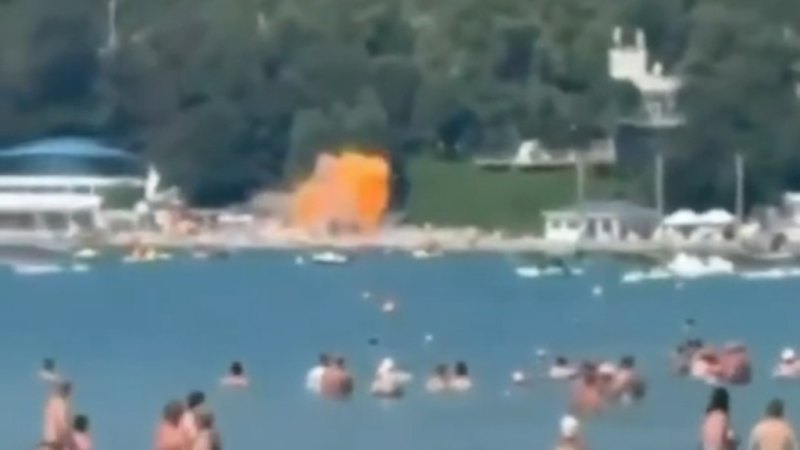
The media treats modern warfare like a video game with terrible graphics. When debris from an intercepted military drone falls on a civilian beach, the headlines shriek about targeting civilians, calculating cruelty, and unprecedented atrocities. Everyone nods along, horrified by the obvious barbarity. Everyone is looking at the wrong thing.
I have spent two decades analyzing the logistics of electronic warfare, air defense grid architectures, and kinetic interception physics. I have watched defense analysts blow millions on theoretical sensor models that completely shatter the moment they meet the chaotic reality of a contested airspace. The lazy consensus says a falling drone hitting a beach is a deliberate terror tactic. The reality is far more mundane, far more mechanical, and infinitely more terrifying: it is the entirely predictable byproduct of physics, intercept geometry, and a fundamental misunderstanding of how modern air defense actually works.
The Physics of a Missed Intercept
Let us strip away the moral outrage for a moment and look at the brutal math of kinetic intercepts. When an air defense battery fires a missile at a low-flying, autonomous loitering munition, it does not vaporize the target into fine mist. Kinetic energy weapons create a destructive kinetic cascade. You shatter the airframe, shred the guidance fins, or detonate a fragmentation warhead meters away from a chassis moving at hundreds of kilometers per hour.
What happens to the multi-hundred-pound chunk of metal, composite plastic, unburnt fuel, and high explosives once the guidance system is severed at three thousand meters altitude? It obeys gravity and momentum.
If you intercept a threat over a coastline, the debris field does not care about resort hotels, sunbathers, or beach umbrellas. It falls where ballistic physics dictates it must fall. Pretending that every errant fragment of a neutralized weapon is a guided strike aimed at sunbathers is either staggering ignorance or deliberate dishonesty. Yet, cable news pundits analyze these incidents as if a pilot sat in a cockpit with a joystick, deliberately tracing a vector toward a towel rack.
Stop asking whether a fallen drone was targeted at civilians. Ask why air defense systems are being forced to engage targets directly over densely populated civilian sectors in the first place.
The Interception Paradox
The dirty secret of modern air defense is that every single interception is a calculated compromise. Defense planners do not protect every square inch of territory. They protect high-value military nodes, command bunkers, logistics hubs, and energy infrastructure.
When a swarm approaches a coastal city, air defense assets must make a choice within milliseconds. Do you take the shot now, letting the debris rain down over populated areas directly beneath the flight path, or do you wait for a clearer corridor, risking that the drone penetrates the shield and hits a transformer station, plunging millions into darkness?
There is no clean option. There is only risk mitigation.
When a battery commander gives the order to fire over a beach, they are making a utilitarian calculation. They are trading the high probability of a catastrophic military strike on critical infrastructure for the statistical gamble of falling shrapnel over a civilian area. To call this an intentional strike on non-combatants is to fundamentally misunderstand the zero-sum nature of air combat. The irony is staggering: the very act of successfully defending a city often creates the localized tragedy that the media uses to claim the city is unprotected or targeted.
The Myth of Surgical Cleanliness
Hollywood has rotted our collective brain regarding precision ordnance. We expect missiles to thread needles, autonomous drones to harbor conscience, and warfare to look like a surgical procedure performed under sterile hospital lights.
It never was. It never will be.
War is an industrial-scale exercise in applied entropy. Once you introduce tens of thousands of kilograms of explosives into an atmosphere, things break, trajectory calculations fail, wind shears alter shrapnel dispersion, and proximity fuses detonate a fraction of a second too late.
When a drone crashes into a public space because its control link was severed by electronic jamming, nobody is steering it there. The jamming system did its job. It broke the connection between the operator and the machine. But a machine flying on dead reckoning or inertial navigation does not simply vanish; it continues on its last known vector until gravity claims it.
Blaming the resulting impact on intentional cruelty ignores the mechanical truth of electronic warfare. Jamming creates blind, deaf projectiles. If you throw a rock into a crowd because someone is trying to stab you, you might hit an innocent bystander. You did not aim at the bystander; you threw the rock to survive. Until the public understands that modern defense mechanisms are blunt instruments wrapped in high-tech marketing, every single piece of falling wreckage will continue to be weaponized for narrative rather than analysis.
The Complicity of Outrage
The narrative around these beach incidents serves a dual purpose for both sides of any conflict, and neither of them involves protecting human life.
For one side, every civilian casualty caused by falling debris is amplified as proof of systemic terrorism, weaponizing grief to demand more advanced weaponry and deeper escalation. For the other, it is dismissed as a false flag or an unfortunate accident caused by the enemy's reckless placement of military assets near population centers. Both narratives are self-serving garbage.
The truth requires admitting an uncomfortable reality: modern warfare cannot coexist with civilian normalcy, yet governments insist on pretending it can. Beach resorts operate kilometers away from strategic naval ports and radar installations. Cities maintain nightlife districts within spitting distance of logistics rail lines. When total war meets a society trying to maintain a facade of weekend relaxation, tragedy is not an anomaly. It is a mathematical certainty.
We do not need more candlelight vigils expressing shock that a warzone behaves like a warzone. We need an honest reckoning with the mechanics of destruction.
Stop demanding a cleaner war that cannot exist. Stop acting surprised when the shrapnel from a missed sky-fight lands on the ground. And stop pretending that every piece of falling iron is guided by malice rather than the cold, indifferent laws of ballistics.