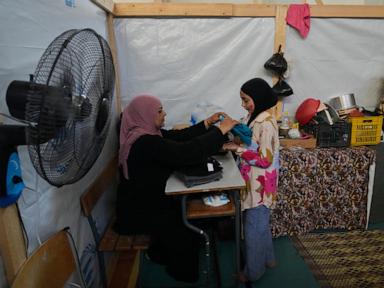
The chalk dust from last May is still settling in the bottom tray of the aluminum trough, gray and undisturbed. Outside, the Mediterranean sun beats down on the concrete yard with a dry, blinding intensity that turns the asphalt to tar. Inside, the air smells of old floor wax, damp wool blankets, and the stale, collective breath of forty souls who have nowhere else to sleep.
For most children, the end of August signals the countdown to fresh notebooks, the crisp snap of new book bindings, and the anxious thrill of finding out who got placed in which homeroom. But in Lebanon, the calendar has fractured. The ministry of education has announced the dates. Desks are supposed to be arranged in neat rows. Teachers are supposed to be sharpening red pencils. Instead, the hallways are choked with rolled-up mattresses, plastic bags containing entire earthly possessions, and the low, constant hum of displaced families waiting for a knock on the door that brings no good news.
Classroom 4B is no longer a place where verbs are conjugated or fractions are simplified. It is a domestic ecosystem.
(Note: To understand the surreal gravity of this crisis, we must look at a hypothetical family living inside these walls, grounded entirely in the documented realities reported by humanitarian agencies across Beirut and the south.)
Imagine Layla. She is twelve. She knows how to calculate the perimeter of a rectangle, but she also knows the exact acoustic signature of a drone hovering three thousand feet above a concrete roof. Her family’s apartment in the southern suburbs vanished into a plume of gray smoke one Tuesday afternoon in July. They fled with their identity papers, three changes of clothes, and a plastic carrier bag of dry pita bread. They ended up here, in a public school three towns away from everything they ever called home.
Her father sits on a blue plastic school chair that is too small for his frame, his knees nearly touching his chest. He stares at the green chalkboard behind him. Someone has wiped away the multiplication tables from the spring term and written a phone number in white chalk—a hotline for food distribution.
The calendar says school starts in days. The reality on the ground says thousands of people are still living beneath these fluorescent lights because their houses are piles of rubble.
This is the collision of two impossible imperatives. On one side stands the state’s desperate need to salvage a generation’s education, to prevent an academic year from evaporating into the ether of a protracted conflict. On the other stands human survival. You cannot evict a family into an active combat zone or an unhoused winter just because the curriculum demands an introduction to organic chemistry.
The numbers tell a story of staggering scale, though numbers have a way of numbing the mind if we let them. Tens of thousands displaced. Scores of public schools converted into ad-hoc shelters because every other municipal building, community center, and hotel reached maximum capacity months ago. These schools were never built to be permanent homes. They lack the plumbing, the kitchen facilities, the privacy, or the psychological infrastructure required to sustain human beings through weeks of trauma, let alone months.
Yet here they are.
Walk down a corridor in one of these transformed schools and the sensory overload is immediate. The acoustic tile ceilings, designed to muffle the chatter of eager children, now bounce the sound of coughing infants, hushed arguments over dwindling rations, and the tinny audio of news broadcasts spilling from cheap smartphones. Privacy is a luxury invented for another life. Sheets are hung from fluorescent light fixtures with twine and duct tape to carve out twelve-by-twelve-foot rectangles of pseudo-solitude. Behind those cotton partitions, women weep quietly so the neighbors won't hear, and children try to sleep with their shoes on, just in case.
How did we arrive at this grotesque intersection of pedagogy and displacement?
The answer lies in the structural fragility of a nation that has endured crisis after crisis, each one layering on top of the last like geological strata of grief. When the war expanded across the southern border, the displacement was not a trickle; it was a tidal wave. Schools were the only large-scale public infrastructure left standing with roofs, walls, and open floors. They became the default sanctuary.
Municipalities flung the gates open. Teachers and directors handed over the keys, knowing that a desk can be replaced, but a life cannot. But now, the grace period of emergency has collided with the unyielding rotation of the earth. September is here.
Consider what happens next when an unstoppable force meets an immovable object.
If the government forces the schools to clear out, where do the families go? The rental market in safer zones has priced out anyone who doesn't earn in fresh foreign currency. Tent camps are springing up in random patches of agricultural land, vulnerable to the coming autumn rains and the biting chill of the mountain winds. To push these families out onto the streets in the name of education is not a solution; it is a cruel shell game that merely shifts the human suffering from one public ledger to another.
Conversely, if the schools remain closed to students, an entire generation of Lebanese children faces the abyss of educational abandonment. This is not just about missing algebra or history dates. It is about the erosion of routine, the psychological anchor that a classroom provides, and the slow, insidious theft of a future. When a child spends a year sitting on a schoolroom floor watching their parents worry about clean water, they are learning a curriculum no ministry ever approved. They are learning the curriculum of displacement.
The education ministry scrambles for alternatives. Shift systems, online learning modules, hybrid models, renting alternative spaces. But these are bureaucratic Band-Aids on a severed artery. Connectivity is spotty. Devices are broken or non-existent. Teachers are themselves displaced, traumatized, and unpaid or underpaid for months.
The tragedy is multi-dimensional, looping through the economic, the psychological, and the political. It reveals the terrifying vulnerability of social fabric when the state has hollowed out to the point where its primary institutions must double as refugee camps just to keep people from sleeping under highway overpasses.
I remember standing in a schoolyard in Beirut years ago during a different crisis, watching a group of boys kick a deflated soccer ball against a brick wall scrawled with graffiti. The ball made a hollow thump, thump, thump sound that echoed off the empty classrooms. An old custodian walked past me, shaking his head slowly. He pointed his broom at the locked classroom doors and said something that has stayed with me through every geopolitical shift and breaking news alert since: We are eating our seed corn.
That is what is happening now. By sacrificing the schools to house the victims of the war, the society is consuming the very instrument it needs to grow its tomorrow.
Yet, step inside one of these improvised shelters at dusk, and you will witness something that defies the grim arithmetic of the situation. In room 3A, a young woman who used to teach third-grade Arabic has gathered seven children sitting cross-legged on a faded Persian rug donated by a local mosque. She has a stub of a yellow pencil and the blank back of an old utility bill.
She isn't teaching them grammar. She is reading them a story about a fisherman who finds a djinn in a bottle. The children lean forward, their chins propped in their small hands, entirely absorbed in the magic of the narrative. For twenty minutes, the concrete walls fade away. The smell of cooking oil and damp blankets vanishes. The drone outside is forgotten.
They are children again, suspended in the amber of a well-told lie, waiting for a world that makes sense to return.
The bell in the courtyard is silent. The wire on the front gate is rusted shut. But somewhere beneath the surface of this unending crisis, beneath the political gridlock and the military calculus, the human spirit is stubbornly, quietly refusing to let the darkness write the final syllabus.