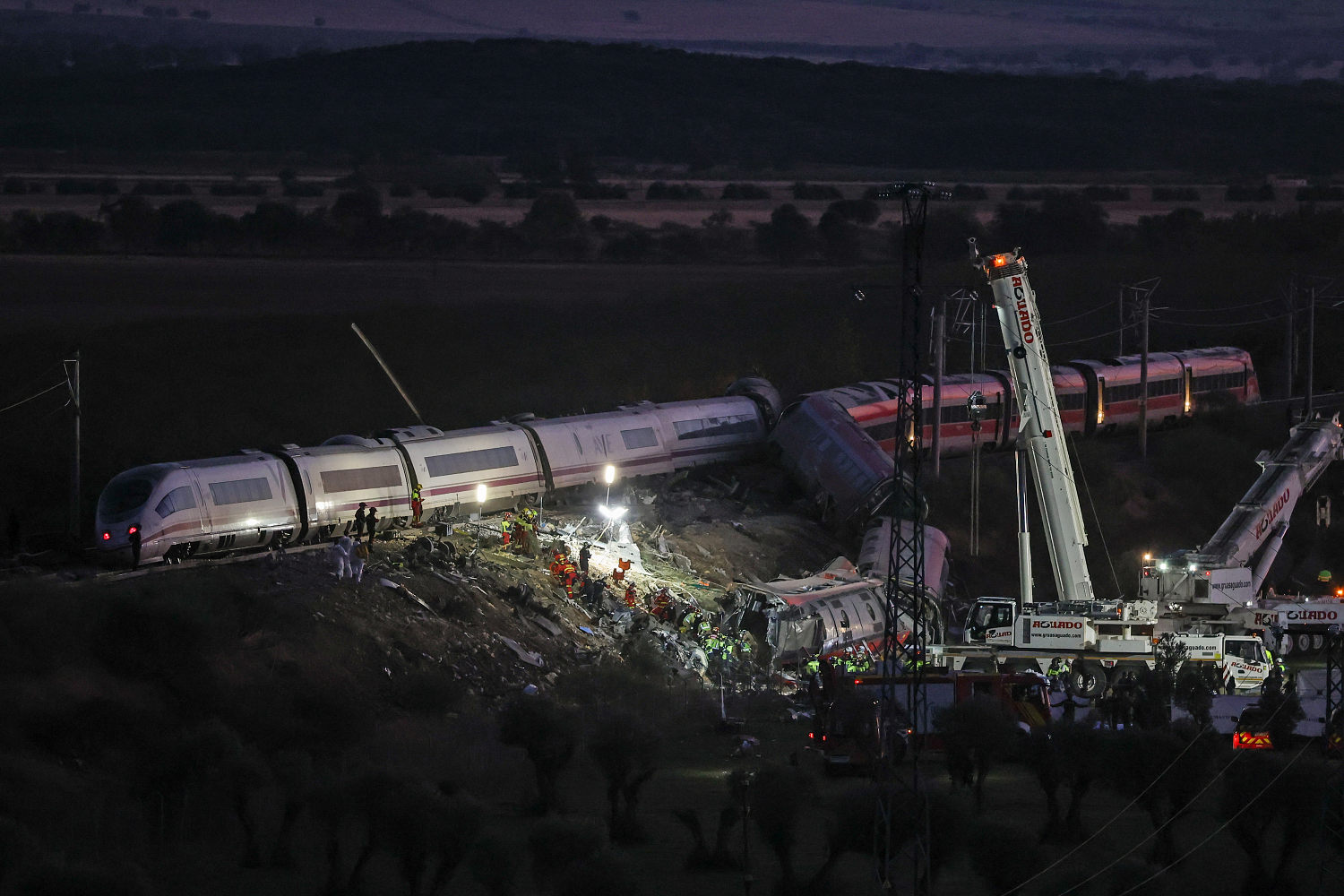
Two minutes. That's all it took for a routine high-speed journey across northwestern Spain to turn into one of Europe's worst rail disasters in decades.
When investigators finally pulled the voice and data recorders from the wreckage of the Alvia train outside Santiago de Compostela, they didn't find a catastrophic mechanical failure or a sabotaged track. They found a phone call.
The audio recordings from inside the cab reveal a sequence of human decisions made just moments before the deadly train crash in Spain that killed 79 people and injured more than 140 others in July 2013. For years, public debate focused on whether one man took the fall for systemic infrastructure flaws. Listening closely to what happened in those final seconds shows it was never an either-or situation. Both human distraction and glaringly absent safety backups collided at nearly twice the legal speed limit.
The Phone Call That Changed Everything
Let's look at the timeline reconstructed by Spain's Railway Accident Investigation Commission (CIAF) and the presiding investigating magistrate. It's chilling because it's so painfully ordinary.
Train 04155, operated by Spain's state rail company Renfe, was traveling from Madrid to Ferrol. It was running about five minutes behind schedule. At 8:39 PM on July 24, 2013, the train was hurtling along a modern high-speed stretch of track at roughly 192 kilometers per hour (about 119 mph).
Then the cab phone rang.
It wasn't an emergency dispatch. It wasn't a warning about a blocked track ahead. It was the train's onboard conductor, Antonio Martín Marugán, calling the driver, Francisco José Garzón Amo, on his work mobile phone. The conductor wanted to discuss which platform the train would arrive at in Pontedeume, a station still dozens of kilometers away, so passengers with heavy luggage could get off faster.
They talked for 100 seconds.
Think about what 100 seconds means when you're moving at 192 kilometers per hour. You cover more than five kilometers of track. You blow past visual markers. You lose your mental map of where the train actually sits on the line.
During that exact window, the train transitioned from the high-speed Ourense-Santiago line onto the conventional approach toward Santiago de Compostela. Ahead lay the A Grandeira curve—a sharp, 80-kilometer-per-hour (50 mph) bend right before the station.
On the audio recording, you can hear the background noise of the cab while the driver chats about station logistics. You don't hear the brakes engaging when they needed to. By the time Garzón hung up, the train was already entering the curve at 195 km/h.
Four seconds before impact, the cab microphone picked up the sound of the emergency brake lever being pulled. Too late. Physics doesn't negotiate. The train was still doing 179 km/h (111 mph) when the second carriage lifted off the rails, slamming into a concrete retaining wall and ripping the 13-car Alvia train apart.
What Investigators Heard in the Final Seconds
When the black boxes—two ruggedized orange boxes designed to survive extreme heat and crushing force—were opened in front of a judge in Santiago de Compostela, the silence in the courtroom was absolute.
The recordings didn't just capture the phone conversation. They captured the immediate, raw aftermath while Garzón was still trapped in the mangled cab, bleeding from a head wound.
In those recordings, Garzón contacted the Atocha control center in Madrid via radio. His voice was panicked, breathless, and immediately aware of the mistake. He told dispatchers he had been going 190 km/h and hadn't been able to brake in time. "I hope there are no dead, because they'll weigh on my conscience," he said into the microphone while sirens began wailing outside the twisted metal.
Honestly, hearing a human being realize the scale of an irreversible mistake in real time is devastating. And from an investigative standpoint, those recordings stripped away any mystery about what happened inside the cab.
Here's what the data recorder and voice log confirmed side by side:
- No technical brake failure. The braking systems functioned normally the second the driver actually applied them.
- No track obstruction. The rails, switches, and signals were intact prior to the derailment.
- Zero automated speed intervention. No electronic system stepped in to slow the train down when the driver missed his braking point.
- Direct spatial disorientation. Because the high-speed track had several similar-looking tunnels before the A Grandeira curve, taking his focus off the visual cues for nearly two minutes caused Garzón to misjudge which tunnel he was exiting.
If you've ever driven a familiar highway late at night while talking on speakerphone and suddenly realized you missed your exit by three miles, you understand the cognitive mechanism here. Now multiply that lapse by 400 tons of steel moving at 120 miles per hour.
Why the Safety System Never Stepped In
If the story stopped at "driver gets distracted by phone call," it would be a simple tale of individual negligence. That's certainly how Renfe and Adif—the state-owned rail infrastructure manager—initially wanted the public to view it.
They were wrong. And the audio recordings actually highlight why.
Modern European high-speed rail lines rely on ERTMS (European Rail Traffic Management System). When ERTMS is active, the track continuously communicates with the train's onboard computer. If a train approaches a sharp curve too fast and the driver fails to brake, ERTMS automatically overrides the human and slams on the emergency brakes. Had ERTMS been active on that curve, the Santiago de Compostela crash could not have happened. Even if the driver had fallen asleep or had a heart attack, the train would have stopped itself.
So why didn't it?
Because the ERTMS system on the Ourense-Santiago line ended roughly four kilometers before the A Grandeira curve. At that exact transition point, control handed off to an older, legacy Spanish signaling system called ASFA (Anuncio de Señales y Frenado Automático).
ASFA was never built to manage high-speed transitions into tight curves. It only checks whether a train obeys basic signal lights and enforces a blanket maximum speed limit of 200 km/h. Since the Alvia train was doing 192 km/h—technically under ASFA's 200 km/h ceiling—the system saw nothing wrong. It didn't issue a warning chime. It didn't trigger an alarm in the cab. It offered zero protection against an 80 km/h curve sitting right around the bend.
Worse still, investigators later uncovered that Adif had originally planned to install ERTMS all the way into Santiago de Compostela. They cut it short to avoid delays in opening the line, shifting the entire burden of slowing down from 200 km/h to 80 km/h onto the driver's memory and eyesight.
How the Audio Recordings Changed the Legal Battle
For over a decade, the Spanish court system wrestled with a fundamental question. Who bears criminal responsibility when a human makes a catastrophic error inside a system that was intentionally stripped of its safety net?
Initially, the judicial investigation pointed almost exclusively at Francisco José Garzón Amo. The black box audio was the smoking gun. Prosecutors argued that professional train drivers are trained extensively on route geography, know every curve by heart, and are strictly prohibited from non-essential phone calls during critical phases of operation.
Victims' associations, however, refused to let the state rail authorities walk away clean. They pushed relentlessly for the court to examine why a high-speed train was allowed to approach a lethal curve with no automated braking backup.
In July 2024—eleven years after the crash—a Spanish court finally delivered its verdict. Both the train driver, Francisco José Garzón Amo, and Adif's former director of traffic safety, Andrés Cortabitarte, were found guilty of 79 counts of reckless homicide and 143 counts of reckless injury. Both were sentenced to two and a half years in prison.
The court's reasoning directly reflected what the black box audio proved. Garzón was convicted because his 100-second phone call directly caused the distraction that led to the late braking. Cortabitarte was convicted because Adif failed to properly assess and mitigate the obvious risk of dropping ERTMS coverage right before a dangerous curve.
Look at how rare that outcome is in transportation law. Usually, either the operator takes 100% of the blame, or corporate executives hide behind layers of bureaucratic compliance. Here, the audio evidence made the driver's error undeniable, while the engineering timeline made the infrastructure manager's negligence equally impossible to ignore.
Lessons Rail Authorities Had to Learn the Hard Way
You don't need to be a railway engineer to see the flaw in relying on human perfection at 120 miles per hour. In aviation, safety protocols are built around the "Swiss Cheese Model"—the assumption that humans will eventually get distracted, misread an instrument, or lose situational awareness. Multiple independent layers of defense exist so that one slip doesn't kill 79 people.
Before July 2013, parts of Spain's rail network operated on the assumption that a seasoned driver wouldn't miss a braking point. After the Santiago de Compostela recordings went public, that mindset collapsed overnight.
Several concrete changes followed across European rail operations:
- Mandatory speed reduction beacons before curves. Adif immediately installed physical ASFA balises (trackside transponders) ahead of sharp speed reductions across Spain's network. If a train passes these beacons above a specific threshold, the brakes lock automatically regardless of what the driver is doing.
- Strict cockpit communication protocols. Rail operators tightened rules around work mobile phones in the cab, restricting calls between conductors and drivers when trains are approaching station transitions or speed-restricted zones.
- Independent risk audits for signaling transitions. European Union Agency for Railways (ERA) guidelines faced intense scrutiny, leading to stricter enforcement of hazard assessments whenever a train transitions from ERTMS to legacy national systems.
What You Should Take Away From High-Profile Crash Investigations
When major transport disasters hit the news, early headlines almost always oversimplify the cause. Either "rogue driver" or "broken system" dominates the first 48 hours of coverage.
If you want to understand what actually happened in any aviation, maritime, or rail accident, look past the initial press releases and check three specific things:
- Look for the official investigation board report, not just police statements. Police look for someone to charge under criminal law. Technical bodies like Spain's CIAF, the US NTSB, or the UK's RAIB look for every link in the chain that failed.
- Pay attention to system transitions. Most transport accidents don't happen during steady cruising. They happen during handoffs—takeoffs, landings, port entries, or the exact kilometer where high-speed rail tracks merge into conventional lines.
- Question any safety design that relies on zero human error. Whenever an organization claims an accident happened solely because an employee broke a rule, ask what automated barrier existed to catch that mistake. If the answer is "none," the system itself was broken long before the crash occurred.