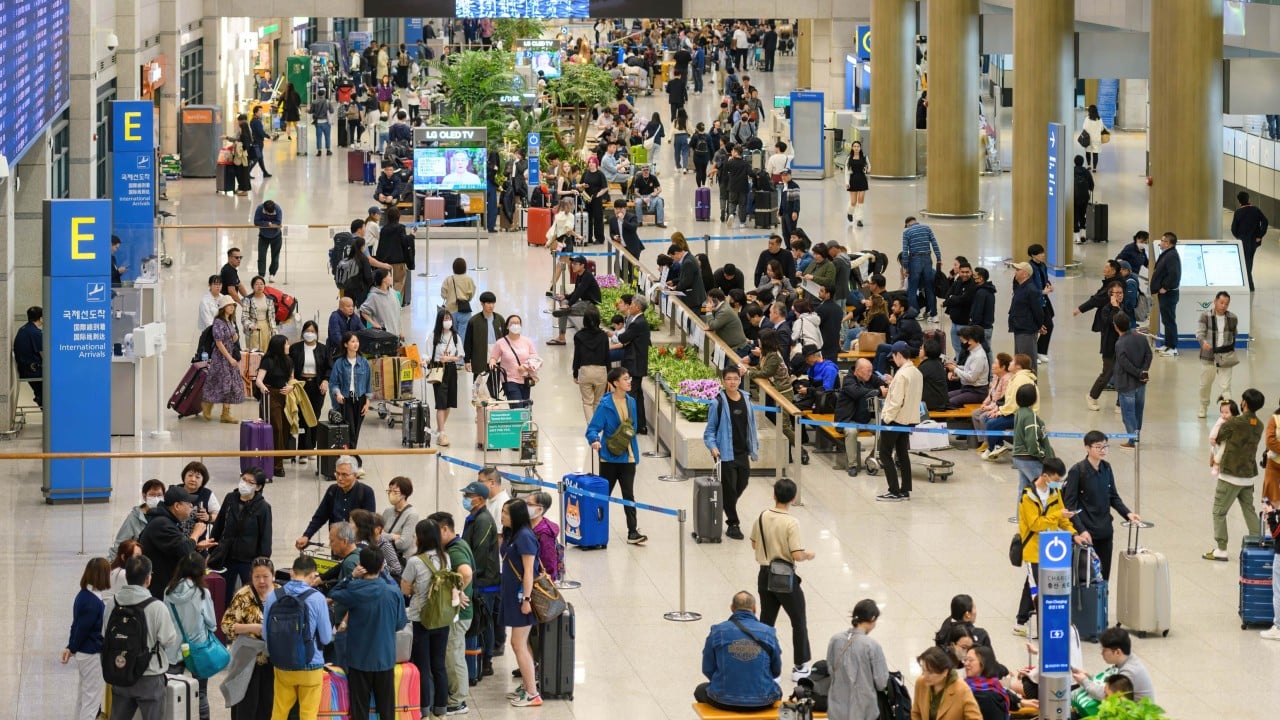
The Sound of One Billion Welcomes
The floorboards don’t creak under the weight of a billion people. Instead, they sing a low, collective hum, a white noise composed of rolling suitcase wheels, soft-soled shoes shuffling toward immigration, and the occasional chime of a departures board shifting its letters.
Incheon International Airport just hit its billionth passenger.
To put that number in perspective, imagine every single person living in the United States, Europe, and Japan packing a bag, boarding a flight, and walking through the exact same glass doors in South Korea. It is a staggering logistical feat, made even more bewildering by the timeline. Incheon achieved this milestone in just twenty-three years. No other airport in aviation history has scaled from a quiet, mudflat-turned-island to a billion-passenger megahub this quickly.
But numbers are cold. They don't feel the sting of jet lag, nor do they understand the heavy ache of saying goodbye to a child moving across the world. To understand what one billion passengers actually means, you have to look at the people who inhabit the terminal, even if only for an hour.
Consider a hypothetical traveler named Min-jun. He represents the typical baseline of this massive statistic. Min-jun is a logistics manager from Seoul, flying to Singapore for a quarterly meeting. He moves through Terminal 2 with the practiced, almost robotic precision of a frequent flyer. He doesn't look at the signs; his feet know the way. He scans his passport, places his fingers on the biometric reader, and passes through security in less than six minutes. To him, the airport is a machine that works so well it becomes invisible.
But look closer at the person next to him.
An elderly woman is gripping her grandson’s arm, her eyes wide as she looks up at the towering, vaulted ceilings that mimic the curves of a traditional Korean fortress. She is flying for the first time in thirty years to visit family in Los Angeles. For her, this isn't a highly efficient transit hub. It is a terrifying, beautiful labyrinth of glass and steel.
Incheon’s true achievement isn't that it handled a billion people. It is that it managed to treat both Min-jun and this grandmother with the exact same level of dignity.
The Mudflat That Chased the Sky
To understand how South Korea built this engine of human movement, you have to go back to the early 1990s. Seoul’s old domestic and international gateway, Gimpo Airport, was choking. It was hemmed in by urban sprawl, paralyzed by a strict nighttime curfew, and completely incapable of handling the tsunami of globalization that was about to hit East Asia.
The solution was radical, bordering on insane.
The government decided to look toward Yongjong Island, a collection of sleepy fishing villages and tidal mudflats off the coast of Incheon. Critics mocked the plan. They argued that building a massive, multi-runway airport on reclaimed land in the Yellow Sea was a recipe for structural sinking and astronomical debt. The area was plagued by thick sea fog. It was far from the capital.
The engineers dug in anyway.
They connected islands, built massive seawalls to hold back the tide, and laid down tarmac where fishermen used to harvest crabs. When the airport opened in March 2001, it was a gamble. South Korea was still recovering from the bruising 1997 Asian Financial Crisis. The country needed a statement piece, a declaration that it was no longer just an island at the edge of the Asian continent, but the literal gateway to it.
The gamble paid off because Incheon was designed from the ground up to solve the universal pain points of travel.
Most airports evolve organically over decades, resulting in a chaotic patchwork of mismatched terminals, confusing signage, and endless, frustrating walks between gates. Think of London Heathrow or New York’s JFK—airports that feel like they are constantly apologizing for their own existence. Incheon was different. It was a master-planned ecosystem designed to grow outward like a tree, adding rings without disrupting the core.
The Architecture of Distraction
Step inside the departure lounge and you notice something strange. There is an absence of panic.
In most major global hubs, the ambient energy is dialed up to a stressful ten. People run. Announcements blare. Security lines snake into infinity, fueled by the mutual suspicion of passengers and guards.
Incheon handles the anxiety of travel through a concept psychologists call environmental buffering. The airport is intentionally designed to distract your nervous system from the reality that you are about to be locked in a metal tube at thirty-five thousand feet.
- The Indoor Forest: Massive, living gardens filled with native Korean plants breathe oxygen into the terminals, cutting through the stagnant, recycled air typical of aviation hubs.
- The Cultural Parades: Instead of static museum displays, actors dressed in traditional Joseon Dynasty royal attire walk through the duty-free areas, shifting the atmosphere from a commercial mall to a living theater.
- The Transit Hotel Oasis: For those trapped between long-haul flights, the airport offers free showers, digital zone sleeping pods, and even a small ice-skating rink.
This isn't just luxury for the sake of luxury. It is a highly calculated business strategy. A relaxed passenger is a passenger who spends money. By reducing the friction of processing—speeding up baggage claims and immigration through intense automation—Incheon converts stressful transit time into profitable leisure time.
But the real magic happens beneath the gleaming floors, out of sight from the passengers drinking lattes and buying cosmetics.
The Subterranean Pulse
Below the passenger levels lies a labyrinth of conveyor belts stretching for dozens of miles. This is the baggage handling system, the unsung hero of the one-billion milestone.
If a single bag misplaces its route, a cascade failure can delay fifty flights, causing a ripple effect that touches airspace from Tokyo to San Francisco. Incheon’s baggage system boasts an error rate that is virtually zero, moving luggage at speeds of up to twenty-two miles per hour through computer-guided tracks.
It is a world of pure automation, yet it relies on human oversight.
Imagine the workers who sit in the control rooms, watching walls of monitors track thousands of individual barcodes every minute. They don't see names or destinations; they see glowing dots moving through a digital grid. To them, a human life is reduced to a twenty-kilogram suitcase that must catch a specific gate in less than twenty minutes.
When the airport hit its one-billionth passenger, the celebration was held in the bright, sunlit atrium of Terminal 2, complete with cameras and dignitaries. But the true victory belonged to these subterranean operators, the engineers, and the janitorial staff who keep the massive complex operating twenty-four hours a day, seven days a week, through typhoons, snowstorms, and global health crises.
The Friction of a Borderless World
There is a deep irony embedded in Incheon’s success. The airport has spent over two decades perfecting the art of seamless movement, creating an environment where crossing an international border feels as natural as walking into a grocery store.
Yet, just fifty miles to the north lies the Demilitarized Zone, the most heavily fortified and impenetrable border on earth.
South Korea is, for all practical purposes, an island. Hemmed in by North Korea and surrounded by sea, the only way out for its citizens is through the air or the water. This geographical isolation is what drove the country to build such an aggressive, outward-facing hub. Incheon isn't just an airport for South Korea; it is its literal connection to the global economy.
As the airport looks toward its next billion passengers, the challenges are shifting. The aviation world of 2026 is vastly different from the one that existed when Incheon opened its doors in 2001. Climate anxieties are rising. Travelers are increasingly questioning the footprint of their journeys.
Incheon’s response has been to pivot toward what it calls the "smart mega-hub," integrating autonomous tugs for aircraft, AI-driven passenger flow forecasting, and biometric tokens that eliminate the need to ever show a physical boarding pass after checking in.
But as the technology becomes more pervasive, the risk of losing the human touch increases. An airport that is entirely automated can easily become sterile, a non-place where people pass through without ever feeling like they have actually been anywhere.
The Golden Passport
Near the boarding gates for flights departing to Europe, a man sits by the window, watching a Boeing 777 being fueled on the tarmac. He holds a passport worn at the edges, its gold lettering fading from years of friction against the inside of his jacket pocket.
He isn't the official one-billionth passenger chosen by the airport marketing team for a photo op. He doesn't get a free ticket or a bouquet of flowers.
But he is the real reason this place exists. He is a grandfather heading home after seeing his granddaughter take her first steps in Seoul. He is a software salesman who just closed a deal that will keep fifty people employed for another year. He is a student traveling on a scholarship, terrified and thrilled by the unknown.
The true metric of Incheon’s success isn't the milestone number celebrated in corporate press releases. It is the quiet reality that for twenty-three years, one billion distinct human stories converged on a piece of reclaimed mud in the Yellow Sea, found exactly what they needed, and went on their way into the sky.


