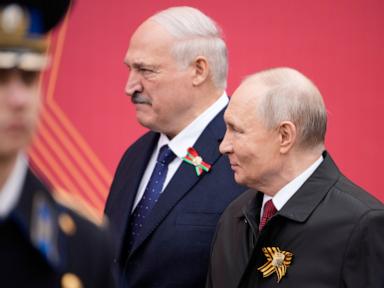
The mainstream media is running the same tired script.
Belarus and Russia announce joint military maneuvers to practice the deployment of tactical nuclear weapons, and right on cue, the pundits panic. The headlines paint a picture of a world teetering on the brink of Armageddon, framing Minsk as a terrifying new nuclear launchpad and Alexander Lukashenko as a man with his finger on the button.
It is a neat, terrifying story. It is also completely wrong.
The lazy consensus treats these drills as a genuine, escalating military threat. They view the deployment of Russian non-strategic nuclear weapons to Belarusian soil as a shifting of the geopolitical balance of power. If you consume defense journalism by the bucketload, you are being conditioned to believe that moving hardware closer to NATO borders fundamentally changes the mechanics of deterrence.
It does not.
Step away from the sensationalism and look at the actual physics, logistics, and command structures governing these weapons. When you strip away the theater, these drills are not a preparation for nuclear war. They are a highly orchestrated, brilliantly executed psychological operation designed to exploit Western media vulnerabilities. And the West falls for it every single time.
The Myth of the Belarusian Nuclear Trigger
Let us correct the single biggest misunderstanding dominating this news cycle: Alexander Lukashenko does not control these weapons. He never will.
I have spent years tracking defense supply chains and command-and-control frameworks across Eastern Europe. The operational reality of Russian tactical nuclear weapons is governed by ironclad centralization. The Russian Federation’s 12th Main Directorate (12th GUMO) is the sole custodian of these warheads.
- The Storage Reality: The warheads are kept in highly secured, Russian-controlled facilities. Belarusians do not have the access codes.
- The Launch Authority: The permissive action links (PALs) required to arm these weapons require authorization that flows strictly from Moscow.
- The Delivery Systems: While Belarusian Su-25 jets and Iskander-M missiles have been modified to carry these payloads, they are useless without the Russian warheads, which remain under Russian lock and key until the hypothetical moment of employment.
To suggest that Belarus has suddenly become a rogue nuclear state is to fundamentally misunderstand how Moscow operates. Vladimir Putin does not share power, least of all the power to initiate a thermonuclear conflict.
Lukashenko’s posturing is pure theater aimed at a domestic audience and nervous neighbors in Poland and the Baltics. He gets to look like a regional heavyweight, protected by Moscow’s ultimate umbrella, while taking zero of the actual operational shots.
The Logistics of Terror vs. The Reality of War
The media treats the proximity of these weapons to Warsaw or Vilnius as a game-changing development. This reveals a profound ignorance of modern missile technology and strategic geometry.
Consider the Iskander-M system. It boasts an official range of up to 500 kilometers. Whether an Iskander-M is fired from the Kaliningrad enclave, from deep within the Western Military District of Russia, or from a forest outside Minsk, the target profile in Central Europe remains virtually identical.
Moving a missile a few hundred kilometers closer to a target does not bypass modern air defense networks like the Patriot systems deployed in Poland. In fact, it does the opposite.
Forward-deploying nuclear assets into Belarus actually makes them more vulnerable, not less.
In a high-intensity conflict, static or predictable storage sites in Belarus become immediate, high-priority targets for NATO conventional precision strikes. The logistical tail required to move warheads from 12th GUMO bunkers to deployment areas is massive, loud, and easily tracked by Western satellite constellations and signals intelligence.
If Moscow genuinely intended to use tactical nuclear weapons, it would not telegraph its moves weeks in advance with joint exercises in Belarus. It would rely on the deep redundancy and mobility of its assets within the Russian mainland.
These drills are loud precisely because they are meant to be seen. They are not a military strategy; they are communication.
Why the Media's Reaction Predictably Rewards Moscow
The real victory for Minsk and Moscow happens in the newsroom, not on the training ground.
Western media outlets operate on an engagement model driven by existential anxiety. "Nuclear Escalation" is a phrase that guarantees clicks, shares, and viewers. By treating these drills as an unprecedented crisis, the press plays the exact role assigned to it by Kremlin doctrine.
Russian military theory has long emphasized the concept of reflexive control—a technique of conveying specially prepared information to an adversary to incline them to voluntarily make a predetermined decision.
When the West panics over a routine deployment drill, it achieves several of Moscow’s core objectives:
- It induces self-deterrence: It scares Western electorates into questioning the wisdom of supporting Ukraine, raising the specter of World War III over every tactical decision.
- It elevates Lukashenko: It forces Western policymakers to acknowledge a dictator they have spent years trying to isolate and delegitimize.
- It creates a false equivalence: It allows Russia to frame its actions as a mirrored response to NATO's own nuclear sharing arrangements (such as US B61 bombs stationed in Europe).
By reacting with breathless horror to every photo of a Belarusian missile loader, the commentary class fulfills the psychological goals of the exercise before a single engine even starts.
The Downside of This Contrarian Truth
Admitting that these drills are mere political theater comes with a distinct downside. It requires us to acknowledge that the real danger in Eastern Europe is far less cinematic—and far harder to solve.
The danger is not an intentional, calculated nuclear launch by a rogue Belarusian general. The real danger is miscalculation born of communication breakdown.
When both sides are locked in a cycle of constant, high-stakes military signaling, the margin for error shrinks. A navigation error by a nuclear-capable jet during an exercise, a technical glitch on a radar screen, or an overreaction by a border patrol guard can trigger a conventional response that escalates out of control.
By focusing entirely on the Hollywood scenario of a deliberate nuclear strike, we ignore the boring, terrifying reality of accidental escalation. We worry about the madman with his hand on the lever, instead of the rusty gear that might snap on its own.
Stop Asking if Belarus Will Use Nuclear Weapons
The question dominating public discourse is fundamentally flawed. If you are asking "Will Lukashenko use these weapons?" or "Is this the start of a nuclear war?", you are participating in a conversation rigged by Kremlin strategists.
The question you should be asking is: "Why are we letting routine military signaling dictate our geopolitical resolve?"
The next time you see a headline about joint nuclear drills in Belarus, look past the scary imagery. Remember that the warheads are locked in Russian safes, the launch codes reside in Moscow, and the entire spectacle is designed to make you blink.
Stop playing your assigned part in their psychological playbook. Treat the theater as theater, focus on the structural realities of the conflict, and refuse to let choreographed logistics pass for a strategic threat.