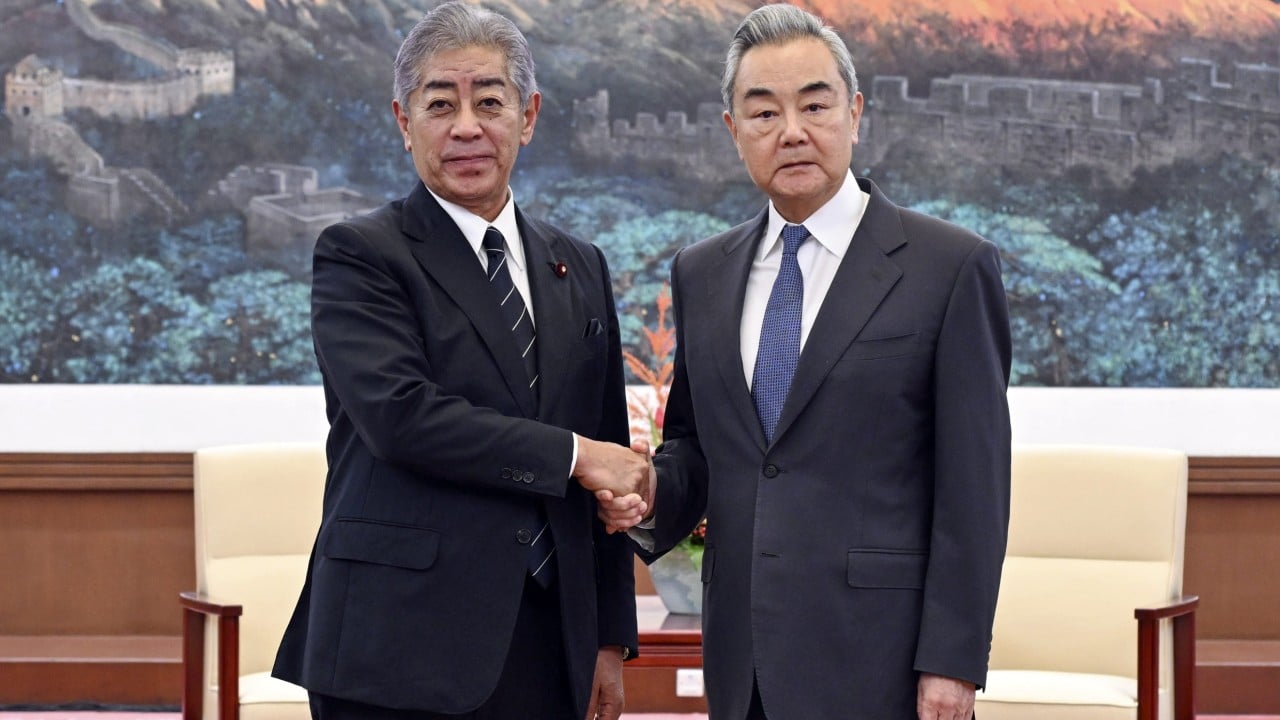
History rarely stays buried in East Asia, especially when economic desperation meets geopolitical strategy. When a prominent Japanese business delegation touches down in the Chinese capital, the reception is rarely just about trade balances or supply chain logistics. Beijing ensures that the ghosts of the twentieth century occupy the room during every negotiation.
Diplomatic handshakes often mask deep underlying friction. The recent visit by Japanese executives to Beijing highlights a persistent dual-track reality in Asia's largest bilateral relationship. Commerce moves forward on one track while historical memory acts as a permanent brake on the other.
The Economic Imperative and Political Friction
Trade between China and Japan remains massive, stubborn, and mutually necessary. Japanese automakers, electronics firms, and industrial conglomerates depend heavily on Chinese manufacturing hubs and consumer markets. Conversely, Chinese industries rely on advanced Japanese components and precision machinery.
Yet, economic pragmatism collides daily with state-managed nationalism. Beijing utilizes historical grievances as a diplomatic instrument whenever political leverage is required. When Japanese business leaders arrive seeking predictability and regulatory relief, they are routinely met with stern reminders of wartime atrocities.
This juxtaposition is not accidental. It serves a calculated purpose within China's broader diplomatic playbook. By keeping historical memory sharp, Beijing establishes an ideological baseline. Japanese visitors are reminded of past aggression, which alters the psychological power dynamic of the boardroom.
Memory as a Political Instrument
The Second World War casts a long shadow over modern Sino-Japanese ties. Unlike Europe, where post-war reconciliation followed distinct institutional paths, East Asia never experienced a definitive closure regarding wartime accountability.
Textbook controversies, territorial disputes over the Senkaku or Diaoyu islands, and visits by Japanese politicians to the Yasukuni Shrine provide a steady stream of fuel for state media. When commercial delegations arrive, state organs amplify historical warnings about militarism and revisionism.
This strategy accomplishes several goals for Beijing. Domestically, it reinforces national unity and legitimizes the ruling party's narrative as the ultimate defender of Chinese sovereignty. Externally, it creates a psychological disadvantage for visiting Japanese executives and politicians. Japanese business leaders, anxious to protect their market share, often find themselves on the defensive, apologizing or making quiet concessions to appease their hosts.
The Corporate Dilemma in Tokyo
Japanese boardrooms face an excruciating strategic puzzle. Decoupling from China is economically unfeasible for many multinational corporations due to sunk capital and entrenched supply networks. At the same time, remaining tethered to a volatile market carries escalating political risks.
Geopolitical tensions between Beijing and Washington add another layer of complexity. Japan remains a staunch security ally of the United States, cooperating closely on export controls for advanced semiconductors and regional defense frameworks. When Tokyo aligns with Washington on technology restrictions, Beijing retaliates through diplomatic reprimands and subtle economic friction.
Business delegations traveling to Beijing walk a tightrope. They must project confidence to shareholders back home while signaling compliance and goodwill to Chinese regulators. Every public statement is parsed for potential missteps. A casual remark about regional security can trigger a sudden regulatory crackdown or a consumer boycott.
Beyond the Rhetoric
Beneath the predictable cycles of diplomatic warnings and trade talks lies a deeper structural shift. Both nations are managing a long-term decline in mutual trust.
China's economic slowdown has altered the calculus for foreign investors. The days of guaranteed double-digit returns are gone. Operating in China now involves tighter regulatory scrutiny, data security laws that criminalize standard corporate due diligence, and the constant threat of arbitrary detention or investigations.
For Japanese firms, the historical warnings delivered during high-level business visits are no longer viewed merely as political theater. They are interpreted as indicators of operating risk. When historical grievances are weaponized in official meetings, it signals that commercial disputes can easily be reclassified as matters of national security.
As Tokyo and Beijing navigate an increasingly fractured global economy, the shadow of the past remains an active participant in modern commerce. The business delegation returns home with signed agreements, tentative deals, and a stark reminder that in the capitals of East Asia, economic survival requires negotiating with history itself.