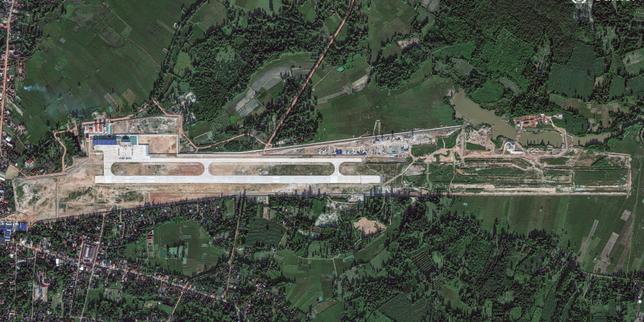
The geography of mainland Southeast Asia is being redrawn by concrete, asphalt, and sovereign compromise.
Quietly, methodically, and with minimal international friction, China has expanded its military and strategic footprint deeper into the Indochinese peninsula. The operationalization of a military logistics and security facility in Laos follows hard on the heels of Beijing’s entrenched presence at Cambodia’s Ream Naval Base. Together, these developments do more than rattle regional capitals from Hanoi to Jakarta. They mark the quiet expiration of ASEAN's diplomatic centrality and signal the consolidation of a contiguous sphere of influence stretching from China's southern border down to the Gulf of Thailand. For a different look, see: this related article.
Western defense analysts tend to view these moves through the tired lens of global superpower competition with Washington. That is a mistake. This is not about aircraft carriers or freedom of navigation patrols in the South China Sea. This is about the total economic and physical integration of the Mekong subregion into the security apparatus of the Chinese state.
Decades of infrastructure investments under the Belt and Road Initiative laid the tracks. High-speed rail lines, deep-water ports, and national fiber-optic backbones created absolute commercial dependence. Now, the security architecture is simply catching up to the balance sheet. Related coverage on the subject has been shared by Reuters.
Consider the mechanics on the ground in Laos. Landlocked, economically exposed, and historically squeezed between larger neighbors, Vientiane has little diplomatic leverage left. When bilateral loans mature and debt servicing becomes an existential crisis, sovereignty becomes a flexible currency. The physical footprint of Chinese security personnel in northern Laos is ostensibly framed around anti-narcotics cooperation, counter-terrorism, and protection of critical infrastructure. But once a security vacuum is filled by a foreign state's military logistics personnel, it rarely empties out.
Downstream in Cambodia, the situation at Ream tells the same story with a maritime accent. Despite repeated denials from Phnom Penh, satellite imagery confirms the dredging of deep-water berths capable of hosting large naval combatants. For Beijing, access to the Gulf of Thailand fundamentally alters its strategic depth. It bypasses the choke points of the Malacca Strait, securing energy and trade corridors that were previously vulnerable to naval interdiction.
ASEAN finds itself paralyzed. Built on consensus and non-interference, the ten-member bloc is structurally incapable of formulating a unified response to bilateral coercion or strategic co-optation. Individual member states have divergent priorities. Phnom Penh and Vientiane orbit firmly within Beijing’s gravitational pull. Manila and Hanoi look outward, forging mini-lateral security partnerships with Washington, Tokyo, and Canberra. Bangkok hedges its bets, as it has for centuries, bending with whichever wind blows strongest from the north.
The regional anxiety is palpable, but muted. Singapore worries about the erosion of international maritime law. Vietnam watches its western flank with deep historical suspicion, acutely aware that a hostile or dominated Laos leaves its narrow central waist entirely exposed. Yet none of these nations can offer Vientiane or Phnom Penh an alternative financial lifeline that matches the sheer speed and scale of Chinese capital.
This is the brutal reality of twenty-first-century geopolitics. Power follows economics, and security follows infrastructure. The bases in Laos and Cambodia are not isolated outposts. They are the fixed nodes of an emerging regional order where Beijing writes the rules of engagement, and smaller neighbors discover too late that sovereignty is harder to reclaim than it is to surrender.