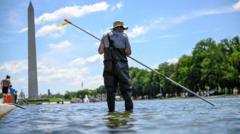
On a humid June afternoon in Washington, D.C., you can stand at the base of the Lincoln Memorial and watch the sky change geometry. If the water is still, the heavy stone of the Washington Monument drops perfectly into the earth, a white dagger cutting through a liquid reflection. It is supposed to be a place of quiet gravity. It is the stage where Martin Luther King Jr. told the world about his dream while a quarter of a million people caught their breath along the stone banks.
But water is a living, stubborn thing. It does not care about national anniversaries, nor does it care about political legacies.
Recently, the 2,000-foot-long Lincoln Memorial Reflecting Pool became something else entirely: a multi-million-dollar theater of friction. Ahead of America’s 250th anniversary celebrations, the water was drained to make way for a rapid, $14.2 million transformation. The goal was architectural perfection—lining the shallow concrete basin with a deep, dramatic coat of what President Donald Trump called "American flag blue". The idea was to create the ultimate mirror, a flawless sapphire lens reflecting the nation's greatest monuments.
Instead, nature and human tension collided.
Within days of refilling the pool, the sapphire dissolved into an aggressive, murky green. A massive bloom of Desmodesmus—a resilient, sun-loving genus of algae—took hold of the shallows. As park employees rushed to pump in hydrogen peroxide and vacuum the floor, the newly applied blue sealant began to blister and peel away from the concrete like sunburnt skin.
The Chemistry of a Conflict
To understand how a national monument turns into an ecological battleground, consider how a standard backyard swimming pool behaves when left untreated for a weekend. Now, scale that up to a massive, stagnant basin containing roughly 6.7 million gallons of water, completely exposed to the blistering summer heat of the mid-Atlantic.
Water treatment requires a delicate, chemical equilibrium. When the bottom of the pool was coated with the thick blue sealant, the physical composition of the basin changed. Aquatic ecologists noted that the intense renovation work likely disturbed the resting nutrient balance of the water system. When you combine high levels of sunlight, fresh chemical compounds, and stagnant water, you create a greenhouse effect on a microscopic level. The algae did not see a monument; it saw a perfect incubator.
What followed was a strange game of physical and rhetorical damage control. On social media, the president announced that federal authorities had executed "multiple arrests" of individuals allegedly destroying the pool. He claimed that "vandals" had used blades to slice a 250-foot gash into the new lining and had poured corrosive chemicals into the water to ruin the finish.
[The National Mall Maintenance Paradox]

    [Heavy Renovation] ──> [Nutrient Disruption] ──> [Algae Bloom]
            │                                               │
            ▼                                               ▼
     [Blue Coating]  ───────────────────────────────> [Peeling Paint]
Standing by the water, the tension is visible. In some areas, the peeling paint left patchy, exposed gray spots on the floor. In one particular section, a visitor had even traced the word "TRUMP" into the accumulating green scum at the bottom. It became a literal canvas for the country's deep ideological divisions.
The Cost of Urgency
The real problem lies in the relentless timeline of civic pride. Building or repairing things to last 50 to 100 years requires a slow, methodical patience that political calendars rarely allow. When concrete is painted, it requires precise curing times, specific moisture thresholds, and optimal atmospheric conditions to ensure the bond holds. If the process is rushed to meet a ribbon-cutting deadline for a national holiday, the materials often fail.
Consider what happens next: the pool must now be drained all over again. Millions of gallons of water will be released into the district's drainage systems, leaving a massive, empty concrete crater in the center of the National Mall just as millions of tourists arrive for the semi-quincentennial.
Contractors and Park Service employees are now working under an "immediate" mandate to scrape, seal, and fix the basin. It is a grueling, repetitive cycle of trying to force a massive ecosystem to behave like a sterile mirror.
The Reflecting Pool was originally built in 1922 to be a place of quiet contemplation. It has leaked, it has gathered moss, and it has required maintenance for over a century. Perhaps its true value isn't in presenting a flawless, artificial blue veneer, but in showing us exactly what we are: a complicated, living landscape that requires constant, careful preservation rather than a quick coat of paint.
The crews will finish their work, the water will flow back in, and for a few days, the blue will look pristine. But the summer sun is patient, and the algae is always waiting just beneath the surface.