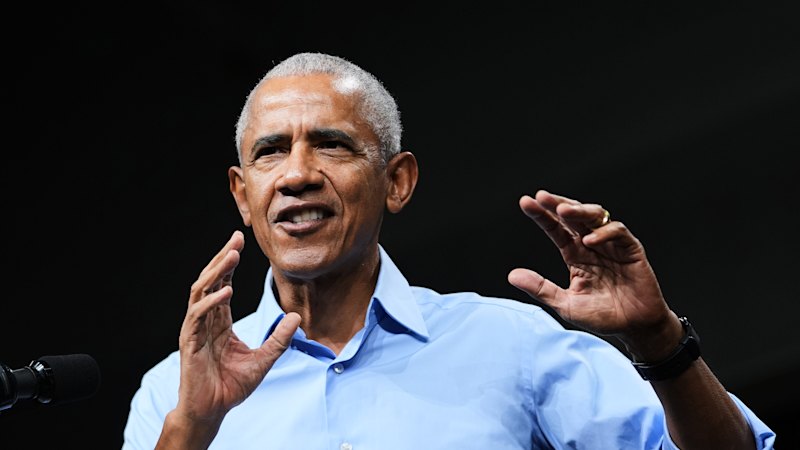
Barack Obama walked back onto the campaign trail and instantly reminded everyone why political strategists still study his rally speeches like game tape. He didn't deliver a dry policy lecture or rattle off twenty-minute macroeconomic breakdowns. Instead, he compared Donald Trump’s White House aesthetic and governing style to what it would look like "like Saddam opened a Cheesecake Factory."
That single line dominated cable news cycles, sparked millions of social media impressions, and accomplished something weeks of carefully vetted Democratic talking points couldn't touch. It punctured an image through pure, relatable absurdity.
If you've spent any time analyzing political messaging over the last two decades, you know that jokes stick far longer than statistics. Voters forget GDP percentages within ten minutes of turning off their phones. They don't forget a visual image that mashes together authoritarian gold-plated excess with a suburban mall chain famous for laminated twenty-page menus and giant slices of red velvet cheesecake.
The Anatomy of Obama's Cheesecake Factory Line
Let's break down why that specific joke worked so well. Political humor usually falls flat when it sounds like a room full of twenty-something speechwriters tried too hard to craft a viral tweet. You can almost hear the focus group testing behind bad political zingers.
Obama's delivery didn't feel like that. It felt observational.
By pairing Saddam Hussein—a dictator notorious for building tacky, marble-and-gold palaces while his country struggled—with The Cheesecake Factory, Obama hit two completely different targets in one breath. First, he mocked the gilded, over-the-top luxury aesthetic Trump has favored since his 1980s Manhattan real estate days. Second, he undercut the grandeur of that aesthetic by comparing it to a mass-market chain restaurant known for faux-Egyptian columns and overwhelming portion sizes.
It's a classic rhetorical move. You take someone who projects strength, wealth, and exclusivity, and you rebrand them as cheap, loud, and slightly ridiculous.
Authoritarian-style branding relies entirely on intimidation and awe. You're supposed to look at the gold trim, the massive crowds, and the sweeping promises and feel small. Humor destroys that dynamic instantly. Once people start laughing at the decor, the aura of invincibility evaporates.
Why Pop Culture References Beat Policy Papers on the Trail
Watch how modern campaigns actually win attention. Most voters aren't sitting at their kitchen tables cross-referencing white papers from think tanks in Washington. They're scrolling between work shifts, picking up kids from soccer practice, and catching thirty-second clips while waiting in line for coffee.
In that environment, cultural shorthand is currency.
Obama has always understood this better than almost any modern politician. Back in 2008, he brushed off attacks by dusting off his shoulders—a direct nod to Jay-Z that required zero explanation for younger voters while confusing pundits on Sunday morning shows. Years later, he used his White House Correspondents' Dinner appearances to dismantle critics with comedic timing that rivaled professional stand-ups.
When he steps back onto a campaign stage, he shifts gears almost effortlessly. He'll spend ten minutes talking seriously about healthcare costs, judicial appointments, or voting access, and then drop a pop culture reference that snaps the entire arena back to attention.
The Cheesecake Factory line wasn't just a throwaway gag. It functioned as a hook to keep audiences engaged so they'd actually listen to the heavier arguments he made right afterward about economic inequality, institutional norms, and executive power.
The Trap of Taking the Bait
Trump's political brand thrives on conflict. When opponents call him a threat to democracy or an existential danger, his supporters often hear strength. Even some undecided voters tune out the alarmist language because they've heard it nonstop for a decade.
Ridicule works differently. You can't easily spin being compared to a mall restaurant.
If you ignore the joke, the clip keeps circulating unchallenged. If you respond angrily, you prove the point that you're thin-skinned and easily rattled. That's the exact trap Obama sets whenever he trades outrage for sarcasm. He forces his opponent onto defensive ground over something trivial while keeping the broader critique intact.
What Most Commentators Miss About Obama's Campaign Comebacks
Every time Obama returns to the stump—whether during midterm cycles or presidential races—pundits immediately frame him as the Democratic Party's "closer." That label misses half the picture.
Yes, he still draws massive crowds and generates unmatched earned media coverage. Few living politicians can walk into an arena in Pennsylvania, Michigan, or Georgia and command that kind of energy. Yet his real value to candidates down the ballot isn't just enthusiasm. It's translation.
Democratic messaging frequently suffers from academic bloat. Candidates talk about "investments in green infrastructure" instead of cheaper electric bills, or "protecting democratic institutions" instead of keeping politicians out of your personal decisions. Obama takes complex, sometimes clunky party platforms and translates them into plain English that sounds like a conversation you'd actually have with a neighbor.
He also gives voters permission to feel skeptical without feeling cynical. He regularly acknowledges frustration with inflation, housing costs, and gridlock in Washington before pivoting to his argument about why returning to Trump's leadership would make those problems worse. Ignoring voter frustration is political suicide, and Obama rarely makes that mistake.
The Limits of Star Power
Still, let's be honest about what a campaign comeback can and cannot do. No surrogate, not even a two-term former president with high approval ratings among his base, can single-handedly carry a weak candidate across the finish line.
History proves this over and over again. Obama campaigned heavily in 2010 and 2014, and Democrats still suffered brutal midterm losses both times. He rallied aggressively in 2016, and Hillary Clinton still lost key Rust Belt states by razor-thin margins.
A viral speech buys a campaign momentum and oxygen for forty-eight to seventy-two hours. After the arena lights turn off and the motorcade leaves town, the local candidate still has to answer tough questions, run a disciplined field operation, and give swing voters a concrete reason to show up on Election Day.
How Trump and Obama Use Humor Differently
Comparing their comedic styles reveals two completely different theories of political persuasion.
Trump treats rallies like marathon improv sets. He riffs for ninety minutes or more, tests out nicknames in real time, mimics opponents' voices, and watches the crowd to see which lines land. When a nickname sticks, he repeats it endlessly until media outlets adopt it out of sheer repetition. His humor is blunt, personal, and aimed squarely at dominating the room.
Obama's humor is surgical. He builds up a premise, lets the audience anticipate where he's going, pauses for half a beat, and drops the punchline with a slight grin. He rarely punches down at ordinary people; instead, he aims upward at ego, hypocrisy, and self-importance.
Both styles work because they feel authentic to the person delivering them. Voters have a built-in radar for fake charisma. If Obama tried to do ninety minutes of off-the-cuff insults, he'd look ridiculous. If Trump tried to deliver tightly scripted, ironic metaphors, his base would fall asleep.
The Real Stakes Behind the Viral Clip
Strip away the jokes about laminated menus and gold-plated furniture, and you're left with a serious clash over what American leadership should look like.
Obama's return to the campaign trail always signals that Democrats believe a race is close enough that turnout among occasional voters will decide the outcome. His primary audience isn't the die-hard partisan who already has a yard sign out front. It's the exhausted, tuned-out voter who normally skips elections or decides who to support during the final week of the campaign.
For those voters, a sharp, memorable line cuts through the noise faster than a million dollars in digital attack ads. It reminds them of a specific style of politics—one rooted in coalition-building, institutional predictability, and a lighter touch—and contrasts it sharply with the chaos and spectacle they associate with the Trump era.
If you're tracking how this campaign cycle unfolds from here, don't just watch the polling averages or the fundraising totals. Watch which lines escape the political bubble and end up in group chats, barber shops, and break rooms across swing states. Right now, Obama's Cheesecake Factory jab is doing heavy lifting that millions in ad spend simply can't buy.