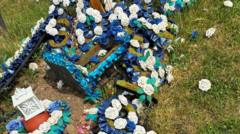
The traditional media loves a predictable villain. Right now, the target is the humble faux flower resting on a tombstone. Ecologists are lining up to demand blanket bans on synthetic tributes in municipal cemeteries, pointing fingers at microplastics and weeping over the visual pollution of faded polyester roses.
It is a comforting narrative. It feels like activism. It is also entirely wrong.
Banning plastic flowers from cemeteries is a masterclass in missing the point. It is environmental theater designed to make bureaucrats look green while ignoring the massive, resource-heavy reality of the modern funeral industry. If you want to fix the ecological footprint of how we mourn, stripping a grieving family of a durable tribute is not just cruel—it is mathematically irrelevant.
The False Idyllic Narrative of Cut Flowers
The core argument for a ban rests on a lazy assumption: synthetic bad, natural good. Activists paint a picture of graves adorned with organic, locally picked wildflowers that melt back into the earth, leaving nothing but memories.
Let us look at how the commercial floral industry actually operates.
Most fresh cemetery flowers do not come from a local meadow. They are imported. They are grown in massive industrial greenhouses in Colombia, Ecuador, or Kenya. To get those flawless, bug-free lilies to a suburban cemetery, growers rely on a staggering cocktail of synthetic pesticides, herbicides, and fertilizers.
Furthermore, the supply chain is a carbon nightmare. Cut flowers are fragile. They require continuous refrigeration—known as the cold chain—from the moment they are harvested to the moment they land in a cemetery vase. They are flown on cargo jets, trucked in refrigerated rigs, and stored in energy-hungry coolers.
Then comes the lifespan. A fresh bouquet looks good for five days. Seven if you are lucky. Once it rots, it gets tossed into a cemetery dumpster, usually wrapped in a plastic sleeve, bound with a plastic clip, or secured in floral foam.
Faux flowers, despite their synthetic origin, stay on a grave for months or even years. When you calculate the carbon emissions per day of tribute, a single high-quality polyester arrangement easily outperforms a weekly replacement cycle of imported, chemically treated roses.
The Dark Reality of Floral Foam
When ecologists complain about microplastics in the soil around headstones, they point at degrading fake leaves. They are looking at the wrong culprit.
The real environmental disaster in cemetery floristry is floral foam—that green, spongy block used to hold fresh arrangements in place.
Floral Foam = Phenol-Formaldehyde Plastic + Blowing Agents
Floral foam is not biodegradable. It is literally a block of microplastics engineered to crumble. When fresh flower arrangements wither and get cleared away, that foam frequently gets smashed, rinsed down drains, or ground into the dirt. It contains known carcinogens, and it leaches directly into the groundwater far faster than a UV-stabilized plastic lily ever will.
Yet, few cemetery boards are banning floral foam. They ban the fake flowers because the fake flowers are highly visible. It is aesthetic snobbery masquerading as conservation.
Classism Wrapped in Green Packaging
Having spent years analyzing the operational costs of municipal spaces, I can tell you that cemetery bans always disproportionately hurt the same group: the working class.
Fresh flowers are an expensive luxury. To maintain a grave with fresh arrangements year-round requires either immense personal wealth or an absurd amount of free time to drive out to the plot every single weekend. For a working-class family living miles away from a regional cemetery, a durable, weather-resistant synthetic wreath is a practical way to keep a loved one’s resting place looking cared for without draining their bank account.
Telling a grieving family they cannot leave a long-lasting tribute because it violates a board's newly adopted "green aesthetic" is a profound display of privilege. It turns mourning into a luxury subscription service.
Shifting the Target: Where the Real Waste Hides
If a cemetery board actually wants to reduce its environmental impact, it needs to stop policing the behavior of grieving families and start looking at its own operations.
Consider the standard American burial. We take a body, pump it full of formaldehyde-based embalming fluid, lock it inside an exotic hardwood or heavy metal casket, and then drop that casket into a massive concrete or steel vault.
- The Vault: Millions of tons of reinforced concrete are buried every year just to keep the cemetery lawn perfectly level for riding lawnmowers.
- The Turf: Cemeteries are essentially massive, sterile golf courses. They consume millions of gallons of water and require constant chemical treatments to keep the grass unnaturally green.
- The Machinery: The carbon output of heavy diesel excavators and commercial mowers running daily vastly outweighs the footprint of a few garbage bags of degraded fake flowers.
Banning plastic arrangements while continuing to mandate concrete vaults and chemically drenched lawns is like rearranging deck chairs on the Titanic and claiming you are fixing the hole in the hull.
Dismantling the Practical Objections
Whenever this debate arises, cemetery managers bring up a list of standard complaints. Let us address them honestly.
"Fake flowers blow away and clutter the grounds."
This is a maintenance issue, not an environmental one. Secure the tributes properly. Implement a rule requiring all synthetic arrangements to be anchored to the headstone or placed in heavy, integrated vases. Problem solved.
"They clog up the commercial mowing equipment."
So do stray rocks, fallen tree branches, and forgotten metal lawn stakes. Operators are already required to scout lines before driving a 60-inch commercial mower over a grid of graves.
"They look tacky when they fade."
Aesthetics are subjective. A faded silk rose might look unappealing to an architect or an ecologist, but to the person who placed it there, it represents a physical marker of continuous memory. A public cemetery is a communal space for grief, not a curated country club.
The Blueprint for Real Cemetery Reform
If we are serious about creating sustainable spaces for the dead, we need to abandon the superficial ban-happy mindset and implement systemic changes.
- Mandate Foam-Free Fresh Arrangements: If an arrangement uses green floral foam, ban it immediately. Force local florists to return to traditional wire, moss, or twig structures.
- Ditch the Monoculture Lawns: Convert unused cemetery acreage into native wildflower meadows. This drastically reduces mowing emissions, eliminates the need for chemical fertilizers, and creates actual habitats for pollinators.
- Normalize Natural Burial Sections: Instead of banning the plastic flowers on traditional graves, expand the availability of true green burial grounds where embalming, vaults, and synthetic materials are completely absent by design. Give people an actual choice instead of micromanaging their existing options.
Stop obsessing over the polyester petals. Focus on the concrete, the chemicals, and the carbon-heavy supply chains that actually drive ecological degradation. Leave the mourners alone.