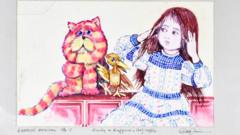
Original artwork from the beloved BBC children's television series Bagpuss recently fetched an astonishing four hundred thousand pounds at auction, proving that physical memorabilia from classic television holds massive financial weight in the modern collector market. Peter Firmin and Oliver Postgate created a quiet icon in 1974, producing just thirteen episodes of a saggy, old, cloth cat who lived in a window shop with his eccentric friends. Decades later, original animation cels, puppets, and production sketches from that small studio in Kent command prices that rival fine art masterpieces.
This record-breaking sale forces a hard look at how society values childhood nostalgia. The market for vintage television assets has shifted from casual garage-sale hunting into high-stakes institutional collecting. Museums, wealthy private investors, and passionate preservationists now compete for the exact same physical artifacts. Understanding how a children's programme made on a shoestring budget reached fine art valuation requires examining the economics of scarcity, emotional attachment, and the dwindling supply of analog media history.
The Economics of Scarcity in Stop Motion Animation
Production in the nineteen-seventies looked entirely different from modern digital animation workflows. Small-scale studios like Smallfilms, founded by Firmin and Postgate, produced television through painstaking stop-motion techniques using paper, cardboard, felt, and basic armature wire.
Every piece of physical artwork served as a disposable utility. Sketches were pinned to boards, paintings were exposed under hot studio lights, and puppets were manipulated frame by frame until the material degraded.
- Original artwork was rarely archived with financial value in mind.
- Many production assets from early British television were routinely discarded after broadcast.
- The surviving material represents a tiny fraction of what was originally created.
Because so few physical assets survived the production process, the supply-and-demand curve for authentic Smallfilms items is severe. When an auction house lists an authenticated piece of production art featuring Bagpuss, Professor Yaffle, or the Mice, buyers realize another opportunity might not materialize for decades. This manufactured or historical scarcity drives prices exponentially higher than the intrinsic material worth of paper and paint.
Why Investors Target Childhood Memories
Financial capital has flooded into alternative asset classes over the past twenty years. Fine art, vintage automobiles, rare watches, and now classic television memorabilia operate as stores of wealth. Baby boomers and Generation X buyers who grew up watching these broadcasts now possess the disposable income required to purchase their childhoods back.
Nostalgia acts as a powerful psychological motivator. When an adult looks at a faded watercolor background from an iconic opening title sequence, they do not see simple illustration work. They feel the safety, routine, and comfort of a simpler era of television broadcasting.
Market analysts tracking alternative investments note that emotional assets often outperform traditional stocks during economic uncertainty. People trust physical objects they can touch and display over abstract digital portfolios. The Bagpuss auction result is not an isolated anomaly; it reflects a broader cultural hoarding of innocence.
The Physical Archive Crisis
The rising value of television heritage highlights a major structural problem within entertainment preservation. Much of Britain's television history from the mid-twentieth century was treated with shocking institutional neglect.
The BBC famously wiped master tapes of early Doctor Who episodes to save storage space and tape costs. While Smallfilms retained more of their personal archives than many of their contemporaries, private creators lacked the climate-controlled facilities necessary to prevent paper decay, color fading, and textile breakdown.
[Original Production] -> [Ephemeral Utility] -> [Private Attic Storage] -> [Auction House Discovery] -> [Institutional / Private Vault]
As prices climb into six figures, the security and conservation of surviving artifacts become paramount concerns. Families who inherited these items are discovering that a box in the attic could pay off a mortgage, but moving those fragile items into the open market risks scattering cultural heritage into private vaults where the public can never see them again.
The Shift from Pop Culture to High Art
For decades, cartoon art and television illustrations suffered from a class divide in the art world. Traditional paintings hanging in national galleries commanded respect, while commercial illustration produced for children's television was viewed as lowbrow craft.
That hierarchy has collapsed. Museums now host major exhibitions celebrating comic book artists, animators, and puppet makers.
When a piece of television artwork crosses the four-hundred-thousand-pound threshold, it completes a journey from commercial television background to high-status collectible. The curators and galleries validating these sales understand that twentieth-century television shaped global culture far more effectively than traditional canvas paintings ever could.
The Bagpuss auction proves that the cultural impact of a sleepy, saggy cloth cat transcends television history. It stands as a monument to hand-crafted art, proving that generations of viewers will pay any price to hold onto a physical piece of their collective past.