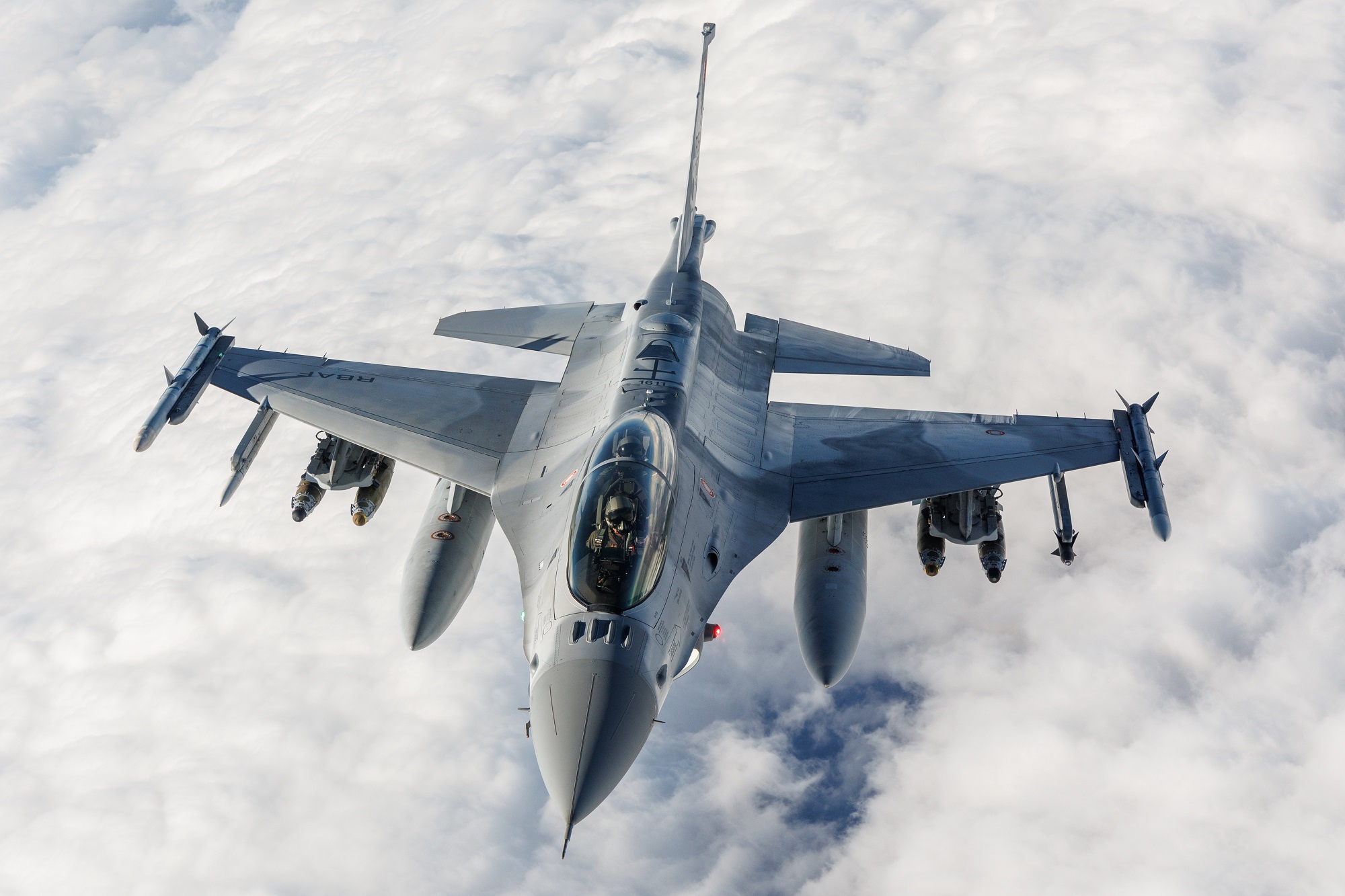
Air superiority in modern combat is not a product of individual airframe performance, but a function of the operational ecosystem in which a platform exists. Public discourse often fixates on pitting the F-16 Block 70 Viper against the Chengdu J-20 in a vacuum, ignoring that neither aircraft operates in isolation. The F-16 remains a highly capable multi-role fourth-generation fighter, but the strategic value of the J-20 lies in its role as a low-observable node within a broader anti-access and area-denial (A2/AD) architecture. Understanding the viability of the Viper against fifth-generation assets requires analyzing the physics of detection, the geometry of engagement, and the institutional constraints of the respective air forces.
The Detection Asymmetry
The primary deficit for any fourth-generation platform like the F-16 when facing a stealth aircraft is the disparity in electromagnetic signature management. Low-observability is not invisibility; it is a reduction in the distance at which an adversary can effectively detect, track, and engage a target.
- Radar Cross Section (RCS) Management: The F-16 was designed during an era where maneuverability and external payload carriage were the dominant design requirements. Its geometry, engine inlets, and vertical stabilizers reflect high radar energy. Conversely, the J-20 utilizes internal weapons bays and radar-absorbent materials to manage its head-on aspect signature.
- Detection Envelopes: In a beyond-visual-range (BVR) engagement, the fighter that identifies the threat first gains the advantage of weapon employment. A J-20’s passive sensors and advanced AESA radar can theoretically identify non-stealthy aircraft at ranges that exceed the F-16’s effective firing solution, allowing the J-20 to launch missiles while remaining outside the Viper’s retaliatory envelope.
The Kill Web Integration
The J-20 is designed to operate as a component of a distributed kill web. This implies that its effectiveness is multiplied by external data links, airborne early warning (AEW) assets, and ground-based radar networks.
- Sensor Fusion: Modern air combat relies on the fusion of data from multiple sources. The J-20’s avionics suite is optimized to synthesize inputs from ground radars, sister aircraft, and electronic warfare platforms. This gives the pilot a composite view of the battle space.
- Support Infrastructure: The F-16 relies heavily on the presence of USAF tankers, AWACS, and electronic warfare support to project power effectively. In a high-intensity, contested environment, the loss or forced withdrawal of these high-value support assets significantly degrades the combat efficacy of the F-16 fleet. The J-20, while also benefiting from similar support, is inherently more survivable when operating near the perimeter of an enemy's integrated air defense system (IADS).
Engagement Geometry
The assumption of "absolute air superiority" ignores the tactical reality of mission profile. If the objective is defensive counter-air—protecting high-value assets or territorial airspace—the Viper can be lethal if directed by ground-based intercept controllers.
The engagement becomes unsustainable for the F-16, however, when the mission requires penetration of contested airspace. Within that environment, the J-20’s design allows it to operate with a level of persistence that the F-16 cannot match. While the Viper is a weapons delivery system, the J-20 is a platform designed to disrupt the enemy's ability to coordinate and command.
- Weapon Range Disparities: Chinese long-range air-to-air missiles, such as the PL-15 and the purported long-range PL-17, are specifically engineered to threaten tankers and command-and-control aircraft. If the J-20 succeeds in forcing these assets to retreat, the Viper is effectively blinded, forced to operate using its own organic, shorter-range radar.
- Maneuverability vs. Situational Awareness: The historical emphasis on dogfighting maneuverability is secondary in the era of high-off-boresight missiles and helmet-mounted cueing systems. The F-16 is agile, but agility is a defensive metric if the pilot is reactive to a missile launch that was initiated beyond the visual horizon.
Operational Limitations and Strategic Forecast
The F-16 Block 70 represents the peak of fourth-generation evolution, offering high reliability, lower maintenance costs, and a sophisticated radar suite compared to its predecessors. It is, however, a platform designed for a different era of air combat.
The institutional gap lies in the rate of modernization. The PLAAF has scaled its production of the J-20 to achieve volume, while simultaneously expanding its support ecosystem of tankers and electronic warfare platforms. The viability of the F-16 in a peer-level engagement depends entirely on the degree to which it is supported by fifth-generation platforms like the F-35 or F-22, which can clear the path by neutralizing the J-20’s stealth advantage.
Any strategic assessment of the Taiwan Strait or similar theater must prioritize force composition over individual airframe comparison. The Viper remains a critical asset for multi-role missions, but it is not a primary solution for air superiority against a peer-level stealth threat. The operational strategy must be the transition of the F-16 to a secondary role, while prioritizing the integration of fifth-generation assets capable of challenging the J-20's sensor and stealth parity. The final move is to shift from a focus on individual airframe performance to an investment in the long-range sensor networks and electronic warfare capabilities necessary to degrade the J-20's operational environment before engagement occurs.