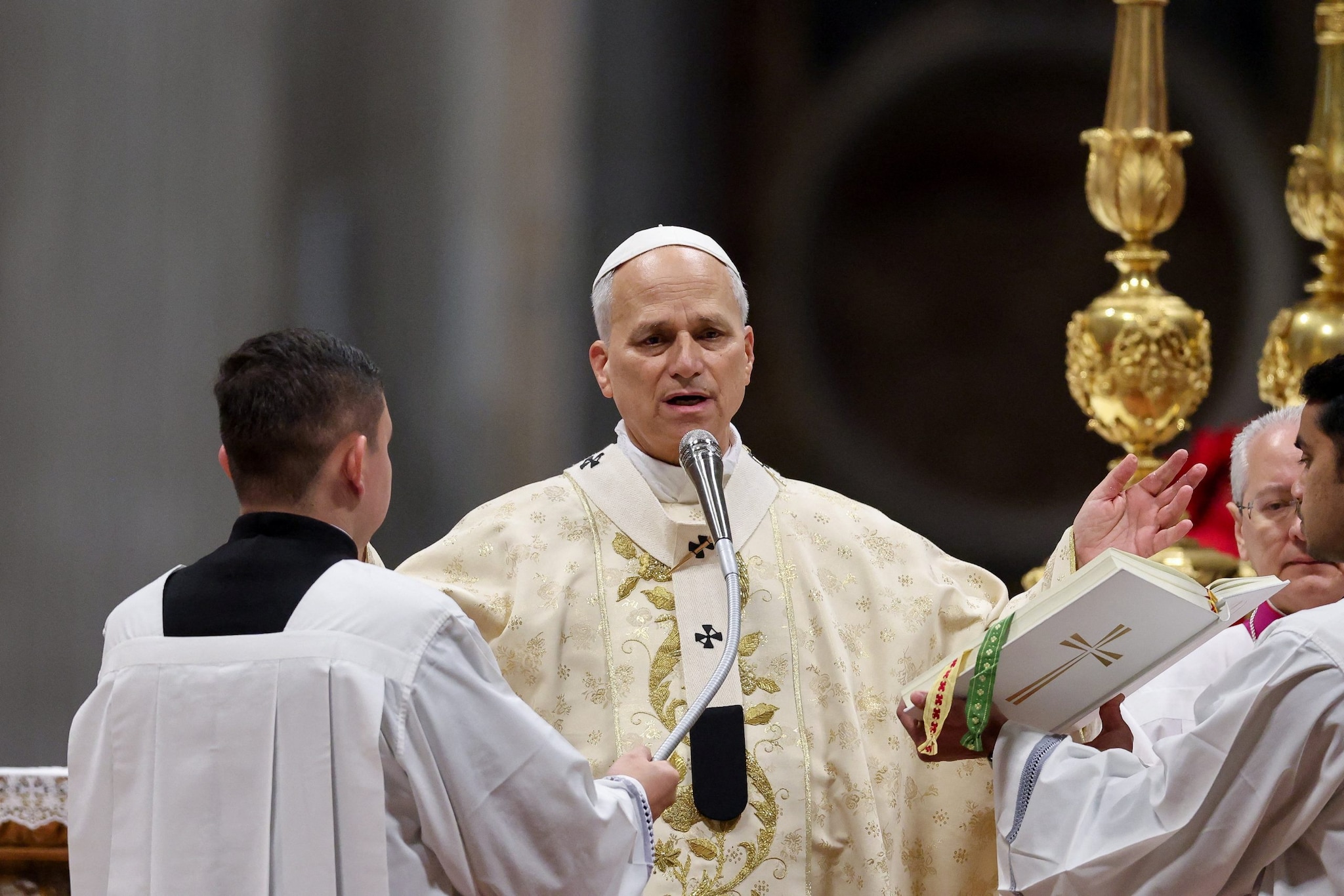
The marble of the Clementine Hall is always cold, no matter how bright the Roman sun shines outside. It is a room built to withstand centuries, a place where history is measured not in fiscal quarters, but in eras. On a damp Thursday morning, a frail man dressed in white sat before a gathering of scientists, tech executives, and policymakers. Pope Leo XIV did not look like a man about to wage war on the future. His hands trembled slightly as he adjusted his spectacles.
Yet, when he spoke, the silence in the room grew heavy.
He was not talking about ancient scripture or theological disputes. He was talking about algorithms. Specifically, he was warning the world about a future where code decides who lives, who dies, and who profits from the transition between the two.
We have arrived at a strange junction in human history. For decades, the Vatican was viewed by the tech elite as a beautiful museum—a relic of the past completely detached from the rapid-fire iterations of Silicon Valley. But something shifted. The architects of artificial intelligence are suddenly realizing that they have built something they do not fully understand, and they are looking for an anchor.
They found one in an old man who doesn’t use a smartphone.
The Ghost in the War Room
To understand why a Pope is suddenly sounding the alarm on autonomous weaponry and profit-driven AI, we have to leave Rome.
Imagine a windowless bunker somewhere in the desert. Inside, a young military analyst sits under the buzz of fluorescent lights. Let’s call him Sarah’s son. He is staring at a screen displaying a thermal feed from a drone hovering over a distant village. The software on his monitor draws a red box around a moving pixel. The AI calculates a 92% probability that the pixel is an enemy combatant holding a weapon.
In the old days—meaning five years ago—the human had to make the final call. The human had to look at the screen, feel the sweat in their palms, and decide to press the button.
Not anymore.
The newest systems don't just identify targets; they are designed to execute the kill cycle automatically to maximize efficiency. The logic is simple, brutal, and entirely financial. In a conflict where drones fly in swarms of tens of thousands, human reflexes are too slow. Humans are a bottleneck. Humans cost money.
This is the exact friction point that drew Pope Leo XIV into the arena.
When the pontiff addressed the international delegation, his critique wasn't aimed at the technology itself, but at the motive behind its deployment. He spoke of a "blind surrender to the market," where the optimization of killing machines becomes just another line item on a corporate balance sheet.
Think about the sheer weight of that. We aren't just outsourcing our math or our writing to machines. We are outsourcing our conscience.
When an algorithm errs and strikes a wedding convoy instead of a missile launcher, who asks for forgiveness? The developer who wrote the library? The defense contractor who sold the hardware? The line of code itself?
The math is flawless, but the math has no soul.
The Illusion of Neutral Math
It is easy to get lost in the sci-fi horror of autonomous drones, but the Pope’s warning cut deeper, into the quiet, invisible ways AI is rewriting the rules of daily life.
There is a comforting lie we tell ourselves about software: computers are objective. We believe that because a machine doesn't have feelings, it cannot be biased. It cannot be cruel.
The reality is far messier.
An AI model is nothing more than a mirror held up to our past. It looks at millions of historical decisions, finds the patterns, and projects them into tomorrow. If you feed a machine fifty years of data from a society that historically marginalized certain neighborhoods, the machine will dutifully learn that those neighborhoods are risky.
Consider a young woman applying for a small business loan. The bank doesn't use a human loan officer anymore; it uses a proprietary risk-assessment tool. The tool runs her metrics through an unreadable neural network and returns a binary result: Denied.
There is no explanation. No human to appeal to. The branch manager shrugs and says the system made the call.
This is what Pope Leo XIV defined as the "technocratic paradigm." It is the systemic belief that every human problem can—and should—be solved by an engineering solution optimized for maximum return. When profit becomes the ultimate metric of a society, human dignity becomes an externality. It gets rounded down to zero.
The danger isn't that machines will suddenly become conscious and rebel against us. The danger is that we will become more like the machines, treating our neighbors as data points to be managed, monetized, or mitigated.
A Global Call for "Algor-ethics"
The Vatican isn't just complaining from the sidelines; it is attempting to build a framework to govern this new frontier. They call it "algor-ethics."
It sounds like a clumsy internet neologism, but the concept is vital. It is the insistence that ethical considerations must be baked into the development phase of software, not tacked on as an afterthought by a public relations team after a scandal breaks.
During his address, the Pope demanded strict, legally binding international treaties to regulate AI development. He specifically called for a total ban on lethal autonomous weapons systems.
But how do you enforce a treaty on lines of code that can be copied to a thumb drive and shipped across an ocean in seconds?
During the Cold War, non-proliferation was a matter of tracking physical materials. You could see uranium enrichment centrifuges from satellites. You could count missile silos. You could monitor the factories.
Software is invisible. It lives in data centers hidden in plain sight, cooled by rivers, drawing power from grids that span continents. You cannot regulate AI by policing the code; you can only regulate it by policing the incentives of the people who fund it.
This is where the argument shifts from a technological debate to a spiritual and political one. The current AI boom is fueled by an unprecedented gold rush. Venture capital firms are pouring billions into startups with the explicit goal of disrupting traditional industries and extracting massive returns. When the incentives are that skewed, safety and ethics are viewed as speed bumps.
The Pope’s intervention is an attempt to slow the car down before it hits the wall. He is appealing directly to the conscience of the engineers and the lawmakers, reminding them that just because a machine can do something doesn't mean it should.
The Loss of the Middle Space
Spend an hour talking to any deep-learning researcher, and they will eventually mention the "black box" problem.
We know how to build these massive neural networks. We know how to train them. But once they reach a certain level of complexity, we no longer know exactly how they arrive at their specific conclusions. The system adjusts millions of internal weights in a web of mathematics too dense for a human brain to trace.
We are creating tools that operate in a realm beyond our own understanding.
This creates a profound crisis of trust. Society functions because of accountability. If a judge sentences a defendant, they must write an opinion explaining their reasoning. If a doctor prescribes a radical treatment, they must justify the medical logic.
When we hand these decisions over to a black box, we lose the middle space where human conversation happens. We replace dialogue with a decree from an digital oracle.
I remember watching an old craftsman carve a wooden door frame in a village outside of Rome. He made mistakes. He corrected them. His hands were calloused, and the final product had imperfections that showed a human being had spent weeks sweating over the grain of the timber.
There was an unspoken relationship between the creator, the tool, and the object.
When we interact with generative AI, that relationship is severed. We type a prompt into a text box, and an output appears instantly, synthesized from the stolen fragments of millions of human artists, writers, and thinkers. It is fast. It is cheap. It is remarkably efficient.
But it feels empty. It lacks the fingerprints of creation.
The Weight of the Ring
The meeting in the Clementine Hall ended not with a grand resolution, but with a quiet warning that seemed to hang in the air long after the attendees walked out into the Roman heat.
Pope Leo XIV looked out at the tech pioneers—the people who hold the keys to the most powerful cognitive tools ever devised—and reminded them of an ancient truth. Power has a way of blinding those who wield it.
We are currently building the digital scaffolding for the next century. If that scaffolding is built solely on the foundations of market efficiency and military dominance, we will find ourselves living in a world that is highly optimized but deeply hostile to the human spirit.
The Pope isn't asking us to smash the machines. He is asking us to remember who we are before we forget how to ask the question.
As the delegates filed out, one executive paused near the back of the room, looking at his phone, then up at the frescoed ceiling. The contrast was stark. On the ceiling, centuries-old paint depicted saints and angels wrestling with eternal questions of good and evil. In his hand, a sleek slab of glass and lithium was quietly connecting to a network of satellites, processing millions of data points every second, completely indifferent to the concepts of grace or damnation.
The future isn't coming; it is already here, running in the background of our lives like a silent process we forgot to close. The question is no longer what the machines can do for us, but what we are willing to surrender to keep them running.