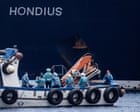
Five people who called a luxury cruise home for the last few weeks are about to trade their cabins for a government charter flight and a very long stint in isolation. The Australian government finally pulled the trigger on a rescue mission for four citizens and one permanent resident trapped on the MV Hondius. This isn't your standard medical evacuation. We're talking about a ship where a rare, deadly outbreak has already claimed three lives and left the rest of the passengers in a state of high-stakes limbo.
The plan is simple but strict. A private charter will scoop up the group from Tenerife in the Canary Islands and fly them directly to Perth. They won't be grabbing a coffee at the terminal or hugging family on the tarmac. Instead, they're heading straight into quarantine. If you're wondering why the response feels so aggressive, it's because hantavirus doesn't play around. With a mortality rate that can hit 40%, the authorities aren't taking any chances with "maybe" or "wait and see."
The reality of the MV Hondius outbreak
The MV Hondius started its journey as an ambitious Antarctic expedition, leaving South America on April 1. It was supposed to be a trip of a lifetime, hitting remote Atlantic outposts like South Georgia and Tristan da Cunha. Somewhere along that route, the virus hitched a ride.
Hantavirus is usually something you associate with dusty sheds or rodent-infested barns, not luxury polar vessels. It typically spreads when people breathe in air contaminated by the droppings or saliva of infected rodents. On a ship, that creates a nightmare scenario for containment. While human-to-human transmission is historically rare, this specific outbreak involves the Andes virus strain. This version, native to South America, is the outlier that can jump between people.
The numbers are sobering:
- Three confirmed deaths (including a Dutch couple and a German national).
- Eight total cases reported so far.
- 146 people caught in the middle of the Atlantic during the initial panic.
Why Australia is acting now
You might think five people is a small number for a dedicated charter flight halfway across the globe. But look at the logistics. Spanish authorities and the World Health Organization (WHO) have been incredibly cautious about letting anyone from the Hondius board a commercial flight. If even one asymptomatic carrier sat in an economy cabin for 14 hours, the contact tracing would be an international disaster.
Australia's five residents—hailing from New South Wales and Queensland—are currently the last ones left on the ship. Other nations like the US and UK already sent their own planes. Our lot will depart Tenerife on Monday at 5:00 PM local time. They're being joined by a New Zealand citizen, proving that the trans-Tasman bubble still holds up even in a viral crisis.
Managing the risk in Perth
When that plane touches down in Perth on Tuesday, the mission shifts from logistics to bio-containment. Even though the government says none of the five are currently showing symptoms, hantavirus is a slow burner. The incubation period can last anywhere from one to eight weeks. You can feel perfectly fine today and be in respiratory distress by next Friday.
The quarantine won't be at a standard hotel. Because of the nature of the virus, the passengers are being moved to dedicated medical facilities. The states—NSW and Queensland—are still hashing out the long-term details, but for now, Perth is the firewall. It's a heavy-handed approach, but when you're dealing with a virus that has no specific cure and can turn into Hantavirus Pulmonary Syndrome (HPS), "heavy-handed" is exactly what you want.
What this means for future cruising
If you've got a polar cruise booked, don't panic, but do pay attention. This outbreak is a freak occurrence, yet it highlights a massive gap in maritime health protocols. Most cruise ship "bugs" are norovirus—annoying, but rarely fatal. Hantavirus is a different beast entirely.
The source of the infection is still a mystery. Did rodents get into the ship’s stores in South America? Did someone pick it up while hiking on a remote island? While the ship heads to the Netherlands for a deep-clean disinfection that would make a lab tech blush, the rest of the industry is watching.
The five returning Australians face a grueling 45 days of monitoring. It's a long road back from what was supposed to be a dream vacation. For the rest of us, it’s a reminder that even the most secluded luxury travel isn't immune to the raw, unpredictable side of nature.
If you're currently traveling in South America or planning a remote expedition, keep your gear sealed and stay away from areas with visible rodent activity. It sounds like basic advice, but as the passengers of the MV Hondius learned, the smallest oversight can have global consequences.
Hantavirus outbreak passengers chartered home
This video provides additional context on the disembarkation process in the Canary Islands and the international effort to repatriate the stranded passengers.