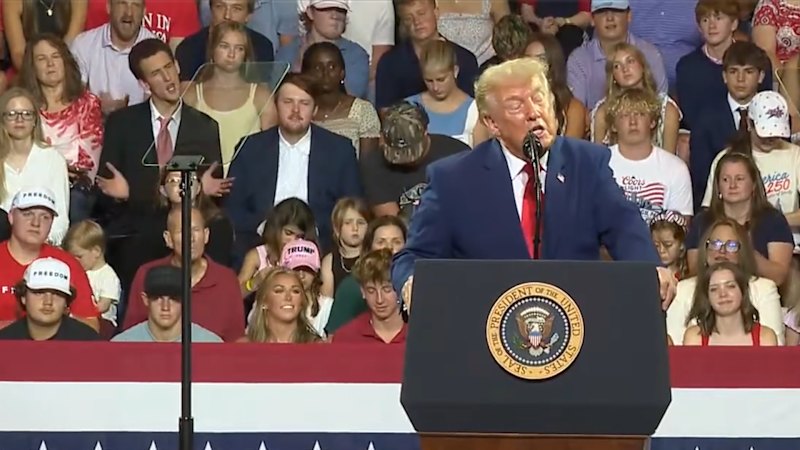
The Optical Illusion of the Background Distraction
Media outlets love a good camera-frame sideshow. A politician delivers a standard stump speech while someone directly behind them rolls their eyes, yawning, or smirking into the lens. Within twenty minutes, digital newsrooms crank out five hundred words on how the leader was "mocked" or "humiliated" by their own crowd.
It is lazy journalism. Worse, it completely misses how modern political optics actually operate.
When commentators fixate on a stray facial expression behind a podium, they treat a split-second viral moment as a organic rebellion. They assume the person behind the candidate represents a crack in the armor, an authentic burst of truth breaking through a scripted event.
I spent over a decade analyzing political broadcasts and rally logistics. Here is the uncomfortable truth: background spectators are rarely spontaneous, and their micro-expressions mean precisely zero to the audience that actually matters.
The Myth of the Unscripted Audience
Every major political campaign treats the camera background—commonly known in production as the "bleacher shot"—as high-value real estate. Advance teams spend hours vetting, placing, and instructing the individuals seated behind the microphone.
- The Uniform Aesthetic: Strategists deliberately mix age, gender, and racial demographics to build an ideal visual composite.
- The Color Palette: Attendees wearing loud brands, conflicting political attire, or distracting patterns are routinely moved out of the primary frame.
- The Energy Mandate: Staff explicitly instruct background guests to clap, nod, and maintain visual focus on the speaker.
Yet, despite rigorous screening, human beings fidget. People get tired standing under 500-watt lights for two hours. They pull faces. They check their phones. They react to side conversations in the arena that the television broadcast never picks up.
When a media outlet frames a tired spectator's eye-roll as a devastating critique of the speaker's platform, they confuse human fatigue with political resistance.
Why Viral "Gaffes" Build Brand Loyalty
The mainstream consensus assumes that getting mocked in your own background damages your credibility. The opposite is frequently true in modern high-polarization environments.
When an opposition media outlet runs a clip highlighting a spectator smirking behind a speaker, it triggers two distinct reactions:
- Opponents share the clip to reinforce their existing dislike, celebrating a perceived burn that changes zero minds.
- Supporters view the coverage as further proof that the media is petty, hyper-focused on trivialities, and incapable of engaging with actual policy statements.
By amplifying micro-distractions, commentators accidentally hand the candidate a classic defense: "They can't debate the message, so they attack a five-second clip of someone standing behind me."
It drives engagement, converts a non-event into a tribal battleground, and reinforces the candidate's core narrative of elite media hostility.
+-----------------------------------------------------------------------+
|                       THE VIRAL FEEDBACK LOOP                         |
+-----------------------------------------------------------------------+
|  1. Minor background movement occurs on camera                        |
|  2. Media frames movement as "widespread audience mockery"           |
|  3. Critics celebrate the clip; base views the coverage as petty      |
|  4. Candidate's core narrative of media bias is strengthened          |
+-----------------------------------------------------------------------+
The Real Power Mechanics of Bleacher Staging
If campaigns know that background spectators occasionally act up, why do they keep putting crowds directly behind the speaker?
Because the visual dividend outweighs the optical risk by a factor of ten.
A politician standing alone at a lectern looks like an isolated bureaucrat. A politician framed by an enthusiastic, dense wall of faces looks like the head of a movement.
The human brain processes visual cues faster than verbal arguments. When a viewer flips past a news channel, a packed bleacher shot instantly signals authority, popularity, and momentum. A stray smirk in row three does not alter that subconscious processing for 95% of viewers who watch without sound in a sports bar or doctor's waiting room.
Campaigns trade the risk of an occasional viral meme for the guaranteed benefit of perceived mass support.
Stop Reading the Faces in the Background
The hyper-analysis of background audience behavior is a symptom of a larger disease in political reporting: the reduction of substantive debate to body language analysis and high school drama.
Focusing on whether an audience member smirked, sighed, or checked their watch allows commentators to avoid analyzing the actual content of the address. It is cheap content creation that satisfies the demand for immediate outrage while offering zero actual insight into voter sentiment or strategy.
Next time a headline tells you a leader was "destroyed" or "mocked" by someone standing three feet behind them, ignore the narrative. Look at the framing, look at the staging, and realize you are watching a production strategy that achieved its exact goal: getting you to look at the candidate.
The audience behind the podium isn't the story. They are human wallpaper. Treat them accordingly.


