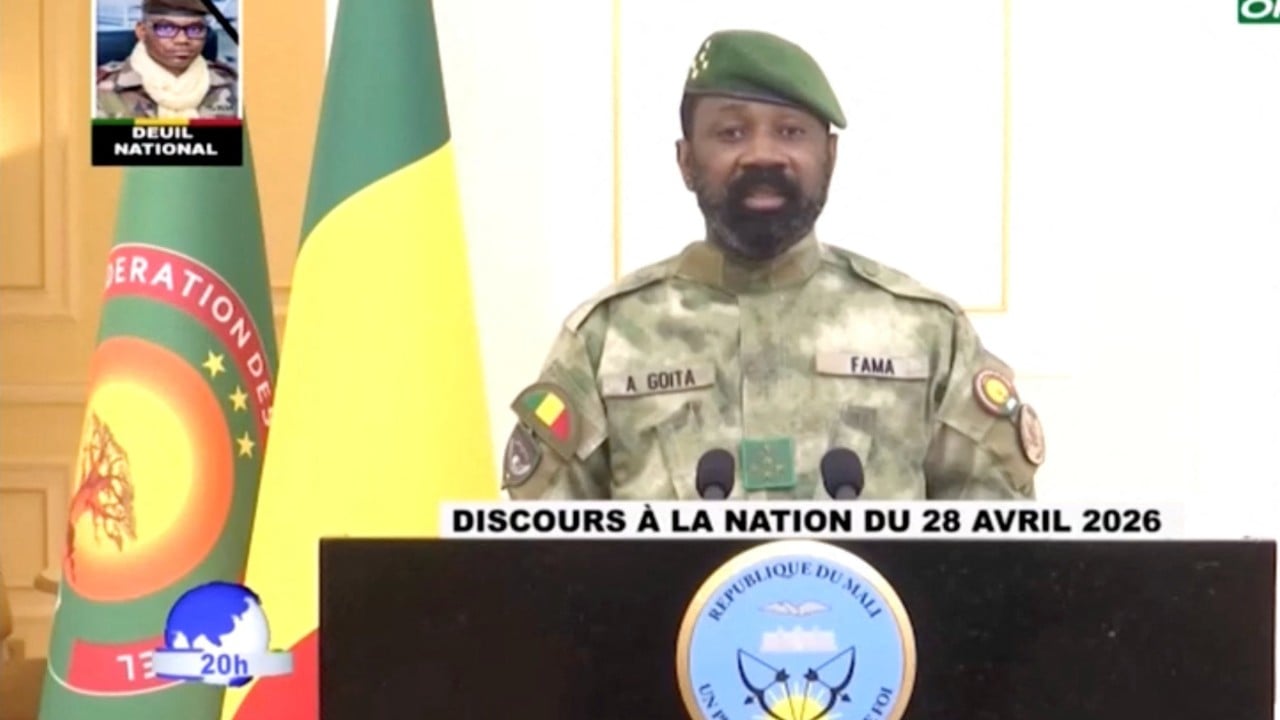
The image was meant to project absolute stability. Colonel Assimi Goïta, the transition president of Mali, appeared on state television looking unruffled, offering platitudes about the security situation being "under control." But the optics could not mask the smell of cordite still hanging over Bamako. Following a daring and coordinated strike by Al-Qaeda-linked militants on a top-tier military police academy and the airport, the junta’s narrative of a "secured" nation has effectively collapsed. While Goïta claims the state remains firm, the tactical ease with which insurgents penetrated the capital's most sensitive zones suggests a massive intelligence failure and a hollowed-out security apparatus.
This is no longer a localized insurgency confined to the desert fringes of the north. The war has arrived at the gates of the palace. You might also find this similar article interesting: Why China's Economic Carrots Won't Buy Taiwan in 2026.
The Myth of the Sovereign Shield
Since seizing power, the junta has staked its entire legitimacy on a single promise: security through sovereignty. They expelled French forces, sidelined UN peacekeepers, and invited Russian mercenaries from the Wagner Group (now rebranded as Africa Corps) to provide the muscle the West supposedly withheld. This "security first" mandate justifies the suspension of democratic norms and the indefinite delay of elections.
However, the recent attacks in Bamako expose a fatal flaw in this strategy. By centralizing power and focusing on high-profile offensive sweeps in the north, the junta has left the capital vulnerable. The insurgents of Jama'at Nusrat al-Islam wal-Muslimin (JNIM) didn't just attack a checkpoint; they filmed themselves lounging in the presidential hangar at the airport, burning a state aircraft. This wasn't just a military operation. It was a sophisticated PR hit designed to show that the "sovereign shield" is porous. As discussed in latest reports by The Washington Post, the implications are significant.
The military's reliance on Russian contractors has created a tactical imbalance. While Wagner's operatives are skilled in scorched-earth tactics and protecting specific mining assets, they lack the deep-rooted human intelligence networks required to prevent urban infiltration. You cannot hold a city of millions with a few hundred foreign contractors and a demoralized domestic gendarmerie.
A Failure of Intelligence or an Inside Job
In the aftermath of the Bamako breach, the question isn't just how the militants got in, but who let them. The Modibo Keita International Airport and the Faladié gendarmerie school are among the most heavily fortified sites in the country. To move the quantity of weapons and personnel required for such an assault through the numerous checkpoints surrounding Bamako requires either total incompetence or high-level complicity.
The Erosion of Professionalism
Under Goïta, the Malian Armed Forces (FAMa) have undergone a rapid politicization. Promotion is often tied to loyalty to the junta rather than tactical merit. This shift has several downstream effects:
- Intelligence Silos: Information is no longer shared across branches for fear of triggering a counter-coup, leaving the state blind to moving threats.
- Resource Drain: The best-equipped units are kept close to the capital to protect the leadership, yet even they failed to stop the JNIM incursion.
- Low Morale: Rank-and-file soldiers see the gap between the "victorious" state propaganda and the reality of the mounting body count in the hinterlands.
The junta's rhetoric blames "foreign powers" and "terrorist hydras" for every setback. This scapegoating is a tired tactic. It ignores the reality that the insurgency is fueled by internal grievances—marginalization, lack of justice, and a state that is often more predatory than protective in rural areas. When the state retreats to the capital and then fails to defend even that, the social contract is voided.
The Economic Cost of the Siege Mentality
Security does not exist in a vacuum. Mali is currently grappling with a dire economic crisis, exacerbated by regional sanctions and the cost of maintaining a war footing. The junta has diverted massive portions of the national budget toward defense spending and payments for Russian "instructors," leaving essential services to rot.
Bamako is plagued by frequent power cuts, some lasting for days. Inflation has made basic staples unaffordable for the average family. By framing every critic as a traitor or a French puppet, Goïta has stifled the very discourse needed to address these systemic failures. The "under control" narrative is a luxury the starving population cannot afford.
The airport attack also strikes at the heart of Mali’s remaining international links. Logistics companies and the few remaining foreign investors view the airport as the final "green zone." If the tarmac isn't safe, the country is effectively an island. The economic isolation resulting from this perception of instability will do more to undermine the junta than any rebel group ever could.
The Wagner Variable
The partnership with Russia was supposed to be the "game-changer" that the junta promised. Instead, it has become a liability. Russian tactics often involve heavy-handed operations that result in significant civilian casualties, such as the 2022 massacre in Moura. These actions serve as the ultimate recruitment tool for groups like JNIM and the Islamic State in the Greater Sahara (ISGS).
Furthermore, the recent defeat of Malian forces and their Russian allies in Tinzaouaten, near the Algerian border, showed that the FAMa-Wagner duo is not invincible. The loss of dozens of personnel and sophisticated equipment in a Tuareg ambush shattered the aura of momentum the junta had cultivated. The Bamako attack was the second half of that one-two punch, proving that the state is losing ground in both the northern deserts and the southern urban centers.
Regional Isolation and the AES Experiment
Mali, alongside Burkina Faso and Niger, has formed the Alliance of Sahel States (AES), a pact that formally severs ties with the regional bloc ECOWAS. This was sold as a move toward "true independence." In practice, it has left Mali without the regional intelligence-sharing and cross-border cooperation necessary to track mobile militant groups.
Insurgents don't care about the new borders drawn by the AES. They move freely between Mali, Niger, and Burkina Faso, exploiting the gaps left by the withdrawal of regional and Western support. Goïta’s insistence that Mali can go it alone—with only Moscow for company—is a gamble that looks increasingly reckless. The junta is essentially betting the house on a narrow military solution to a problem that is fundamentally political and social.
The Fragility of the "Under Control" Narrative
When a leader says a situation is "under control" while smoke is still rising from his military bases, he is not talking to the international community. He is talking to his own officers. Goïta’s primary concern isn't the JNIM; it’s the threat of a palace coup from within his own ranks.
History in Mali shows that when the military feels the leadership is failing them on the battlefield, the leadership changes. Goïta himself came to power this way. He knows better than anyone that a colonel who cannot protect the capital is a colonel who cannot hold onto power.
The recent televised appearance was a performance of strength, but the cracks are visible. You cannot talk away the loss of air assets. You cannot talk away the fact that militants were able to walk into the heart of the security state and stay there for hours. The "control" Goïta speaks of is a thin veneer, a fragile consensus among the ruling elite that is being tested by every new casualty report.
Mali is not a country under control. It is a country in a state of high-velocity erosion, led by a group that has traded long-term stability for short-term survival. The militants have proven they can strike when and where they please. The next move won't be a televised speech; it will be a desperate attempt by the junta to tighten the screws on a population that is quickly losing its patience.