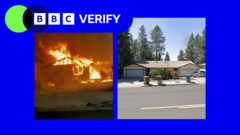
The satellite imagery tells one story. The charred foundations, the melted aluminum wheels of commuter sedans, and the skeletal remains of chimney stacks tell another. When a wildfire sweeps through a Pacific Northwest suburb, the immediate public fascination fixates on the before and after photographs. We stare at side-by-side frames of leafy neighborhoods replaced by moonscapes of ash, searching for a visual shorthand to process the sheer scale of the loss.
Those images are deceptive. They treat a complex environmental and urban planning failure as if it were a sudden act of God, a bolt of lightning descending from a clear blue sky to ruin everything in its path.
The Spokane wildfire disaster was not a freak accident. It was the predictable mathematical outcome of decades of municipal zoning decisions, aggressive fire suppression policies, and an escalating climate volatility that local authorities failed to match with equal urgency.
When you strip away the smoke and look at the municipal records, a starkly different reality emerges. This is an investigative breakdown of how Spokane became a tinderbox, why standard emergency protocols failed when every second counted, and what this catastrophe reveals about the future of suburban expansion in the American West.
The Geography of Neglect
Spokane sits in a unique topographical trap. Surrounded by rolling hills, dense pine forests, and dry grasslands, the region has always experienced seasonal fire cycles. For thousands of years, low-intensity ground fires cleared out dead timber and maintained a natural equilibrium.
Then humans arrived with subdivisions.
During the rapid real estate expansion of the late twentieth and early twenty-first centuries, developers pushed deeper into the wildland-urban interface. They built cul-de-sacs directly against dense timber tracts, often marketing the proximity to nature as the primary selling point. Homebuyers wanted the pine trees in their backyards. They did not want the liability that came with them.
Municipal planning departments approved these projects without enforcing mandatory defensible space buffers. Builders used standard asphalt shingles and wooden siding, materials that act as fuel when airborne embers travel miles ahead of the actual fire front.
When the Spokane wildfire sparked, it did not move like a wall of roaring flames. It moved as a relentless storm of burning brands. These embers rained down on wood-shake roofs and accumulated in dry pine needles packed neatly into rain gutters.
Houses did not burn because a wall of fire rolled over them. They burned from the roof down, ignited by thousands of tiny, glowing coals that outpaced the wind and bypassed the fire lines established by crews miles away.
The Infrastructure Bottleneck
Emergency evacuation exposed a secondary vulnerability that local officials had quietly ignored for years. Many of the neighborhoods hardest hit by the Spokane wildfire featured single-access entry roads.
Urban planners call this the cul-de-sac trap.
When the evacuation order finally flashed across mobile phones, thousands of residents attempted to flee simultaneously down narrow, winding two-lane roads flanked by burning brush. Traffic stalled within minutes. Residents abandoned their vehicles on the shoulders, turning escape routes into linear parking lots of trapped steel and glass.
Fire engines trying to push inward to combat structural blazes found themselves blocked by panicked civilians moving outward.
The structural failure of the evacuation plan highlights a dangerous disconnect between civil engineering and emergency preparedness. Cities across the West continue to approve housing developments with inadequate egress routes, prioritizing developer profit margins over public safety.
Emergency management agencies knew these choke points existed long before the fire started. Annual risk assessments routinely flagged these neighborhoods as high-consequence zones. Yet, retrofitting evacuation roads requires millions of dollars in eminent domain seizures and road widening projects, money that local governments routinely allocate elsewhere until the ash settles and the lawsuits begin.
The Myth of Complete Suppression
For over a century, the dominant paradigm in American forestry was absolute suppression. Every spark was an enemy to be annihilated immediately.
This policy created a massive ecological debt. Forests that historically supported forty trees per acre now groaned under the weight of four hundred trees, competing desperately for dwindling groundwater. Dead underbrush accumulated unchecked, turning the forest floor into a powder keg.
When a wildfire finally breaches containment lines in an over-suppressed forest, the energy release is exponential. Modern mega-fires burn so hot they create their own weather systems, generating pyrocumulonimbus clouds that hurl burning embers miles into the air.
Firefighters on the ground in Spokane found themselves facing conditions that defied their training manuals. Water drops from helicopters evaporated before hitting the flames. Radiant heat melted the face shields on protective gear fifty feet away from the actual fire front.
The traditional model of dispatching trucks and pouring water on hotspots is obsolete when confronting fires fueled by decades of accumulated timber and prolonged regional droughts.
The Economic Aftermath
The true cost of the Spokane wildfire will not be measured in the immediate days following the containment. It will echo through insurance markets and municipal budgets for the next decade.
Insurance carriers have quietly pulled out of fire-prone regions across California and Oregon, and the Pacific Northwest is rapidly becoming the next casualty. Homeowners returning to their charred properties in Spokane are discovering that even if their policies are honored, the replacement cost to rebuild to modern, fire-resistant standards far exceeds their coverage limits.
Those who manage to renew their policies are facing premium spikes of three hundred percent or more.
This creates a slow-motion economic displacement. Lower-income families who owned homes outright or held modest mortgages cannot afford the cost of rebuilding with steel framing, non-combustible siding, and dual-pane tempered glass. They sell their land at a fraction of its pre-fire value to speculative developers, accelerating gentrification disguised as recovery.
The Hard Truth About Mitigation
Preventing the next Spokane wildfire requires abandoning comforting illusions. Thinning forests and performing controlled burns are messy, expensive, and politically unpopular. Smoke from prescribed burns upsets residents and impacts local tourism, leading politicians to defund or delay preventative treatments.
Zoning laws must change. Local governments need the political courage to ban wood-shake roofs and mandate perimeter clearances, even if it pisses off homeowners who value their backyard privacy over collective survival.
Until municipal leaders treat wildfire mitigation as a core piece of public infrastructure rather than an optional landscaping choice, the before and after photographs will keep repeating across the American landscape. Every few years, a new set of neighborhoods will be reduced to ash, and we will act surprised when the wind blows.