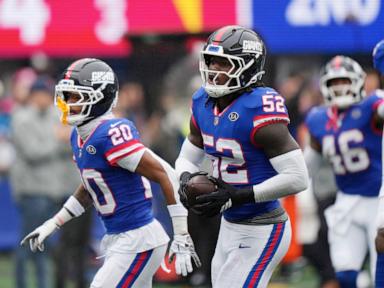
When the New York Giants spent the fifth overall pick in the 2026 NFL Draft on Arvell Reese, scouts knew they were getting an absolute physical freak. At 6-foot-4 and 243 pounds, the former Ohio State star ran a scorching 4.46-second forty-yard dash. Numbers like that usually belong to elite secondary players, not front-seven thumpers. Yet skeptics always wonder if raw traits can translate into every-down value right away.
Then came the matchup against Philadelphia.
If you watched Reese dismantle the Eagles with twelve tackles, three sacks, and a forced fumble that swung the momentum, you stopped asking if he could handle every down. You started wondering how offensive coordinators are supposed to block him.
The Myth of the Specialized Linebacker
For years, defensive coordinators faced a frustrating trade-off. You either put a heavy, traditional linebacker on the field who could stop the run but got exposed in space against slot receivers, or you played a hybrid safety type who could cover but got bullied in the trenches.
Reese wrecks that entire dilemma.
Against Philadelphia, defensive coordinator Dennard Wilson didn't just use Reese as a standard middle linebacker tracking running backs. He deployed him all over the formation. Sometimes Reese lined up inside to stuff gaps, and other times he walked up as an edge rusher to overwhelm protection schemes.
When a rookie can register double-digit tackles while simultaneously collapsing the pocket from completely different alignments, your defensive playbook opens up exponentially. You don't have to sub him out in passing situations. You don't have to hide him in heavy packages. He stays on the field because his skill set covers every possible threat an offense can throw at him.
Decoding the Versatility
What makes Reese's every-down viability so dangerous isn't just his speed—it's his processing speed. Too many young linebackers rely purely on athletic traits, getting caught out of position when offenses run complex misdirection.
Reese plays with a controlled violence that belies his age. When he shoots through an interior gap, he breaks down cleanly instead of overrunning the play. When he drops into zone coverage, his length erases passing lanes that quarterbacks think are open.
Take his early-season breakout against Arizona, where he logged nine tackles, three pass deflections, and an interception. That box score highlights a crucial truth. Linebackers who only rack up tackles are dime-a-dozen. Linebackers who can flip their hips, match tight ends downfield, and disrupt passing rhythms are franchise cornerstones.
The Giants didn't draft him to play a rotational role. They drafted him to anchor a defense for the next decade. Performances like the one in Philadelphia prove the front office's vision wasn't a gamble—it was an accurate read on where the modern NFL position is heading.
What This Means for the Giants Defense
For a franchise that has spent years searching for a defensive identity, having an anchor who requires pre-snap identification on every single play changes everything. Opposing quarterbacks have to point him out, running backs have to account for him in chip-blocking assignments, and coordinators have to waste valuable installation time figuring out where alignment shifts might happen.
You're seeing a player dictate terms to the entire opposing offense. That is rare for any rookie, let alone someone adjusting to the speed of the professional game.
The physical traits got him drafted fifth overall. His instincts and multi-faceted production are keeping him on the field for every crucial snap. Keep tracking how defensive staffs utilize his range over the rest of the season, because the blueprint for defending modern NFL offenses is shifting right in front of us.