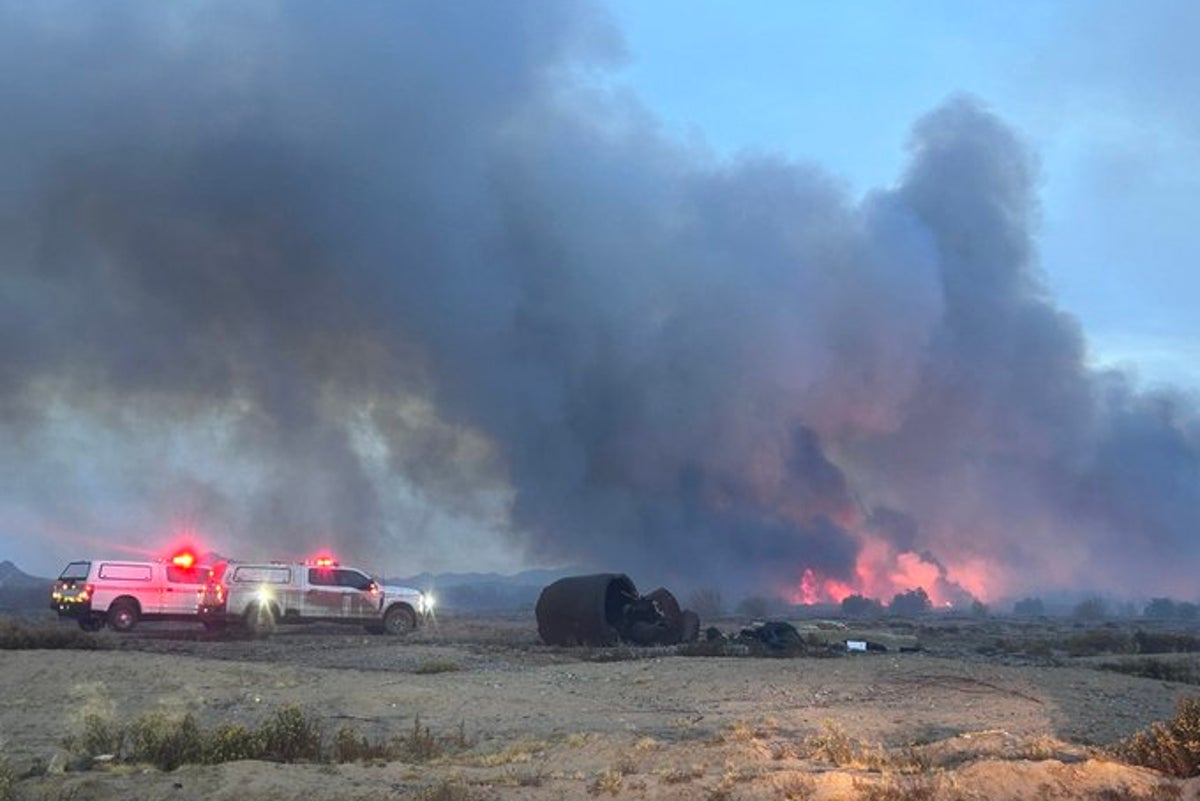
The rapid expansion of the current wildfire in Arizona, which has already consumed nearly 1,000 acres of parched terrain, is not a freak accident of nature. It is the predictable outcome of decades of failed federal land management and a crumbling infrastructure that can no longer contain the predictable results of a drying Southwest. While local residents describe the scene as a war zone, the reality is more akin to a long-neglected powder keg finally meeting a match. Firefighters are currently struggling to establish containment lines as high winds and low humidity turn small spot fires into massive walls of flame that jump highways and firebreaks with ease.
The Myth of the Unstoppable Blaze
Public officials often point to climate shifts as the sole culprit for these massive fires. This narrative is convenient because it shifts the blame away from policy failures and onto global forces beyond local control. However, the true story lies beneath the canopy. For over a century, the United States Forest Service followed a policy of total fire suppression. They put out every flicker, every spark, and every natural burn.
This sounds logical to the average person. We see fire as the enemy. But in the Ponderosa pine forests of the Southwest, fire is a biological necessity. By stopping the small, low-intensity burns that naturally clear out needles and saplings, the government effectively stockpiled fuel. Today, the Arizona wilderness is packed with ten times the amount of timber and brush it would have carried in the year 1900. When a fire starts now, it doesn't just crawl along the ground. It climbs "ladder fuels"—shrubs and low branches—and reaches the crowns of the trees. Once a fire becomes a crown fire, it creates its own weather patterns and becomes nearly impossible to stop until it runs out of things to burn.
A War Zone by Design
The "war zone" imagery used by those on the ground is accurate in its chaos, but the comparison falls short in one key area. In a war, there is a strategy for victory. In the current fight against Arizona’s wildfires, the strategy is almost entirely reactive.
Resources are stretched thin across the Western United States. When a fire hits the 1,000-acre mark in a matter of hours, the demand for Type 1 Incident Management Teams—the elite coordinators of fire suppression—skyrockets. But there are only so many air tankers and hotshot crews to go around. We are seeing a breakdown in the logistical chain. Crews are being asked to defend homes built in the "Wildland-Urban Interface," or WUI. This is the danger zone where residential development meets raw wilderness.
State and local governments have permitted massive housing developments in areas that are biologically meant to burn. When a fire breaks out, firefighters cannot focus on containing the perimeter. They are forced into "structure protection," a dangerous and often futile effort to save houses built with flammable materials in the middle of a forest. This draws resources away from the actual fire line, allowing the main blaze to grow exponentially.
The Cost of Hesitation
Thinning projects and prescribed burns are the only proven ways to reduce the intensity of these fires. Yet, these projects are frequently tied up in years of litigation and bureaucratic red tape. Environmental groups often sue to stop logging or thinning operations, fearing the impact on local habitats. While their intentions may be to protect the forest, the result is the opposite. A thinned forest survives a fire; a neglected forest turns into a moonscape of ash and sterilized soil where nothing will grow for decades.
The financial math is equally grim. It costs a fraction of the price to thin an acre of forest compared to the cost of fighting a fire on that same acre. We are spending billions on the "cure" while starving the "prevention."
The Logistics of the Current Front Line
The current blaze in Arizona is being driven by a specific set of meteorological conditions known as "red flag" days. In these windows, the relative humidity drops into the single digits. The air becomes so dry that it sucks the remaining moisture out of every twig and leaf.
Ground crews are facing uphill battles, literally. Fire moves faster uphill because it pre-heats the fuel above it. As the flames tilt toward the slope, the heat rises and dries out the brush just inches away from ignition. By the time the fire arrives, the fuel is ready to explode.
Air support is often grounded during the most critical phases of these fires. High winds make it too dangerous for heavy tankers to fly low enough to drop retardant. Even when they do fly, the retardant is not a "fire extinguisher." It is a chemical barrier designed to slow the spread so that ground crews can move in with shovels and chainsaws. If the wind is blowing at 40 miles per hour, the fire simply blows embers right over the retardant lines.
The Human Element
We cannot ignore the fact that the majority of these fires are human-caused. Whether it is a poorly extinguished campfire, a chain dragging on the asphalt, or a stray cigarette, the ignition point is usually a result of negligence. However, a spark only becomes a 1,000-acre disaster if the environment allows it.
The focus on the "spark" distracts from the "fuel." If we lived in a state with healthy, managed forests, that same spark might burn a few dozen acres of grass and die out against a stand of widely spaced trees. Instead, we have created a landscape where a single mistake leads to an evacuation order for thousands of people.
Redefining Recovery
When the smoke finally clears, the narrative usually shifts to "recovery." This is another area where we are failing. Current recovery efforts focus on rebuilding the same homes in the same locations with the same risks. There is little talk of changing zoning laws or requiring "fire-wise" construction, such as metal roofs and cleared defensible space.
The soil itself suffers the most. In high-intensity fires, the heat is so intense that it creates a "hydrophobic" layer. The soil becomes like plastic, unable to absorb water. When the summer monsoons hit Arizona following a fire, the water doesn't soak in. It sheets off the mountain, creating massive debris flows and flash floods that kill people miles away from the original burn site.
The Necessary Shift in Strategy
Stopping these 1,000-acre explosions requires a fundamental shift in how we view the American West. We have to stop treating fire as a surprise. It is a recurring, certain reality of the geography.
The following steps are the only way to break the cycle:
- Massive Investment in Mechanical Thinning: We must physically remove the excess biomass from the forests surrounding our communities. This isn't about commercial logging; it's about public safety.
- Reform the Litigation Process: Forest management projects that have passed environmental reviews should not be stalled for years by repetitive lawsuits.
- Update Building Codes: If you choose to build in the forest, your home should be held to the same fire-resistance standards as a commercial building in a city center.
- Direct Funding to Prescribed Burning: We need to burn on our own terms during the winter and spring so we don't have to fight fires on the forest's terms in the summer.
The current fire is still spreading. It will likely get much larger before it is contained. While we praise the bravery of the men and women on the line, we must also criticize the leaders who sent them there with a losing hand. We are not just fighting a fire; we are fighting the consequences of our own inaction.
Stop looking at the flames and start looking at the thickets of dry, dead wood that allowed them to roar in the first place.