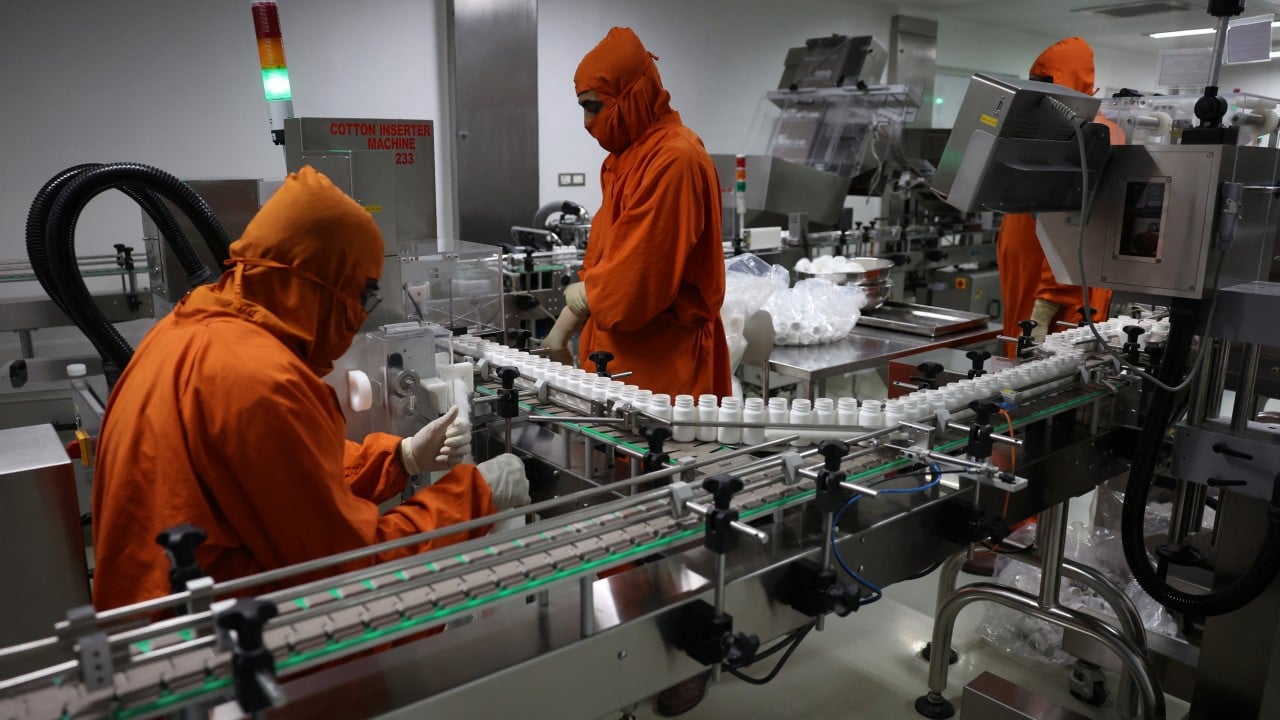
The announcement of a phased, escalating tariff schedule targeting foreign generic medicines in the United States upends decades of structural cost-containment in Western healthcare. Under the white house framework, imported generic drugs maintain a zero-percent duty for a two-year runway ending in August 2028, after which rates climb to 100 percent, followed by an escalation to 200 percent in August 2029. This policy directly targets the foundational architecture of the global pharmaceutical supply chain, where Indian manufacturers supply roughly 47 percent of all generic prescriptions dispensed in the United States. Evaluating whether this policy terminates India's status as the pharmacy of the world requires examining capital expenditure constraints, regulatory approval friction, and active pharmaceutical ingredient dependencies that policymakers frequently omit.
The Three Structural Pillars of U.S. Generic Reliance
The American healthcare system operates on a margin-thin generic drug market where low acquisition costs are treated as an entitlement. Three variables explain why structural reliance on foreign manufacturing is deeply entrenched:
- Labor Arbitrage and Scale Economics: Indian facilities achieve marginal costs per dose that domestic U.S. plants cannot match without total automation overhaul. High-volume continuous manufacturing lines located in Gujarat and Hyderabad benefit from optimized facility utilization rates running near 85 to 90 percent.
- Regulatory Familiarity: Major Indian pharmaceutical firms possess decades of experience navigating United States Food and Drug Administration compliance, maintaining hundreds of approved Abbreviated New Drug Applications.
- Payer Acceptance: Pharmacy benefit managers and health insurers rely on low-cost generic drugs to keep premium increases manageable. Replacing these supply streams overnight introduces severe cost-push inflation.
Despite these advantages, the tariff threat shifts the corporate calculus from operational efficiency to geopolitical risk mitigation. The policy operates less as a traditional revenue-generating tax and more as a penalty mechanism designed to force capital expenditure into domestic brick-and-mortar facilities.
The Cost Function of Domestic Reshoring
The primary economic fallacy in assuming immediate onshoring is the timeline mismatch between policy execution and facility validation. Constructing, equipping, and validating a sterile injectable or solid oral dose facility in the United States involves a rigorous multi-year sequence.
[Policy Announcement (2026)] ---> [2-Year Zero-Duty Window] ---> [100% Tariff (2028)] ---> [200% Tariff (2029)]
          |                                                                                             ^
          +-------------------> [3 to 5 Year FDA Facility Validation Timeline] -------------------------+
A greenfield tablet manufacturing plant requires three to five years to reach commercial supply status under current regulatory requirements. Sterile injectable and complex biologic facilities require up to seven years. Because a manufacturing site is legally bound to the drug's regulatory filing, a pharmaceutical company cannot simply redirect production lines overnight when tariffs escalate.
Furthermore, building physical structures inside the United States does not decouple domestic production from foreign supply chains. The United States remains heavily dependent on China and India for active pharmaceutical ingredients and raw chemical starting materials. If a domestic U.S. plant must import its basic chemical building blocks under separate trade restrictions, the final cost of the domestic generic drug will reflect both domestic labor overhead and imported chemical duties.
Margin Compression and Market Dislocation
When the 100 percent tariff threshold takes effect in August 2028, the financial impact will not distribute evenly across all product categories. Commodity small-molecule oral solids operate on razor-thin margins. Doubling the import duty instantly eliminates profitability for these items, forcing manufacturers into a binary choice: absorb the cost penalty, raise prices to patients, or discontinue the product line entirely.
Discontinuation of low-margin, single-source sterile injectables and older cancer generics poses a systemic danger to the U.S. healthcare infrastructure. The market already suffers from chronic shortages in these exact categories because low pricing provides zero incentive for redundancy. Imposing steep tariffs on products that have no alternative domestic manufacturer exacerbates hospital-level supply shocks rather than driving local production.
Differential Regional Impacts
The policy structure creates an uneven playing field through international trade agreements. Under existing frameworks such as the United States-European Union trade arrangements, European generic competitors may face vastly different duty structures or exemptions compared to Asian exporters. If European manufacturers secure exemptions while Indian firms absorb the full force of the 100-percent and 200-percent penalties, global market share will reallocate across geographic borders rather than shifting onshore to American soil.
Strategic Play for Pharmaceutical Executives
Executives managing portfolios exposed to these tariffs must act during the two-year grace period rather than waiting for regulatory deadlines. The optimal operational response requires a three-tier pivot:
- Portfolio Triage: Audit the current Abbreviated New Drug Application portfolio to isolate low-margin, single-source products that cannot absorb a cost multiplier. Divest or reprice these lines before the August 2028 deadline.
- Geographic Diversification of Active Ingredients: Accelerate secondary sourcing for raw chemical precursors outside concentrated regional clusters to mitigate upstream supply vulnerabilities.
- Targeted Joint Ventures: Partner with domestic contract development and manufacturing organizations inside the United States to secure localized manufacturing slots now, insulating high-value complex generics from impending tariff walls.
The policy will not terminate the global trade of medicine, but it permanently alters asset allocation. Supply chain strategy must treat trade policy volatility as a core operational variable rather than an external shock.