The Murphy Mechanism of Comedy Dominance
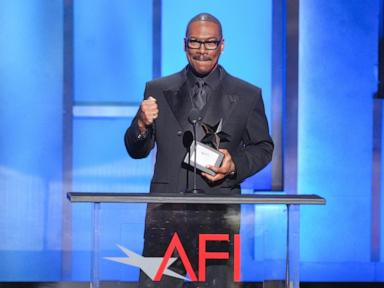
The American Film Institute (AFI) Life Achievement Award bestowed upon Eddie Murphy is not merely a celebration of longevity; it is a recognition of a specific economic and cultural pivot point in the global entertainment industry. To understand the standing ovation at the Dolby Theatre, one must move past the sentimentality of the event and analyze the structural shifts Murphy forced upon Hollywood. Murphy’s career serves as a case study in the transition from the traditional studio system to the era of the high-leverage superstar-producer.
The logic of Murphy’s impact can be broken down into three distinct operational pillars: The Saturday Night Live (SNL) Restoration, The R-Rated Blockbuster Paradigm, and The Multiversal Performance Model. Each of these pillars solved a specific crisis in the film and television markets of the 1980s and 90s, creating a blueprint that still dictates how talent-led franchises are built today. Recently making news lately: Why Extreme Rooftopping Proposals Are Running Out of Room.
Pillar I The SNL Restoration and the Logic of Talent Monopolies
In 1980, Saturday Night Live faced an existential threat following the departure of its original cast and creator. The show’s survival depended on the discovery of a singular talent capable of maintaining viewership during a period of creative volatility. Murphy did not just fill a slot; he achieved a talent monopoly.
The Value Capture of "The Murphy Era"
During his tenure, Murphy’s presence created a disproportionate value-to-cost ratio. While the ensemble format usually distributes risk across multiple performers, the "Murphy Era" consolidated risk and reward into a single asset. This concentration of viewership led to: Additional information on this are covered by The Hollywood Reporter.
- Platform Stabilization: Preventing the cancellation of a foundational NBC asset.
- Brand Transferability: Proving that television sketches could be converted into high-intent moviegoing audiences.
- The Velocity of Character Development: Murphy’s ability to generate distinct, recurring intellectual properties (IP) within a 90-minute live window became the R&D lab for his future film career.
The standing ovation at the AFI ceremony acknowledges this historical rescue mission. Without the Murphy stabilization of SNL, the pipeline for sketch-to-cinema transitions—which later fueled the careers of Mike Myers, Adam Sandler, and Will Ferrell—would likely have been severed or significantly delayed.
Pillar II The R-Rated Blockbuster Paradigm
Before Murphy, the industry operated under the assumption that high-grossing films required a PG or G rating to maximize the Total Addressable Market (TAM). Murphy’s filmography, specifically 48 Hrs. and Beverly Hills Cop, shattered this constraint by proving that an R-rated lead could achieve "four-quadrant" appeal (men/women over/under 25).
The Mechanics of the Beverly Hills Cop Disruption
The success of Beverly Hills Cop (1984) was not an accident of charisma; it was a masterclass in tone-shifting that expanded the commercial boundaries of the action-comedy genre.
- Genre Hybridization: The film combined the stakes of a procedural thriller with the timing of a stand-up routine. This reduced the "friction" for audiences who found pure action too grim or pure comedy too light.
- Cultural Arbitrage: The script’s central tension—the juxtaposition of Detroit street smarts against Beverly Hills opulence—served as a social commentary that resonated across class lines, effectively scaling the film's relevance beyond a niche urban demographic.
- Capital Efficiency: By relying on Murphy’s verbal improvisation rather than expensive practical effects (the standard for 80s action), the production achieved high margins. Beverly Hills Cop grossed over $316 million on an estimated $13 million budget, representing a Return on Invested Capital (ROIC) that redefined studio expectations for R-rated content.
The AFI's recognition signals the industry's debt to this model. Murphy proved that a performer’s "voice" could be a more valuable visual effect than an explosion, a realization that paved the way for the dialogue-heavy blockbusters of the modern era.
Pillar III The Multiversal Performance Model
The third pillar of Murphy’s career is the technological and performative innovation seen in films like The Nutty Professor and Coming to America. In these projects, Murphy utilized makeup and prosthetics not for aesthetic shock, but to act as his own ensemble.
The Unit Economics of the Multiple Character Strategy
From a production standpoint, having a single actor play seven characters is a complex logistical challenge with significant financial implications.
- Risk Mitigation: By playing multiple roles, Murphy ensured that the "chemistry" between characters was always optimal, as it was controlled by a single creative mind.
- Marketing Maximization: Each character served as a separate entry point for different audience segments. In The Nutty Professor, the "Klump Family" dinner table scene became a standalone viral asset long before the term existed.
- Technical Benchmarking: These films pushed the boundaries of split-screen photography and motion control, forcing the industry to innovate in post-production workflows to keep up with Murphy's speed of performance.
This was not "stunt casting." It was an exercise in extreme brand leverage. Murphy was essentially competing with himself, capturing a larger share of the audience's attention by filling every role that might otherwise have gone to a secondary star.
The Strategic Pivot to Prestige and the "Dolemite" Rebirth
The standing ovation at the AFI event is also a response to Murphy’s successful "Third Act" pivot. Following a period of commercial cooling in the 2010s, Murphy utilized a sophisticated content strategy to re-establish his market position.
The Netflix Arbitrage
The production of Dolemite Is My Name (2019) represented a shift from the theatrical "tentpole" model to the "prestige-streaming" model. Murphy identified a gap in the market: the sophisticated, adult-oriented biopic that traditional studios were increasingly hesitant to greenlight.
By partnering with Netflix, Murphy secured:
- Creative Sovereignty: The freedom to pursue a passion project without the pressure of a massive opening weekend.
- Global Distribution: Immediate access to a global subscriber base, bypassing the international distribution hurdles that often plague comedies.
- Critical Recalibration: The film reminded critics and Academy voters of his range, leading directly to his 2020 Emmy win and the momentum that culminated in the AFI Life Achievement Award.
This phase of his career demonstrates an acute understanding of "Brand Equity Management." Rather than continuing to chase the diminishing returns of the family-comedy sequels that dominated his mid-career, Murphy reinvested in his "legacy" assets—his ability to inhabit complex, flawed, and deeply human characters.
Structural Constraints and the Limitations of the Murphy Model
While the AFI tribute highlights the successes, a rigorous analysis must acknowledge the limitations of the talent-centric model Murphy pioneered. The reliance on a single "mega-star" creates a single point of failure. If the star’s personal brand suffers or if their creative instincts miss the cultural zeitgeist (as seen with The Adventures of Pluto Nash), the financial downside is catastrophic for the studio.
Furthermore, the "Murphy Model" is historically difficult to replicate. It requires a rare confluence of:
- Precocious mastery of live performance.
- The ability to bridge racial and cultural divides without diluting the core message.
- The stamina to navigate the transition from a performer-for-hire to a global IP architect.
Most modern attempts to manufacture a "new Eddie Murphy" fail because they focus on the superficial aspects—the humor or the multiple characters—without understanding the underlying structural logic of genre hybridization and capital efficiency.
The Definitive Strategic Forecast
The AFI Life Achievement Award is more than a trophy; it is a lagging indicator of Murphy’s role as the architect of the modern star-led ecosystem. His career trajectory suggests a final phase characterized by Legacy IP Optimization.
We are currently seeing the execution of this strategy through projects like Coming 2 America and the fourth Beverly Hills Cop installment. The logic here is clear:
- Monetizing Nostalgia: Extracting value from high-equity brands built decades ago.
- Intergenerational Onboarding: Using established characters to introduce his brand to Gen Z audiences on streaming platforms.
- The "Elder Statesman" Premium: Transitioning from the high-energy disruptor to a curated icon, which allows for higher-margin deals with lower physical production demands.
The standing ovation in 2026 confirms that the market has fully priced in Murphy’s historical value. The strategic move for the industry now is to study the Murphy blueprint not for its jokes, but for its lessons in platform stabilization, genre expansion, and the aggressive management of personal brand equity. The next evolution of the superstar will not look like Eddie Murphy, but they will operate according to the financial and structural rules he wrote.