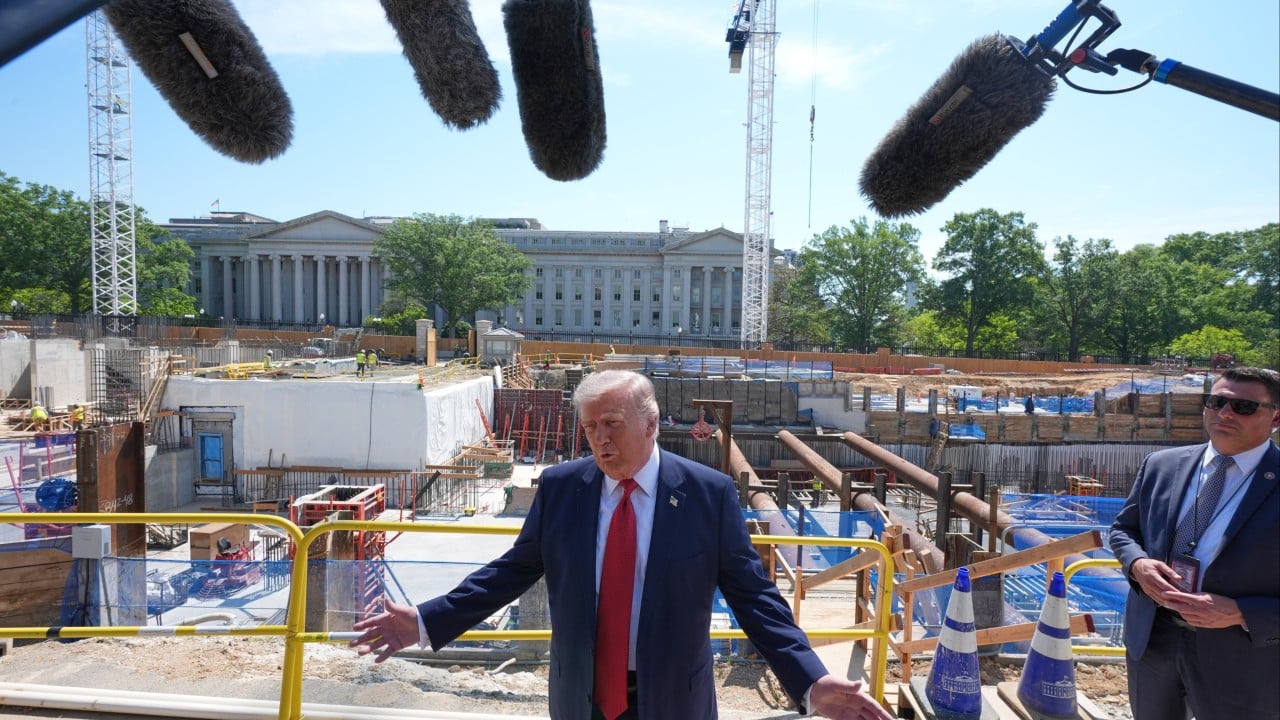
The physical manifestation of executive power requires an equilibrium between public diplomacy and absolute survivability. The structural overhaul adjacent to the White House executive mansion—publicly framed around a 90,000-square-foot state ballroom—represents a fundamental realignment of presidential continuity of government (COG) infrastructure. Beneath the aesthetic shell of a privately funded entertainment venue sits a multi-story, military-grade subterranean fortress designed to counter 21st-century asymmetric threats.
To understand this project, analysts must look past political rhetoric and evaluate the structural, financial, and strategic mechanics driving the development. You might also find this similar coverage insightful: The Shift in the Silicon Valley Silence.
The Dual-Layer Structural Framework
The design relies on a dual-layer survival architecture. The above-ground ballroom and the six-story subterranean complex are not distinct architectural choices; they function as an integrated defensive system.
[Above-Ground: 90,000 sq ft Ballroom] -> Functions as a sacrificial protective blast shield
       │
       ▼ [4-Inch Bulletproof Glass & Impenetrable Steel Roof]
       │
[Subterranean: Six-Story Military Fortress] -> Contains PEOC, Hospital, & Bio-Defense Hub
The 90,000-square-foot ballroom acts as a sacrificial protective barrier for the primary asset below. In structural defense engineering, this is known as a shielding layer. By building an reinforced structure on the surface, the kinetic energy of an aerial bombardment or drone strike is absorbed before it can fracture the subterranean concrete caps. As extensively documented in recent coverage by CNET, the results are worth noting.
Hardened Surface Defense Vectors
The surface layer integrates three specific hardening mechanisms:
- Kinetic Deflection Roofing: Described as "impenetrable steel," the roof geometry and material composition are engineered to neutralize small unmanned aerial systems (sUAS). The primary mechanic relies on deflection and pre-detonation—causing airborne threats to explode or ricochet off the surface without transferring kinetic energy to the primary structural columns.
- High-Performance Glass Envelope: The windows utilize four-inch-thick optical-grade ballistic glass. This material balances visual clarity with structural integrity, designed to withstand overpressure waves from close-proximity blast overpressures and repeated impacts from high-velocity kinetic rounds.
- Perimeter Inertial Barriers: The newly installed titanium fencing functions as an anti-ram barrier. The structural yield strength of titanium alloy guarantees that the fence can absorb and dissipate the kinetic energy of heavy vehicle ramming attempts, securing the structural perimeter from ground-based threats.
Subterranean Stratification
Beneath the surface shield, the excavation extends six stories into the earth, replacing the World War II-era Presidential Emergency Operations Center (PEOC) infrastructure. This deep-earth engineering achieves protection through mass, utilizing layers of reinforced concrete and geological dampening to isolate the core operational units from surface shocks.
The underground facility compartmentalizes critical survival infrastructure into three functional zones: emergency medical operations, biological defense isolation, and strategic command communications.
The Cost Function and Funding Bifurcation
The financial engineering of the project matches its physical architecture. It uses a bifurcated capital allocation model designed to bypass standard federal procurement bottlenecks while maintaining strict statutory compliance for military spending.
The total capital deployment is split across two distinct funding mechanisms:
Private Capital Component ($400 Million)
The above-ground structure is financed via private donations, corporate contributions, and personal capital from the executive. This private funding model isolates the luxury elements of the estate from public fiscal scrutiny, serving as a political and legal insulation layer against charges of fiscal extravagance.
Public Defense Appropriation ($1 Billion Track)
The subterranean infrastructure, classified military systems, and regional security upgrades fall under federal defense and Secret Service budgets. The justification rests on the statutory mission of the Secret Service to ensure executive protection.
The $1 billion package targeted by legislative friction represents the technical integration phase—specifically the deployment of distributed defense systems capable of extending a protective umbrella beyond the immediate perimeter.
The fundamental limitation of this financial strategy is its vulnerability to legislative line-item vetos. When the Senate Parliamentarian or congressional committees block fast-tracked security packages, it creates an operational bottleneck. The structural hull (the ballroom and basic excavation) can proceed under private funding and existing defense authorizations, but the high-tier technology integration—such as drone port electronics and advanced biological scrubbing units—remains contingent on federal cash flows.
Tactical Capabilities and Ecosystem Integration
The strategic value of the facility depends on its active defensive capabilities and its integration into the broader Washington D.C. defense network.
[Image of hydrogen fuel cell]
The Urban Drone Port Concept
The roof is engineered to act as a localized drone port. This shifts the executive mansion from a passive defensive posture to an active node in the National Capital Region integrated air defense system.
The operational mechanics of this node involve:
- Distributed Sensor Integration: Utilizing localized radar and radio frequency (RF) sensors to detect low-altitude sUAS that evade long-range regional radar networks.
- Counter-sUAS Deployment: Serving as a launch and recovery platform for defensive drone swarms designed to intercept hostile incoming assets via kinetic or electronic jamming mechanisms.
- Regional Umbrella Extension: Acting as an command-and-control node capable of coordinating low-altitude airspace defenses for the entire executive district.
Autonomous Subterranean Systems
For long-term survival, the six-story complex functions as a closed-loop life-support apparatus. This requires precise management of inputs and outputs through three distinct sub-systems:
┌────────────────────────────────────────────────────────────────────────┐
│                      CLOSED-LOOP LIFE-SUPPORT APPARATUS                │
├───────────────────────────┬───────────────────────────┬────────────────┤
│       SUB-SYSTEM          │     PRIMARY MECHANIC      │ OPERATIONAL EX │
├───────────────────────────┼───────────────────────────┼────────────────┤
│ Positive-Pressure Air     │ Chemical, Biological,     │ Isolates core  │
│ Handling                  │ Radiological, Nuclear     │ atmosphere     │
│                           │ (CBRN) Filters            │                │
├───────────────────────────┼───────────────────────────┼────────────────┤
│ Autonomous Power & Fluid  │ Redundant Fuel-Cell &     │ Eliminates     │
│ Grid                      │ Deep-Well Systems         │ municipal grid │
│                           │                           │ reliance       │
├───────────────────────────┼───────────────────────────┼────────────────┤
│ Sub-Surface Medical Core  │ Tier-1 Military Trauma    │ Prevents high- │
│                           │ Surgery Unit              │ risk emergency │
│                           │                           │ evacuations    │
└───────────────────────────┴───────────────────────────┴────────────────┘
The integration of a full military hospital inside the perimeter addresses a critical vulnerability in traditional executive protection: the transit risk. Moving an injured or compromised executive to an off-site facility like Walter Reed National Military Medical Center creates an open window of vulnerability during a multi-domain crisis. Internalizing Tier-1 medical capabilities removes this logistical bottleneck entirely.
Legal and Historical Friction Points
The deployment of high-density military infrastructure in a historic civilian district introduces inevitable legal and institutional conflict. The project faces two primary structural hurdles that could disrupt its completion timeline.
The first limitation stems from historic preservation statutes. The total demolition of the historic East Wing—originally finalized in its modern form during the Franklin D. Roosevelt administration—has triggered litigation from organizations like the National Trust for Historic Preservation.
The legal friction hinges on executive authority versus legislative oversight. Under standard federal urban planning guidelines, modifications to the National Mall and historic white house grounds require reviews by the National Capital Planning Commission (NCPC) and the Commission of Fine Arts. The administration has bypassed these traditional review cycles by citing national security exemptions.
The second bottleneck is a direct consequence of this secrecy. Because key technical components of the underground excavation are classified as top secret, the administration cannot present a complete, transparent administrative record in federal court. This lack of transparency complicates judicial review, leading to a high-stakes standoff in the U.S. Court of Appeals.
If the judiciary rules that the above-ground ballroom is a non-essential luxury asset rather than an inseparable component of the national security apparatus, the project faces a structural split. Above-ground work could be halted by court order, while the subterranean work continues under military authorization—leaving the foundational bunker exposed to the elements and compromising the entire dual-layer defensive strategy.
Strategic Forecast
The construction site will remain a focal point of legal and physical engineering maneuvers leading up to critical judicial deadlines. The operational reality dictating the project’s future is that the Secret Service and the Department of Defense view an uncompleted, exposed excavation site as a severe national security vulnerability. Leaving the central command bunker open to satellite observation and environmental degradation is unacceptable from a counter-intelligence perspective.
As the litigation moves toward hearings, expect the administration to lean heavily on the invocation of emergency executive privileges and the State Secrets Privilege. This legal maneuver will likely isolate the technical details of the subterranean complex from public discovery, forcing the courts to evaluate the project purely on its merits as a military asset.
The final layout will likely see the completion of the structural shield, as the operational demands of securing executive continuity override local zoning, historic preservation, and standard legislative procurement tracks. The venue will ultimately function less as a traditional ballroom and more as the reinforced lid of a hardened command silo designed for long-term geopolitical stability.