A desk inside the White House is not just furniture. It is a funnel.
Every proposal, executive order, border dispatch, and internal dispute must flow through one single point before reaching the Resolute Desk. For months, that gateway was defined by quiet control. But when political shocks reverberate through the halls of power, the nature of the gateway changes. The quiet operators exit. The believers step into the center.
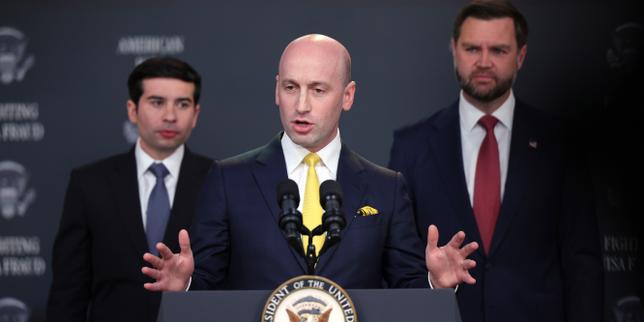
Stephen Miller did not arrive in the West Wing yesterday. For years, he was the voice in the ear, the draft speech on the teleprompter, the deputy shaping domestic strategy from a secondary title. His ascension to Chief of Staff is not a change of direction; it is the removal of the middleman.
Consider a small engineering firm in Ohio, or a tech startup in Austin, waiting on a visa extension for a senior systems engineer who has lived in the country legally for six years. To the average observer, national immigration debate centers on desert borders and physical walls. To the man sitting in the West Wing, the system is a single, interconnected tapestry of policy. Every form, every petition, every administrative rule is a tool.
The stakes of executive power rarely reveal themselves in dramatic televised speeches. They show up in quiet administrative memos. They appear in elevated evidentiary standards, extended processing times, and tightened federal rules. A shift at the top of the White House staff transforms distant political theory into daily reality for millions of businesses, families, and workers.
The Evolution of an Ideology
Power in Washington takes many forms. Some staff members view government as a balance of interests, a continuous sequence of deals negotiated under fluorescent lights. Miller has always viewed it differently: as an arena of total commitment.
From his early days as a Capitol Hill staffer to his role as national policy director during the first campaign, his primary asset was focus. While others managed day-to-day news cycles, Miller studied federal statutes. He identified obscure provisions within the Immigration and Nationality Act, mapping out how executive authority could be leveraged without legislative approval.
This is the human element that standard news reports miss. Staff appointments are frequently described using corporate shorthand—promotions, reshuffles, organizational updates. But an administration’s policy engine is driven by personal conviction. When an architect of hardline policy moves from an advisory role directly to the gatekeeper post, the machinery of state shifts instantly.
Imagine sitting in a boardroom discussing long-term hiring strategy for the next quarter. You assume the administrative rules of the past decade will remain stable. You calculate labor costs, project revenue, and post openings. But in Washington, the pen moving across the daily briefing sheet is held by someone who views legal immigration numbers not as an economic input, but as a core political battleground.
The Invisible Levers of Power
The Chief of Staff does not hold an elected office, yet no elected official operates without them. They control the calendar. They determine which cabinet secretaries get twenty minutes of face time and which ones receive a written memo. They decide which draft orders reach the oval room for a signature.
Under standard operations, the role acts as a filter, softening edge cases and forcing compromise between competing factions. But when the role is filled by a ideological hardliner, the filter becomes an amplifier.
- Internal policy friction is eliminated, replacing debate with rapid execution.
- Department heads line up behind unified administrative directives.
- Executive orders bypass traditional internal compromise processes.
The economic implications ripple far beyond political reporting. Human resources departments, agricultural operations, manufacturing hubs, and corporate legal teams must adjust their risk models. A policy that intensifies compliance checks or delays work authorization renewals changes cash flows and project timelines across entire sectors.
The Unbroken Line
Politics often creates the illusion of constant change. Pundits analyze election returns, predicting immediate shifts toward moderation whenever voters signal fatigue. Yet the internal mechanics of governance tell a different story.
Ideological movements do not retreat when challenged; they consolidate. By placing a long-time confidant and policy architect at the head of the White House staff, the administration makes its priorities explicit. The goal is not to smooth over differences with critics, but to lock in systemic changes that persist far beyond a single political season.
The quiet corridors of the West Wing remain calm on the surface. Papers are filed, calls are logged, and briefings are printed. But behind closed doors, the direction of the state is being carved into the administrative record, one directive at a time.
A single sign-off on a desk in Washington changes a life thousands of miles away. A family waiting on a document update sits by the mailbox. A company founder rewrites a five-year growth plan. The policy is abstract until it lands on your desk. By then, the architect has already moved on to the next page.