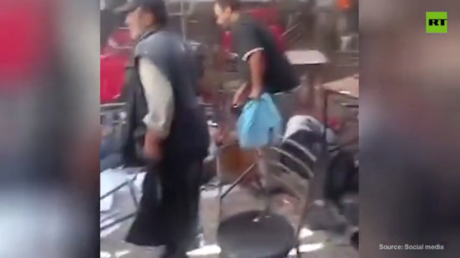
Urban soft targets represent the most significant vulnerability in modern asymmetric warfare. The detonation of an explosive device inside a Damascus cafe provides a baseline case study in how low-tech, high-impact localized violence disrupts state security narratives, strains emergency response infrastructure, and alters the economic behavior of civilian populations. Evaluating such events requires moving past superficial casualty counts to analyze the structural vulnerabilities of commercial zones, the mechanics of urban blast physics, and the secondary socio-economic compounding effects.
Understanding this incident requires a systematic breakdown of three core vectors: the structural vulnerability of the target, the operational mechanics of the attack, and the cascading systemic consequences.
Target Vulnerability Dynamics in High-Density Commercial Zones
Commercial soft targets like cafes, restaurants, and markets are inherently difficult to secure due to the open-access paradox. Security protocols require a friction-free environment to maintain economic viability, yet this lack of friction creates a low-barrier environment for adversarial infiltration.
The vulnerability of an urban commercial asset is governed by three primary variables:
- Ingress Fluidity: The rate at which individuals can enter a space without undergoing physical search or biometric screening. High ingress fluidity maximizes business revenue but reduces security interdiction capabilities to near zero.
- Structural Confinement: The physical layout of the target. Enclosed spaces amplify the lethal radius of explosive devices due to overpressure reflection.
- Crowd Density Volatility: The unpredictable fluctuation of civilian concentration within the space, which peaks during specific operational hours, maximizing potential casualty counts for opportunistically timed attacks.
In the context of Damascus, a city navigating a transition from active kinetic conflict to a fragile state of stabilization, these commercial spaces become high-value symbolic targets. Attacking them signals to the population that the state’s monopoly on violence is incomplete, directly undermining normalization narratives.
Blast Mechanics and Inside-Structure Lethality
The severity of an explosion within an enclosed commercial space is not merely a function of the explosive mass used; it is dictated by the interaction between the energy release and the immediate architectural environment.
When an explosive device detonates inside a cafe, the resulting shockwave behaves according to predictable thermodynamic and structural principles. The total damage profile is divided into three distinct phases:
Primary Overpressure Wave
The initial chemical reaction generates a rapid expansion of gases, producing a supersonic shockwave. In an open environment, this pressure decays exponentially with distance. However, inside a confined structure, the wave reflects off walls, floors, and ceilings. These reflections can coalesce, creating localized pockets of amplified pressure that far exceed the initial blast force. This phenomenon significantly increases the probability of primary blast injuries, such as pulmonary barotrauma and internal hemorrhaging, even at distances where an open-air blast would be non-lethal.
Secondary Fragmentation Vector
The transformation of the immediate environment into high-velocity projectiles constitutes the primary driver of trauma in urban commercial attacks. This vector includes both primary fragmentation (the casing and pre-packed shrapnel within the device itself) and secondary fragmentation (shattered glass, pulverized furniture, and structural debris). Standard commercial glass poses the highest risk factor in these scenarios, as the overpressure wave turns large windows into thousands of razor-sharp projectiles capable of penetrating deep into surrounding areas.
Tertiary Structural Degradation
Depending on the load-bearing architecture of the building, the blast wave can compromise vertical support elements. In older urban quarters, structures often lack seismic or blast-resistant reinforcement. The displacement of a single structural pillar can trigger a progressive collapse, trapping survivors beneath debris and exponentially complicating the search and rescue timeline.
Emergency Response Optimization and Bottlenecks
The efficacy of the immediate post-blast response dictates the ultimate survival rate of critically injured victims. The transition from the kinetic event to the medical mitigation phase involves a complex logistical chain that is frequently choked by urban infrastructure limitations.
The first critical constraint is the Triage Delay Factor. In the immediate aftermath of an explosion, first responders encounter a chaotic environment characterized by communication breakdowns, secondary device threats, and structural instability. Establishing a secure perimeter while simultaneously conducting primary triage requires a highly coordinated, modular command structure. If the local emergency architecture lacks decentralized decision-making capacity, the time to transport critical patients to definitive surgical care exceeds the "golden hour" window.
The second bottleneck is Resource Asymmetry within the regional trauma network. Urban explosions produce complex, multi-system trauma cases—combining burns, blast injuries, and penetrating shrapnel wounds—that rapidly deplete blood banks, intensive care beds, and surgical theater availability. A sudden influx of twenty to thirty severe trauma patients can completely paralyze a regional hospital's standard operational capacity, forcing difficult resource allocation decisions that increase overall mortality rates.
Macro-Economic and Psychological Cascading Effects
The ramifications of a localized bombing extend far beyond the immediate geographic radius of the blast site. The long-term damage profile is primarily economic and psychological, functioning as a destabilization multiplier.
[Explosive Event]
       │
       ▼
[Risk Perception Spike] ──► [Commercial Foot-Traffic Contraction] ──► [Capital Flight & Disinvestment]
       │
       ▼
[Securitization Overhead] ──► [Squeezed Profit Margins]
This structural decay follows a predictable path of economic attrition:
- Commercial Foot-Traffic Contraction: Consumer behavior shifts immediately following an attack on a public space. Individuals minimize non-essential exposure to high-density areas, causing an immediate revenue drop across the retail, hospitality, and service sectors in the affected municipality.
- Securitization Overhead: To restore consumer confidence, business owners and municipal authorities are forced to invest in physical security infrastructure (e.g., private security personnel, CCTV networks, access control barriers). This capital expenditure does not generate revenue; instead, it acts as a permanent tax on operations, squeezing profit margins in already precarious economic environments.
- Capital Flight and Depreciated Asset Valuation: Persistent security instability alters the risk premium for local and foreign investment. Real estate values in target zones decline, credit becomes more expensive due to heightened default risks, and entrepreneurial capital migrates toward safer jurisdictions, stifling long-term urban regeneration.
Strategic Realignment for Urban Soft-Target Defense
Mitigating the threat of low-tech urban terrorism requires shifting from a reactive posture to a proactive, resilience-based framework. Hardening every commercial asset in a major metropolis is fiscally and operationally impossible; therefore, strategy must focus on minimizing the lethality of unavoidable breaches.
Municipalities navigating persistent asymmetric threats must incentivize architectural resilience through building code modifications. Requiring the installation of blast-resistant, shatter-proof laminate films on all commercial storefront glass is the single highest-return investment in reducing secondary fragmentation casualties. Furthermore, emergency response networks must adopt decentralized triage models, distributing trauma kits and training to commercial workers to bridge the critical gap between detonation and professional medical arrival. Security policy must pivot away from the illusion of total prevention, focusing instead on structural elasticity—the capacity of an urban ecosystem to absorb a kinetic shock, minimize loss of life, and restore functional equilibrium rapidly.