In elite international football, matches are rarely decided by raw emotion or generic momentum shifts. Instead, outcomes are dictated by structural inefficiencies, systemic fatigue, and the speed at which a coaching staff adapts to an opponent’s defensive geometry. South Korea’s 2-1 victory over Czechia on the opening day of the World Cup serves as a textbook case study in tactical inversion. By dissecting the match through the lens of spatial control, transitional phases, and pressing triggers, we can isolate the exact mechanisms that allowed a trailing team to systematically dismantle a rigid low-block defense.
The opening phase of the match demonstrated the structural limitations of Czechia’s defensive framework. Operating in a disciplined 5-4-1 mid-block, Czechia prioritized central compaction, effectively neutralizing South Korea’s initial attempts to progress the ball through the half-spaces. The primary objective of this defensive structure was to force South Korea into wide areas, where the touchline could act as an extra defender.
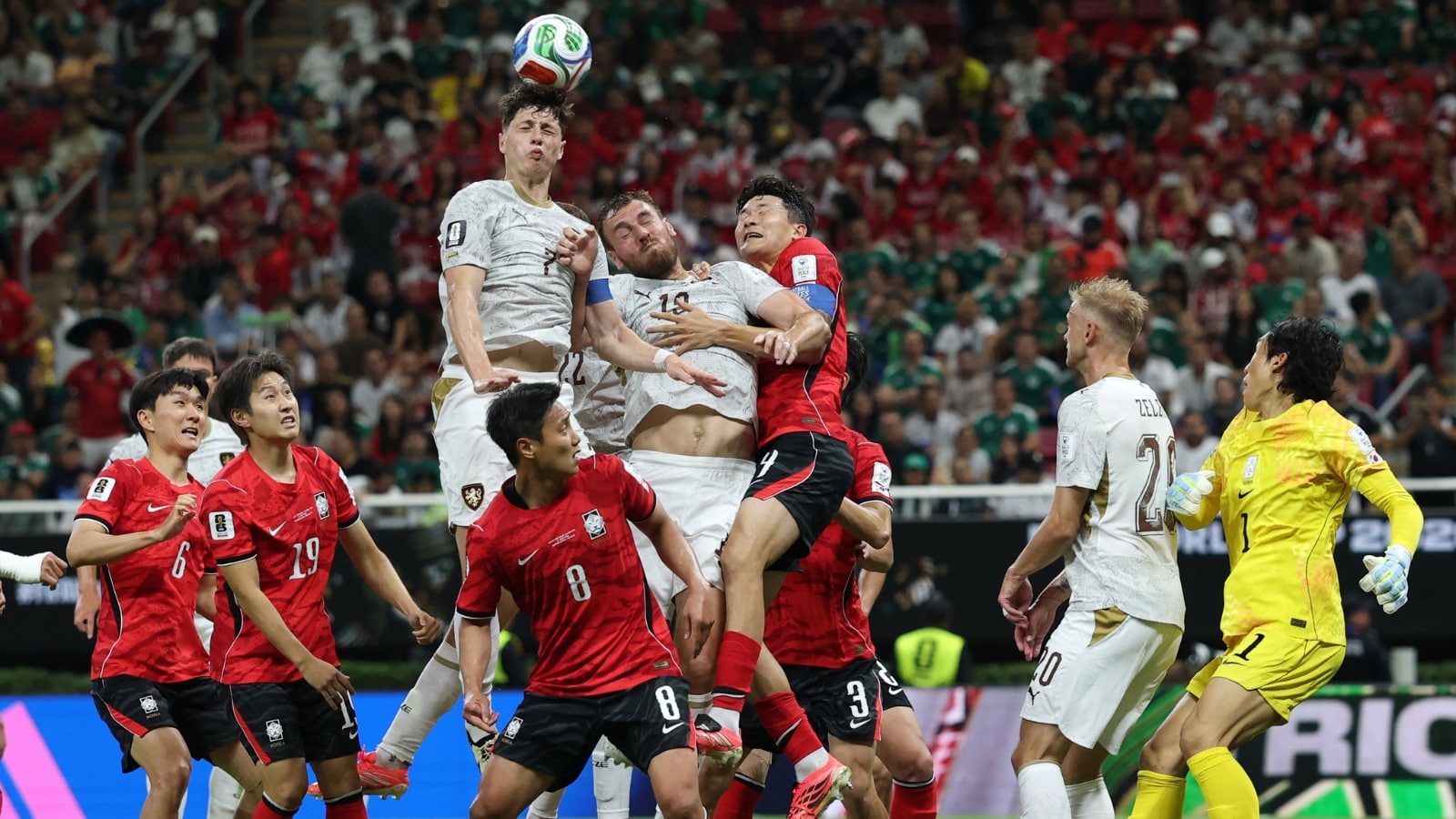
Czechia’s early 1-0 lead was not a product of random variance, but rather a direct exploitation of South Korea’s high defensive line during a rest-defense failure. When a team commits numbers forward in possession, their vulnerability to counter-attacks is governed by the positioning of their remaining defenders—the rest-defense. South Korea's failure to secure the central zone immediately upon losing possession allowed Czechia to execute a vertical transition, exposing a temporary numerical equality in the penalty box.
The Three Pillars of South Korea’s Structural Adaptation
To overcome a one-goal deficit against a low block, a chasing team must alter the arithmetic of the pitch. South Korea achieved this in the second half by implementing three distinct structural shifts that broke Czechia's defensive cohesion.
1. Overloading the Half-Spaces to Force Horizontal Stretching
A five-man backline is naturally equipped to handle wide crosses because three center-backs can cover the width of the penalty box. South Korea recognized that attacking from the extreme flanks was statistically inefficient. Instead, they instructed their interior midfielders to occupy the half-spaces—the longitudinal channels between the flanks and the center of the pitch.
By positioning creative players precisely between Czechia’s wing-backs and outside center-backs, South Korea created a cognitive dilemma for the Czech defenders. If the outside center-back stepped up to press, a gap opened behind him for a penetrating run. If the wing-back tucked in to cover, South Korea’s overlapping full-backs were left completely unmarked on the flanks. This constant spatial manipulation forced Czechia's defensive line to stretch horizontally, widening the intervals between individual defenders from a compact four meters to an exploitable six-to-eight meters.
2. Manipulating the Pressing Trigger Dynamics
In the first half, Czechia remained comfortable because South Korea played at a predictable tempo, passing horizontally across their backline. In the second half, the Asian side systematically altered their passing angles to disrupt Czechia’s pressing triggers.
Defensive blocks rely on specific cues to initiate a press, such as a heavy touch, a backward pass, or a ball played into a player with his back to goal. South Korea countered this by utilizing "up-back-through" combinations. A central defender would play a firm, vertical pass into a striker's feet (the "up" pass). This action triggered the Czech center-backs to step forward aggressively. Before the defender could make contact, the striker executed a one-touch cushioned pass backward to a facing midfielder (the "back" pass), who immediately launched a first-time ball into the space vacated by the advancing defender (the "through" pass). This sequence weaponized Czechia’s own defensive aggression against them.
3. Asymmetric Full-Back Positioning and Rest-Defense Stabilization
The equalizer and subsequent winning goal required South Korea to commit more bodies to the final third without exposing themselves to a second fatal counter-attack. The technical staff solved this by shifting from a symmetrical 4-3-3 structure to an asymmetric 3-2-5 in possession.
The left-back was instructed to invert, moving centrally into the midfield pivot space alongside the defensive midfielder. This created a stable two-man screening presence directly in front of the center-backs. Meanwhile, the right-back pushed high and wide, effectively acting as a winger. This structural adjustment achieved two critical objectives:
- It provided immediate counter-pressing coverage in the central corridor, preventing Czechia from launching clean transitions upon winning the ball.
- It allowed the nominal left winger to drift completely inside, creating a numerical overload against Czechia’s two central midfielders.
The Cost Function of Low-Block Sustained Defending
To fully understand why Czechia collapsed in the final thirty minutes, one must analyze the physical and psychological toll of sustained defending. In football analytics, this can be understood as a physical cost function where defensive efficiency degrades exponentially relative to time spent without possession.
When a team maintains less than 35% possession, their players cover significantly more distance at high-intensity sprinting thresholds than the team dictating the tempo. Defenders must constantly shift laterally to track the ball, accelerate to close down spaces, and decelerate to maintain body shape. By the 65th minute, Czechia’s midfield four began to arrive a fraction of a second late to their pressing assignments.
This micro-fatigue has a compounding effect. A delay of just 0.5 seconds in closing down a passer gives an elite playmaker enough time to calculate a passing trajectory and execute it with precision. Both of South Korea’s goals resulted directly from this degradation of physical output. The first goal arrived via a late midfield rotation that allowed an uncontested cross from the half-space, while the second goal was conceded after a tired challenge inside the penalty area failed to stop a dynamic underlapping run.
Tactical Biases and Strategic Limitations
While South Korea's tactical adjustments deserve analytical praise, a objective evaluation reveals significant vulnerabilities in their approach that higher-tier opposition will inevitably exploit.
The strategy of committing to an asymmetric 3-2-5 structure relies heavily on the technical proficiency of the central defenders under pressure. Because the rest-defense is minimized to a three-man backline, any unforced turnover in the initial phase of build-up completely bypasses the midfield screen. If a central defender misplaces a pass while the full-backs are fully committed to their advanced positions, the opponent gains an immediate, unimpeded path to the penalty box. South Korea’s high-variance style yields high rewards against rigid mid-blocks, but it introduces an unacceptable level of risk against elite counter-pressing teams who deliberately trap build-up play in central areas.
Furthermore, South Korea’s reliance on wide overloads exposes a lack of verticality through the direct center of the pitch. Against an opponent with superior aerial dominance or more disciplined lateral shifting capabilities, the half-space crosses that unpicked Czechia would likely be cleared consistently, leaving South Korea vulnerable to sustained counter-attacks.
The Optimal Strategic Blueprint for Group Stage Progression
To transform this single opening victory into a sustainable template for tournament progression, the South Korean coaching staff must transition from a reactive tactical adjustment model to a proactive structural framework. Relying on halftime adjustments to rescue points introduces unnecessary variance into a tournament group stage where goal differential and early point accumulation are paramount.
The immediate operational priority must be the optimization of the first-phase build-up speed. The technical staff should permanently implement the asymmetric 3-2-5 framework from the opening whistle rather than waiting for a structural bottleneck to occur. By starting the match with an inverted full-back, South Korea can establish immediate control over the central zones, forcing opposition managers to compromise their preferred defensive shapes before they can establish a comfortable rhythm.
Additionally, the central attacking line must introduce varied run profiles. Rather than having the forward line consistently drop deep to link play—which allows opposing center-backs to maintain a static front-facing posture—at least one winger must consistently threaten the space directly behind the opposition backline. These blind-side vertical runs force the defensive line to drop deeper, naturally creating the exact central pockets that South Korea’s creative midfielders require to dictate the game.