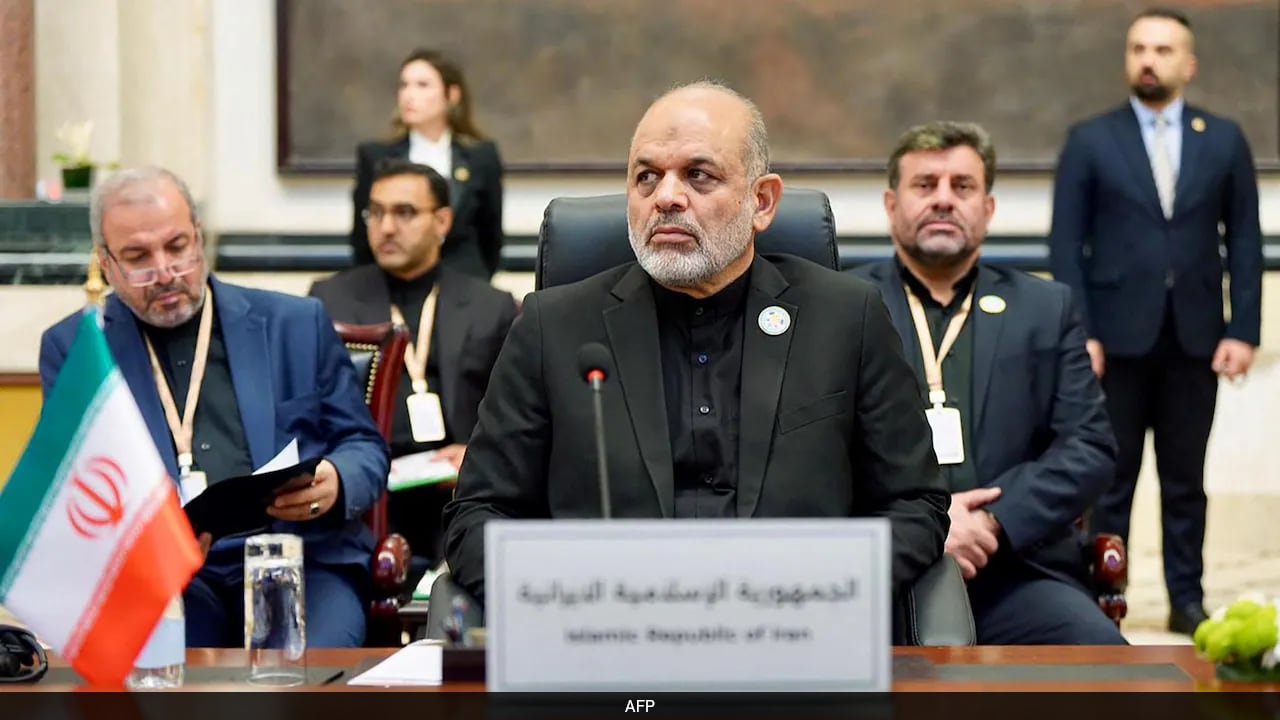
The physical reemergence of General Ahmad Vahidi alongside the casket of late Supreme Leader Ayatollah Ali Khamenei provides critical empirical validation of Iran’s wartime command architecture. Vahidi, a former defense minister, senior commander within the Islamic Revolutionary Guard Corps (IRGC), and a central architect of Tehran's external security apparatus, had vanished from public view on February 8, 2026—weeks prior to the kinetic opening of the current war with the United States and Israel. His return on July 2, 2026, at a private mourning service inside the late Supreme Leader’s compound, signals the completion of a subterranean transition phase and the stabilization of a highly decentralized military executive.
To analyze this event strictly through the lens of political theater misses its operational utility. In asymmetric state structures facing severe decapitation risks, the physical placement of military elites serves as a functional indicator of institutional continuity. Vahidi’s public reassignment to active oversight of the state funeral—and by extension, the security matrix of Tehran during a period of acute vulnerability—reveals the mechanics of how the IRGC intends to manage its transition of power while actively engaged in state-level warfare. Building on this topic, you can also read: Tehran Mourning Spectacle Proves Western Intelligence Analysts Are Still Blind to Iranian Power Stability.
The Dual-Track Succession Model
The death of Ayatollah Ali Khamenei on February 28, 2026, following targeted strikes that also wounded his son and designated successor, Ayatollah Mojtaba Khamenei, forced Iran into a highly irregular succession environment. Standard constitutional procedures require a smooth transition managed by the Assembly of Experts. However, wartime constraints have forced the adoption of an operational model that separates spiritual-political legitimacy from direct command functionality.
This structural divergence can be calculated through a simple conceptual framework mapping two distinct vectors: Observers at BBC News have shared their thoughts on this situation.
- The Legitimacy Vector: Managed by the transition of the Supreme Leadership to Mojtaba Khamenei. Despite his injuries and continued absence from the public domain, Mojtaba Khamenei represents institutional and dynastic continuity for the state’s ideological base.
- The Executive Command Vector: A small, highly insulated clique of veteran IRGC officials who hold actual operational authority over state defense, diplomatic negotiation, and internal stability mechanisms.
Vahidi’s role is defined by this second vector. By placing a veteran paramilitary strategist directly next to the casket during the initial, restricted-access service, the regime communicated that the physical custody of the transition rests entirely with the IRGC’s hardline operational core. This move is designed to mitigate the primary structural risk facing the regime: a coordination failure during the multi-day public funeral ceremonies.
Logistical Vulnerability and Risk Mitigation Frameworks
The state funeral scheduled for July 4–9, 2026, represents a profound security bottleneck for the Iranian state. The regime has committed to transporting the body across multiple major cities, including Tehran, Qom, and Mashhad, alongside ceremonies planned in neighboring Iraq. The logistics of this operation present clear vectors of vulnerability that the IRGC command structure must actively neutralize.
The Decapitation Risk Function
For an intelligence apparatus executing a counter-decapitation strategy, a public funeral is an asset-rich environment that concentrates high-value targets in predictable geographic nodes. The IRGC’s mitigation strategy relies on a strict policy of asymmetric exposure.
While secondary political figures, foreign delegations from Pakistan, China, and Russia, and public mourners are directed to the Grand Mosalla of Tehran, primary decision-makers operate on a staggered exposure schedule. Vahidi’s emergence after a multi-month absence confirms that the leadership utilizes deep underground command and control facilities, surfacing individuals only when their presence serves a specific structural purpose. The ongoing public absence of Mojtaba Khamenei indicates that the regime calculates the risk to the ultimate executive seat as still exceeding acceptable thresholds, requiring Vahidi and a small inner circle to act as the overt face of the regime’s continuity.
The Airspace and Urban Closure Matrix
To secure the massive crowds expected in Tehran, the IRGC has instituted a total operational shutdown of local daily life, including the complete closure of commercial airspace and specific urban corridors. This is not merely an act of mourning; it is a tactical necessity designed to create a sterile operating environment.
By grounding commercial flights and clearing major avenues, the state’s air defense systems can transition to a simplified threat-detection matrix, where any unidentified aerial signature or anomalous vehicular movement is instantly classified as hostile. This radical reduction in urban noise is the only mechanism available to protect an outdoor gathering of millions from precision standoff munitions or drone incursions.
Negotiation Leverage and the External Strategy
Beyond internal stabilization, Vahidi’s emergence is directly tied to Iran’s positioning in back-channel diplomatic negotiations aimed at establishing a permanent cessation of hostilities with the United States. Within the Iranian political calculus, negotiating capability is directly proportional to visible institutional resilience.
If a state’s military leadership remains entirely invisible or rumored to be dead, its adversarial bargaining position degrades, as the counterparty assumes they are negotiating with a fractured command. Vahidi's public appearance alongside the state's most sacred symbolic relic effectively counters western and Israeli information operations that have sought to emphasize the degradation of the IRGC command structure.
The message delivered to international observers is precise: the individuals formulating Iran’s rigid, unyielding negotiation terms are alive, structurally secure, and in absolute control of the state’s coercive apparatus. The strategy relies on demonstrating that the structural damage inflicted by the air campaign since February has failed to sever the links between the supreme political leadership, the IRGC executive branch, and the deployment of the state's remaining strategic assets.
The Operational Play
The upcoming days will test whether this highly centralized, insulated executive model can maintain domestic cohesion while under severe external pressure. The strategic play for the IRGC is to utilize the intense, highly controlled environment of the public mourning ceremonies to solidify Mojtaba Khamenei’s legitimacy in absentia, using figures like Vahidi to project an illusion of absolute administrative normalcy.
Watch for the specific composition of the military guard surrounding the casket as it moves from Tehran to Qom and Mashhad. The presence or absence of specific operational commanders will reveal whether the internal power balance is stable, or if Vahidi’s emergence is part of a broader consolidation effort to sideline moderate factions pushing for immediate concessions to Western powers. Expect zero deviation from Iran’s established negotiation baseline during the mourning period; the regime will deliberately maintain a posture of aggressive equilibrium until the formal burial rites are concluded in Mashhad on July 9.
Iran's Quds Force chief Qaani reappears at funeral after rumours of death
This video provides critical historical context on how the IRGC utilizes high-profile state funerals to publicly debunk western rumors of command degradation and re-establish a narrative of operational continuity during times of geopolitical tension.