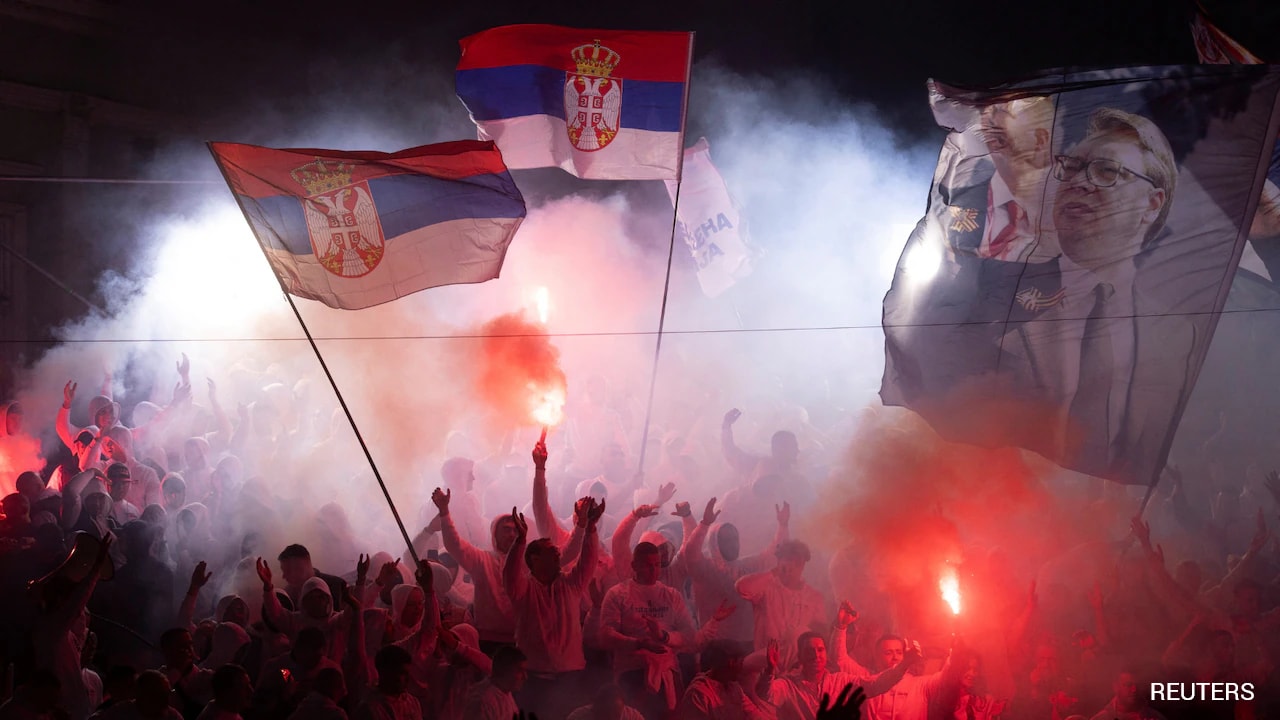
Mass street protests triggered by a former president seeking the prime ministership expose a structural tension that headlines rarely capture: visual crowd scale does not automatically convert into parliamentary durability or institutional veto power. When a competitor piece frames such an event around raw video footage and headline crowd estimates, it treats street mobilization as a self-explanatory measure of political momentum. A rigorous analytical framework separates the mechanics of protest assembly from the constitutional and electoral rules that govern executive authority in Serbia, clarifies what is established by the headline premise versus what remains a testable hypothesis without primary event records, and maps how opposition coalitions, incumbent institutions, and swing voters actually react once the cameras leave the square.
To analyze this dynamic systematically, this article breaks the phenomenon into four interlocking parts: the structural logic of a presidency-to-premiership pivot, the mechanics and limits of street mobilization as a political signal, the causal pathways connecting demonstrations to coalition bargaining and voter turnout, and the practical constraints that shape strategic options for political actors. Because no external article text, date, or verified tally was supplied alongside the title, specific crowd counts, candidate names, and election dates are treated strictly as unknown variables rather than invented figures.
Reversing the Executive Path in Serbian Politics
A former president running for prime minister flips the conventional trajectory of executive ambition. In systems where the presidency carries strong symbolic stature or direct electoral legitimacy while day-to-day policy execution, legislative coordination, and cabinet control sit with the government, moving from the presidency to the premiership is rarely a simple step down or a neutral lateral move. It is an attempt to trade high-visibility national standing for operational control over ministries, budgets, and parliamentary majorities.
Two competing hypotheses explain why a former head of state pursues the prime ministership amid large-scale demonstrations:
- The consolidation hypothesis: The candidate views the premiership as the practical center of state power—where patronage, administrative implementation, and coalition horse-trading actually happen—and believes prior national name recognition can anchor a governing bloc.
- The counter-mobilization hypothesis: The candidate enters the prime ministerial race specifically to project inevitability, rally loyalists against street pressure, or force rival opposition factions into a high-stakes binary choice rather than allowing protest organizers to set the terms of debate.
Distinguishing between those motives requires looking past speeches to coalition arithmetic. A prime minister governs through parliamentary confidence and inter-party agreements, not applause in a public square. Even a candidate with high name recognition faces a structural bottleneck if fragmented opposition parties refuse to coordinate or if smaller partners demand disproportionate cabinet portfolios in exchange for votes.
Crowd Scale, Media Framing, and the Signaling Trap
Video-led coverage of large demonstrations excels at showing energy, density, and emotional commitment, yet those same qualities distort strategic assessment. A crowd of thousands visible on video proves that a grievance has crossed a threshold of public visibility and personal risk-taking. It does not, by itself, measure whether that sentiment is concentrated in major urban centers, how evenly it is distributed across age and income cohorts, or whether it translates into ballots cast weeks or months later.
Political analysts often conflate three distinct dimensions of mobilization that operate on different clocks and follow different rules:
- Expressive turnout: Citizens showing up in the streets to register anger, solidarity, or moral opposition. Expressive turnout can spike rapidly around a symbolic flashpoint or a polarizing candidacy.
- Organizational capacity: The ability of movements, civic groups, or parties to sustain logistics, recruit poll watchers, protect protest spaces from provocation, and keep participants engaged across multiple weekends.
- Electoral conversion: The harder process of persuading undecided voters, overcoming apathy in lower-turnout precincts, and turning street frustration into disciplined party-list or candidate votes on election day.
Visual coverage amplifies expressive turnout because movement, banners, and large gatherings photograph and film well. Quiet groundwork—local organizing in smaller municipalities, candidate vetting, voter contact, and coalition negotiations—rarely makes compelling video, yet that unglamorous work often determines whether a protest wave reshapes government or fades once media attention shifts.
Cause and Effect Beyond the Street
When thousands gather in response to a former president's prime ministerial bid, the consequences travel along several distinct causal chains rather than a single straight line from protest to power.
Incumbent and Institutional Reactions
Large demonstrations force ruling elites and state institutions to choose among responses that each carry steep costs. Heavy-handed policing or administrative pressure can suppress immediate street numbers in the short term while inflaming grievances and broadening sympathy among previously detached observers. Conversely, visible concessions or procedural delays can buy time but risk signaling weakness to core supporters and emboldening protesters to raise their demands.
Institutional actors—courts, electoral bodies, public broadcasters, and state-aligned media—also shape how the conflict is interpreted. When information ecosystems are polarized, two citizens can watch footage from the same demonstration and draw opposite conclusions: one sees an authentic popular uprising against entrenched power, while the other sees a partisan maneuver engineered by political rivals.
Coalition Dynamics and Opposition Fragility
A polarizing candidacy often unifies street energy faster than it unifies opposition strategy. Protesters may agree on what they oppose without agreeing on a common legislative program, a shared candidate list, or a post-election governing pact.
This creates a classic coordination problem:
- Fragmentation risk: If multiple opposition actors compete for credit or run separate slates, vote splitting can dilute anti-incumbent leverage even when street dissatisfaction looks high.
- Leadership friction: Street movements frequently distrust established politicians, while established parties rely on institutional rules and fundraising networks that grassroots activists may view with skepticism. When a former president enters the prime ministerial contest, that tension sharpens because the candidate embodies traditional high-level politics right in the middle of a protest moment.
Voter Fatigue and the Time Horizon of Protest
Street politics runs on high adrenaline, which is difficult to sustain indefinitely. Weather shifts, work obligations, economic strain, and repeated cycles of marches without immediate policy breakthroughs all erode attendance over time. Meanwhile, campaigns for prime minister test endurance across news cycles, debates, endorsements, and administrative hurdles. If the opposition treats a single large gathering as proof of inevitable victory rather than a starting point for disciplined campaigning, momentum can plateau before ballots are counted.
Strategic Playbook and Analytical Blind Spots
Any serious assessment of a protest-and-election clash in Serbia requires separating verified facts from inference. Without access to the specific video footage, verified attendance estimates, official electoral rules in force at the moment, or internal polling, claiming certainty about crowd size, voter shifts, or final outcomes would be guesswork dressed up as rigor. Frameworks clarify mechanisms; they do not substitute for primary evidence.
For political strategists, campaign operators, and analysts tracking the race, execution hinges on four disciplined moves:
- Audit crowd claims against independent indicators: Pair visual impressions with geographic spread, transit patterns, local reporting, and credible polling rather than treating headline crowd figures or viral clips as objective measurements.
- Separate protest demand from governing math: Map every core grievance against concrete parliamentary seats, coalition partners, and administrative levers so street energy is tied to a realistic path to a majority.
- Build local infrastructure before peak energy fades: Channel high-visibility demonstrations into durable voter registration, precinct-level outreach, and poll-monitoring networks while public attention is high.
- Stress-test against counter-narratives and institutional friction: Prepare rapid, verifiable responses to state-media framing, legal or procedural challenges, and potential provocations aimed at discrediting peaceful demonstrators.
The decisive test is not who commands the largest crowd on a single day, but who converts temporary street intensity into durable institutional leverage before the political calendar resets.