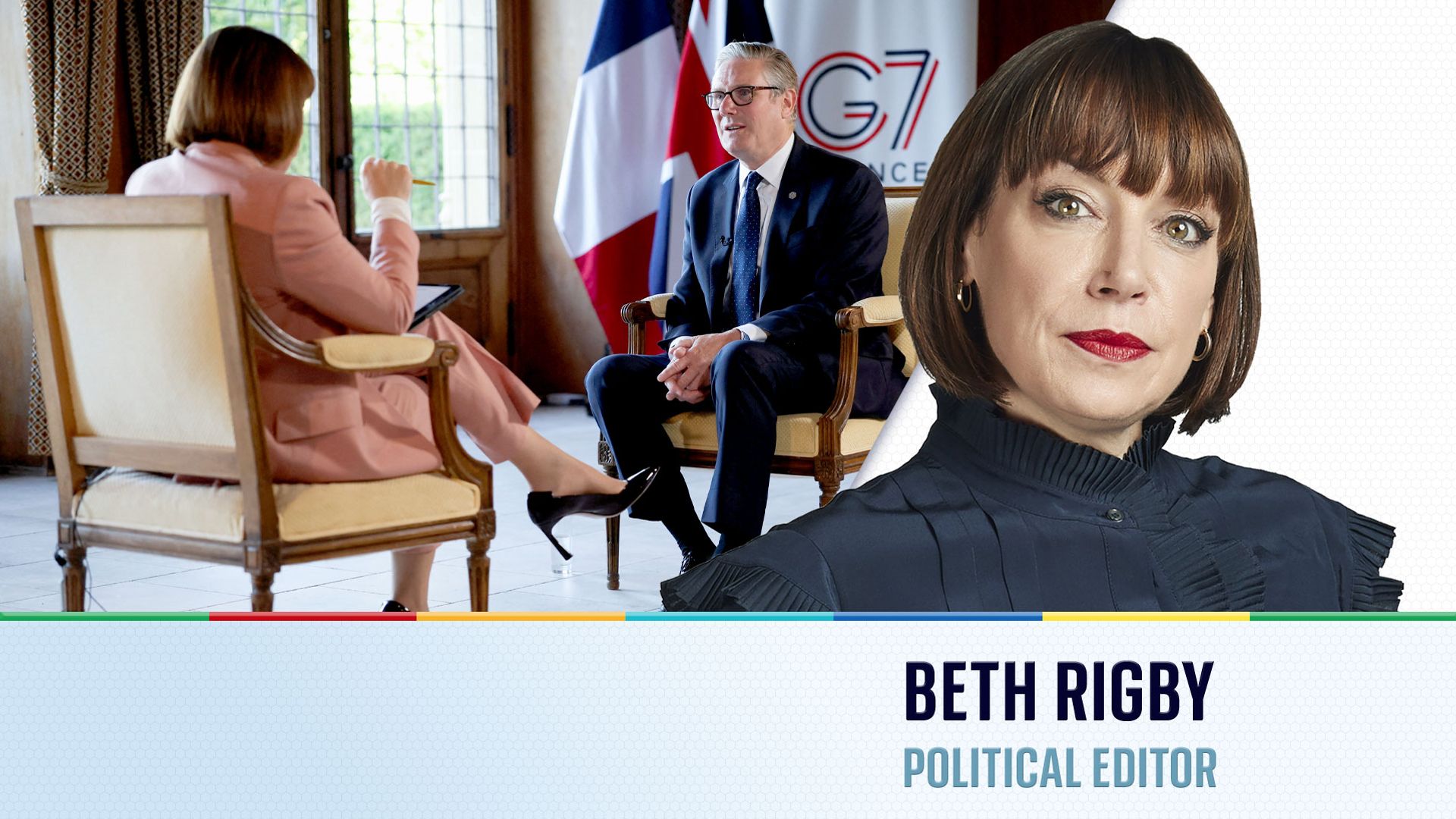
Political communication at international summits operates on a dual-axis model: the projection of state capability outward to global peers, and the strategic feedback loop directed inward to a domestic electorate. When British Prime Minister Keir Starmer arrived at the G7 summit in Évian, France, standard journalistic accounts focused on surface narrative adjustments, noting a "different kind of Starmer" wielding a more aggressive defensive posture. This superficial observation misses the underlying structural mechanics. The shift in communication style was not an arbitrary rhetorical choice; it was a mandatory defensive response to a severe contraction in his domestic political capital.
The structural reality confronting the administration reveals a clear cause-and-effect relationship. Domestically, the government faces a highly volatile political bottleneck: the resignation of Defense Secretary John Healey over an alleged £10 billion security funding shortfall, an impending high-stakes byelection in Makerfield, and public leadership maneuvering from Cabinet figures like Wes Streeting and regional mayors. When a head of government loses leverage at home, their international negotiating efficacy diminishes proportionally. Starmer's performance at Évian represents a deliberate attempt to decouple his international stance from his collapsing domestic polling numbers, utilizing specific geopolitical mechanisms to manufacture authority.
The Three Pillars of Tactical Deflection
To counteract the perception of domestic vulnerability, the Prime Minister’s media strategy relied on three distinct structural pillars designed to project executive stability.
The Historic Mandate Recalibration
The first pillar seeks to counter immediate leadership threats by shifting the focus toward legalistic permanence. Confronted by journalists regarding a potential internal leadership challenge, Starmer continually decoupled his immediate low poll numbers from his statutory authority.
The core of this mechanism rests on the concept of institutional inertia. By explicitly referencing the "landslide victory in 2024" and the resulting "five-year mandate," the rhetorical strategy treats a past electoral outcome as an unassailable asset that cannot be liquidated by contemporary factional dissent. This framework categorizes all current domestic criticism as mathematically irrelevant noise when measured against a constitutional timeline that extends deep into the decade.
Geopolitical Asset Utility
The second pillar relies on deploying specific, high-value technical capabilities where the UK maintains an international competitive advantage, specifically maritime security. By committing British forces to assist in demining the Strait of Hormuz following the US-Iran peace agreement, the administration attempted to shift the domestic conversation from structural military underfunding to immediate operational execution.
This tactical pivot leverages a specific economic narrative. The closure or disruption of global shipping chokepoints introduces immediate inflationary pressures on domestic household supply chains. By framing the deployment of Royal Navy demining assets as a direct intervention to protect British household incomes, the government seeks to convert a costly foreign policy obligation into a tangible domestic economic benefit.
The Defensive Spending Multiplier
The third pillar addresses the fiscal friction caused by John Healey's high-profile resignation. The former Defense Secretary claimed that an additional £10 billion was required immediately to guarantee national security. Starmer's counter-argument relied on changing the baseline metrics of the debate.
Instead of addressing the nominal cash deficit highlighted by critics, the Prime Minister emphasized the rate of increase, asserting that his administration oversaw the largest sustained rise in defense spending since the 1980s—escalating the budget from 2.3% to 2.6% of GDP, with a nominal target of 3.0% by 2030. This strategy attempts to neutralize accusations of austerity by presenting defense spending as a structured, long-term growth trajectory rather than a series of emergency capital injections.
The Cost Function of International Isolation
While the rhetorical strategy was engineered to project control, an objective analysis of the summit’s structural dynamics reveals significant transactional friction. The primary limitation of relying on international prestige to shore up domestic authority is that foreign peers are highly sensitive to a leader’s internal weakness.
The absence of a formal, bilateral meeting between Starmer and US President Donald Trump underscores this dynamic. While the Prime Minister categorized their interactions during group dinners as "very productive, very honest and frank," the structural reality remains that access at a G7 summit is a direct reflection of political currency.
The mechanism of this diplomatic discounting can be modeled as a clear function of political shelf-life:
$$Efficacy = f(Domestic;Approval, Institutional;Longevity)$$
When global leaders perceive that a counterpart is facing an imminent internal leadership challenge or a disastrous byelection outcome, the expected utility of entering long-term bilateral agreements with that leader drops toward zero. French President Emmanuel Macron's reported exclusion of the UK from informal strategic conversations illustrates this operational reality. International allies are hesitant to expend diplomatic capital on an executive whose domestic survival is highly uncertain.
Furthermore, the domestic trade-offs required to maintain these international positions create internal friction. Starmer's public endorsement of a G7 statement praising Trump's leadership on the US-Iran deal presents a clear political calculation. To maintain alignment with the United States and secure a role in the subsequent maritime reconstruction of the Strait of Hormuz, the Prime Minister chose to absorb the immediate domestic blowback of validating a highly controversial US foreign policy framework.
Fiscal Constraints and Capital Reallocation
The structural bottleneck underlying the administration's current crisis is fundamentally fiscal. The debate over defense funding is not merely a philosophical disagreement over state capability; it is a rigid zerosum budgetary constraint.
[Fixed Fiscal Envelope]
       │
       ├──► Reallocate to Defense (Increases Security Projection)
       │
       └──► Reallocate to Social Welfare / Public Services (Eases Domestic Polling Friction)
As the Prime Minister admitted, the current Defence Investment Plan requires taking capital from other civil government departments and reallocating it to the military.
This creates a self-reinforcing negative feedback loop:
- To maintain international credibility and meet NATO commitments, the executive must divert scarce funds into defense.
- This capital extraction starves public services and domestic infrastructure, accelerating the decline in domestic approval ratings.
- The resulting domestic unpopularity weakens the leader’s authority at international summits, forcing them to adopt an even more aggressive, defensive posture abroad to prove their continuing relevance.
The administration’s proposal to implement a social media ban for under-16s by next spring serves as an alternative example of this dynamic. When fiscal levers are highly constrained by macroeconomic realities, an executive will frequently turn to low-cost regulatory interventions to signal domestic control and assert authority without drawing down precious financial reserves.
The Imminent Strategic Play
The administration cannot rely on rhetorical resilience indefinitely. To break out of this negative feedback loop before internal party challenges solidify, the executive must transition from defensive media positioning to concrete structural maneuvers.
The optimal strategic play requires immediate execution across two distinct horizons:
First, the administration must utilize the upcoming appointment of Dan Jarvis as Defence Secretary to execute a comprehensive strategic defense review that shifts the metric of capability from raw capital expenditure to technological optimization. By reframing the rejection of Healey’s £10 billion demand not as a shortfall, but as an active transition away from legacy military hardware toward high-yield digital and autonomous systems, the government can defend its fiscal discipline without appearing weak on national security.
Second, the Prime Minister must immediately convert the outcome of the Makerfield byelection—regardless of the margin—into a mandate for internal party consolidation. If the seat is held, the victory must be weaponized to publicly marginalize cabinet rivals and regional challengers. If the margin deteriorates significantly, the executive must rapidly deploy its long-planned regulatory agenda, including the youth social media restrictions and infrastructure planning reforms, to demonstrate tangible legislative momentum.
Ultimately, international summits provide a powerful stage for theater, but they cannot manufacture genuine authority out of a domestic vacuum. The survival of the current executive depends entirely on its capacity to convert its nominal five-year institutional mandate into immediate, localized structural victories.