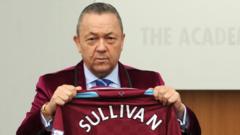
The sudden resignation of David Sullivan from his executive positions at West Ham United Football Club marks a fundamental operational shift in English football governance. By stepping down as joint-chair and director following a joint investigation into historical misconduct by the BBC and The Times, Sullivan attempted to insulate the club from corporate contamination. However, the immediate intervention of the Independent Football Regulator (IFR) demonstrates that voluntary corporate exit no longer preempts regulatory scrutiny. The IFR's invocation of statutory powers to evaluate Sullivan's suitability under its Owners, Directors and Senior Executives (ODSE) regime establishes a critical precedent for how state-backed football oversight will function in practice.
This intervention exposes a profound structural friction between traditional sports equity ownership models and emerging statutory frameworks. To understand the trajectory of this crisis, the financial stability of West Ham, and the boundaries of regulatory authority, the situation must be broken down through rigorous corporate and economic frameworks.
The Dual-Layer Governance Conflict
The crisis operates on two distinct dimensions: private corporate law and statutory sports governance. When an owner steps down from an executive board seat, standard corporate law treats them as a passive investor, provided they retain their equity. In Sullivan’s case, he remains the largest single shareholder with just under a 39% stake in WH Holding Limited.
The traditional regulatory framework—previously managed by the Premier League’s Owners’ and Directors’ Test (OADT)—struggled to manage the systemic risk posed by a dominant, non-executive shareholder facing reputational or legal exposure. The IFR’s statutory design corrects this structural loophole through a comprehensive compliance model.
The ODSE Suitability Matrix
The IFR evaluates club stakeholders using a continuous fitness function, rather than a point-in-time entry test. This mechanism analyzes fitness across three distinct vectors:
- Financial Integrity: Assessing whether the individual’s capital sources or personal solvency expose the sporting institution to structural default or liquidity shocks.
- Corporate Conduct: Reviewing active or historical judgements, corporate failures, and structural transparency in non-football corporate operations.
- Reputational Viability: Determining if an individual's association undermines the commercial, heritage, or operational stability of the football pyramid.
The core vulnerability in the historic Premier League governance model was its binary nature. An individual either passed or failed based on specific, narrow criminal convictions or financial insolvencies. The statutory framework of the IFR expands this scope. By maintaining contact with West Ham despite Sullivan's resignation, the regulator signals that changing a corporate title from "Active Director" to "Major Shareholder" does not truncate its statutory jurisdiction. Under the emerging regulatory architecture, a major shareholder holds material influence; therefore, their suitability remains mathematically tied to the club's operational license.
The Relegation-Shock Cost Function
The regulatory intervention arrives at a moment of maximum financial vulnerability for West Ham United. The club was relegated from the Premier League just two weeks prior to Sullivan’s resignation, creating a severe economic mismatch between fixed structural costs and collapsing revenue streams.
The economics of football relegation follow a steep, non-linear decay curve. According to the club’s recent financial disclosures, West Ham generated £227.5 million in revenue but posted a net loss of £104 million. In the Premier League, broadcast revenue forms the foundational floor of this income. Relegation to the EFL Championship triggers an immediate reduction in central media distributions, which drop from a baseline floor of approximately £100 million down to standard Championship distributions, offset only partially by temporary parachute payments.
The Capital Structure Bottleneck
This structural revenue collapse intersects dangerously with a fractured corporate governance layout at the club:
WH Holding Limited Equity Distribution:
├── David Sullivan: ~39% (Resigned executive, primary shareholder)
├── Daniel Křetínský: 27% (Sole Chair, second-largest shareholder)
├── Gold Family Trust: 25% (Passive minority equity)
└── Other Minority Shareholders: ~9%
This equity distribution creates an immediate capital call bottleneck. In a typical relegation crisis, a club requires equity injections or shareholder loans to cover the operational deficit caused by sticky player contracts and reduced matchday or commercial income. Sullivan's transition into legal and regulatory defense effectively freezes his capacity or willingness to deploy further capital into the vehicle.
Simultaneously, the club’s second-largest shareholder, Czech billionaire Daniel Křetínský, has assumed the role of sole chair. While Křetínský possesses the liquidity to stabilize the club, a structural misalignment emerges if one major shareholder must dilute their position or fund a disproportionate share of working capital while the primary shareholder’s equity is locked in regulatory limbo. The capital structure becomes highly illiquid precisely when maximum agility is required to engineer a return to the top flight.
Strategic Forecasting: The Three Governance Trajectories
The intersection of the IFR's statutory inquiry and West Ham's capital bottleneck will force one of three structural outcomes over the coming months.
1. Forced Equity Divestment via Regulatory Sanction
If the IFR's formal information-gathering process concludes that Sullivan's continued ownership violates the core integrity standards of the licensing regime, the regulator can deploy its ultimate enforcement mechanisms. While the regulator cannot easily seize private property, it can condition or revoke West Ham United's mandatory operating license unless specific governance conditions are met.
This mechanism acts as an indirect forced divestment tool. To preserve the club's license and asset value, Sullivan would be forced to sell his ~39% stake in an illiquid secondary market. Because the club is currently in the Championship, this stake would be sold at a significant discount relative to its Premier League valuation, creating a distressed asset scenario.
2. The Křetínský Consolidation Play
The most seamless operational transition involves an accelerated equity transfer to Daniel Křetínský. Prior to the crisis, frameworks were being evaluated for Křetínský and Sullivan to purchase portions of the Gold family’s 25% stake to equalize control at approximately 40% each.
The regulatory risk surrounding Sullivan now creates a strong incentive for Křetínský to execute a clean buyout of Sullivan's entire position. This would consolidate more than 65% of the club's equity under a single corporate entity, clearing the governance logjam, satisfying the IFR’s demands for structural clarity, and allowing for an immediate cash injection to restructure the squad's wage bill for Championship realities.
3. Structural Operational Limbo
The third trajectory is a prolonged period of corporate inertia. If Sullivan vigorously defends his position, refuses to sell his shares, and the IFR's investigation stretches across multiple fiscal quarters, West Ham will remain in operational limbo.
Under this scenario, the club cannot easily secure external debt financing because credit institutions evaluate governance instability as a material default risk factor. The club would be forced to balance its budget exclusively through aggressive asset liquidation—namely, selling its highest-value playing assets at compressed valuations. This route severely degrades the club's probability of achieving promotion, trapping it in a negative economic loop where costs must be continuously cut to match a permanently lower revenue base.
The immediate strategic priority for the West Ham board is to decouple the legal liabilities of its primary shareholder from the operational balance sheet of the football club. The independent regulator's action proves that corporate shielding through resignation is no longer an absolute defense against state-backed sports governance. The speed and method by which the club restructures its top-tier equity will directly dictate its long-term financial survival and capacity to return to elite competition.