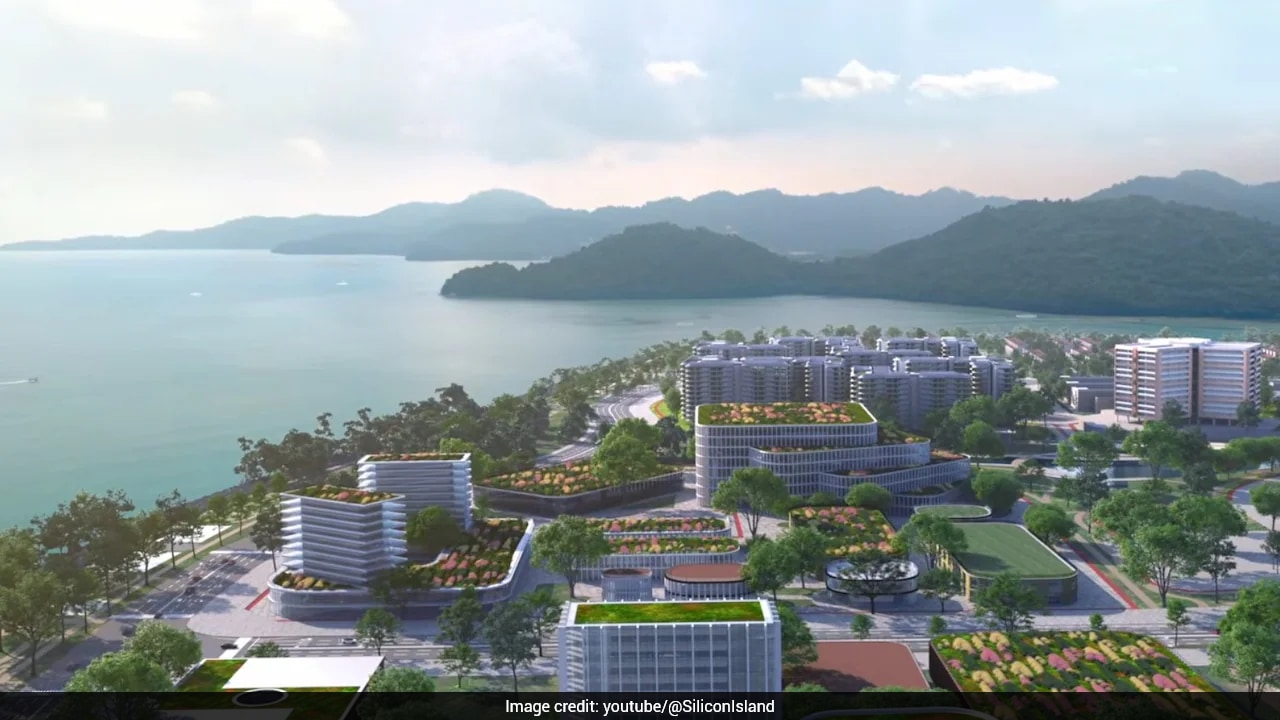
Penang has spent half a century entrenched in the global electronics supply chain, evolving from a low-cost assembly outpost into a critical node for semiconductor testing and packaging. That trajectory now faces a physical barrier. The Bayan Lepas Free Industrial Zone is saturated, and the island's mountainous topography precludes interior expansion. When a manufacturing cluster runs out of horizontal geography, the options narrow to vertical integration or maritime territorial expansion. Malaysia chose the latter.
The state government, in partnership with developer Gamuda Berhad, is executing a massive land reclamation project off the southern coast of Penang Island known as Silicon Island. Spanning 2,300 acres (930 hectares), this artificial landmass is designed to bypass traditional land acquisition constraints and house the next generation of artificial intelligence hardware manufacturing, photonics, and advanced packaging infrastructure. Read more on a similar issue: this related article.
Understanding the viability of this project requires deconstructing its core economic, logistical, and structural variables.
The Capital Expenditure and Infrastructure Mechanics
Land reclamation on a marine scale introduces heavy upfront capital expenditure long before any manufacturing yields economic return. The initial phase of reclamation and foundational infrastructure carries an estimated price tag of RM14 billion. Financing such projects typically relies on hybrid public-private funding models, where the appreciation and subsequent auction of industrial land parcels offset the massive engineering outlays. Further journalism by Gizmodo delves into similar views on the subject.
The technical timeline dictates a multi-stage deployment curve:
- Phase 1 involves dredging and filling operations targeting a pace of 300 to 400 acres annually, pushing total reclamation milestones toward completion by the early 2030s.
- Industrial land sales open to early tenants are scheduled ahead of full completion, aiming to attract capital investment for facilities slated for operational status by the end of the decade.
- Infrastructure provisions include a designated 280-hectare Green Tech Park built under a 5-Diamond Low Carbon City framework, incorporating renewable energy quotas and strict environmental governance.
The capital expenditure assumes that global semiconductor demand, specifically driven by AI hardware accelerators, high-bandwidth memory, and photonics, will maintain a growth trajectory steep enough to justify high-cost industrial real estate.
The Geopolitical Arbitrage and Supply Chain Proximity
Silicon Island does not exist in a vacuum; it benefits from structural shifts in global manufacturing geography. Ongoing trade friction between the United States and China has forced multinational corporations to adopt a China-plus-one diversification strategy. Penang occupies an advantageous position in this realignment due to its existing ecosystem of multinational OSAT (outsourced semiconductor assembly and test) providers, established engineering talent pools, and local supply chain networks.
By placing new industrial plots directly adjacent to Bayan Lepas, the development solves the spatial bottleneck without forcing companies to sever ties with existing logistics corridors, airports, and deep-water ports. Manufacturers gain access to greenfield land equipped with modern utilities while remaining anchored to a mature electronics cluster. This mitigates the friction typically associated with moving operations to entirely greenfield inland regions lacking supporting infrastructure.
Regional Competition and Market Positioning
Malaysia is not the sole actor attempting to capture the capital expenditure surge in Southeast Asian semiconductor infrastructure. Regional competitors present distinct value propositions:
- Singapore continues to dominate high-end wafer fabrication and capital-intensive R&D, though constrained by high labor and land costs.
- Vietnam captures significant assembly and packaging investments through lower labor overhead and aggressive foreign direct investment incentives.
- India is deploying substantial state subsidies to build domestic semiconductor fabrication and display ecosystems.
Silicon Island carves out a specific niche by targeting advanced packaging, testing, and photonics—segments that require high-precision engineering environments rather than pure low-cost assembly. Deloitte-backed economic impact projections estimate cumulative economic output reaching RM1.1 trillion through 2050 alongside hundreds of thousands of jobs. These long-term projections serve as strategic targets rather than guaranteed returns, contingent entirely on sustained macroeconomic demand for specialized silicon.
Execution Risks and Ecological Trade-offs
Large-scale marine reclamation alters coastal ecosystems, presenting operational and social friction. Environmental impact mitigation requires strict adherence to ecological offset masterplans, artificial reef deployment, and silt containment to protect local fisheries and marine biodiversity. Financial compensation and livelihood transition programs for artisanal coastal communities form a mandatory component of project execution to prevent labor disruptions and legal blockades.
Technically, the risk profile centers on soil settlement timelines for reclaimed land, structural resilience against rising sea levels, and the speed at which specialized tenants commit capital. If global capital expenditure on artificial intelligence infrastructure plateaus, the absorption rate of industrial plots on Silicon Island will slow down, extending the payback period for the initial RM14 billion public-private outlay.
Align capital deployment schedules with the operational readiness of Phase 1 industrial land parcels, prioritizing long-term supply chain contracts in advanced packaging over speculative real estate acquisition.