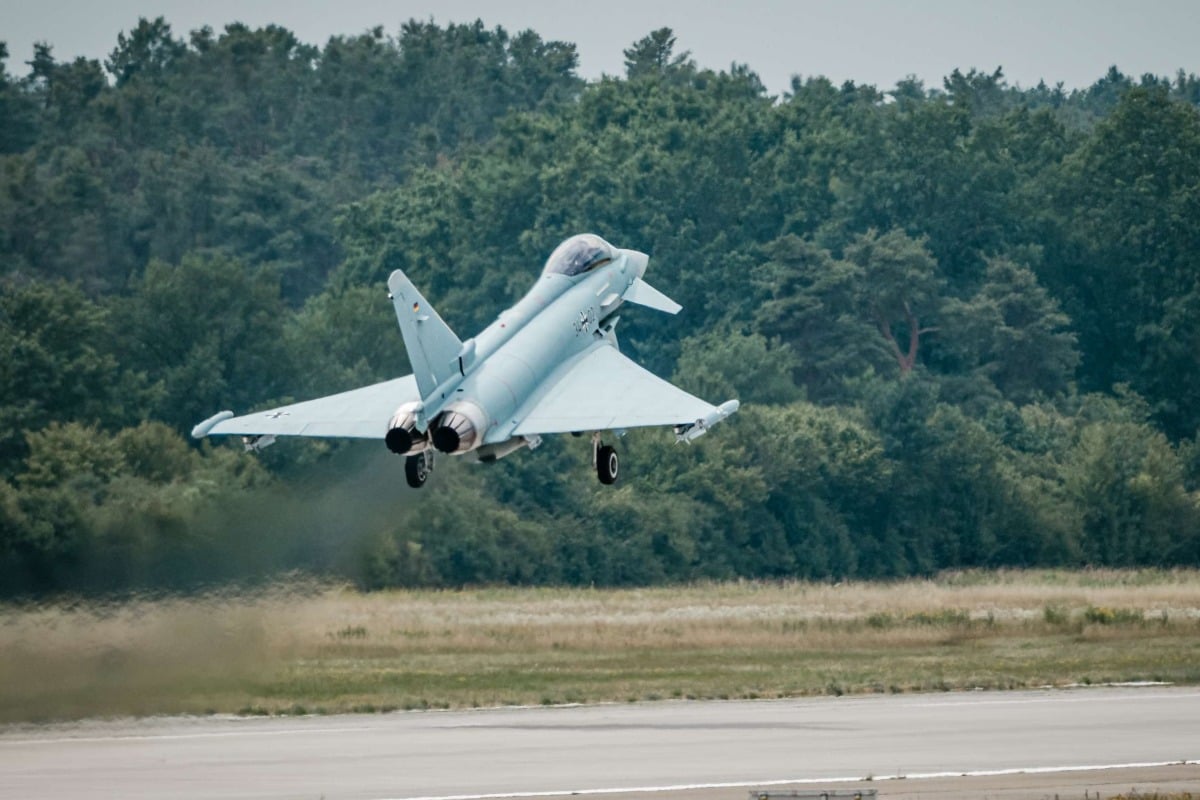
Germany has crossed a decisive threshold in European combat aviation. On July 14, 2026, the first Quadriga-standard Eurofighter Typhoon—carrying serial number 34+02—completed its maiden flight from Airbus Defence and Space’s final assembly line in Manching, Bavaria. While a one-hour Production Flight Acceptance Test under test pilot Stefan Auer appears routine, this event marks a structural shift. It represents the first physical manifestation of Project Quadriga: a €5.4 billion program to deliver 38 new-build Tranche 4 Eurofighters to the Luftwaffe.
This procurement represents far more than a simple inventory replacement of 38 aging Tranche 1 jets. It functions as a strategic hedge against the collapse of the Franco-German sixth-generation Future Combat Air System (FCAS), a critical bridge for Germany’s air power sovereign capabilities, and a fundamental modernization of NATO's European air defense infrastructure.
The Three Pillars of the Quadriga Architecture
The Tranche 4 airframe is aerodynamically identical to its predecessors, but its internal systems have been completely re-engineered. The modernized architecture rests on three core technical pillars:
- Active Electronically Scanned Array (AESA) Integration: The defining upgrade of the Tranche 4 is the European Common Radar System (ECRS) Mark 1 AESA radar. This sensor replaces the mechanically scanned Captor-M array of earlier generations. By utilizing hundreds of independent transmit-receive modules, the ECRS Mk1 allows the aircraft to simultaneously track multiple air and ground targets, resist heavy electromagnetic jamming, and perform high-resolution synthetic aperture radar mapping.
- Upgraded Processing Backbone: To process the massive influx of data generated by the ECRS Mk1, the Tranche 4 integrates a high-performance mission computer and modernized cockpit displays. This processing headroom prevents data bottlenecks and provides the electronic architecture required to integrate future weapons systems via software updates rather than costly structural retrofits.
- The Eurofighter EK (Electronic Combat) Baseline: Out of the 38 Quadriga aircraft, 15 are designated to receive the Saab Arexis electronic warfare suite under Step 1 upgrades. These specialized variants will replace Germany's ancient Panavia Tornado electronic combat aircraft. Outfitted with transmitter location systems and armed with AGM-88E Advanced Anti-Radiation Guided Missiles (AARGM), the Eurofighter EK will restore Germany's sovereign capability to perform Suppression of Enemy Air Defenses (SEAD) in highly contested airspace.
The Strategic Trilemma: Bridging the Capability Gap
Germany's fighter acquisition strategy is a response to three overlapping pressures: the immediate retirement of legacy platforms, the long-term failure of next-generation collaborative projects, and the need to meet NATO deterrence requirements.
                  +-----------------------------------+
                  |  Luftwaffe Air Power Rebuilding   |
                  +-----------------+-----------------+
                                    |
         +--------------------------+--------------------------+
         |                          |                          |
+--------v--------+        +--------v--------+        +--------v--------+
| Legacy Phaseout |        | Sovereign Hedge |        |  NATO Nuclear   |
|   (Tornado &    |        |   (Quadriga/    |        |   Deterrence    |
|   Tranche 1)    |        |   Tranche 5)    |        |    (F-35A)      |
+-----------------+        +-----------------+        +-----------------+
1. Legacy Phaseout and the Tornado Bottleneck
Germany is operating under a strict timeline to retire its fleet of Panavia Tornados and its oldest Tranche 1 Eurofighters. The Tranche 1 aircraft, designed primarily for air-to-air combat, lack the processing architecture and structural longevity required for modern multi-role operations. Project Quadriga directly resolves this by delivering 30 single-seat and eight twin-seat multi-role aircraft to maintain frontline squadron numbers.
2. The Collapse of the Joint Sixth-Generation Project
In June 2026, Germany and France officially terminated their joint Next Generation Fighter project under the FCAS banner after years of industrial friction, workshare disputes, and conflicting operational requirements. France required a carrier-capable variant for the Marine Nationale, whereas Germany favored land-based operations and questioned the massive cost of a bespoke nuclear-capable sixth-generation platform.
Without a viable sixth-generation European fighter on the horizon, Germany has turned to a dual-track strategy. First, it is buying time by ordering 38 Project Quadriga aircraft and a follow-on batch of 20 Tranche 5 Eurofighters. This ensures that the German aerospace manufacturing base—specifically Airbus's facility in Manching—retains critical systems-integration and manufacturing skills into the 2030s. Second, Berlin is looking to negotiate entry into the UK-Italy-Japan Global Combat Air Programme (GCAP) as a partner.
3. The Nuclear Sharing Role
While the Eurofighter forms the conventional backbone of the Luftwaffe, it cannot fulfill Germany’s NATO nuclear sharing commitment, which requires an aircraft certified to carry the B61 tactical nuclear bomb. To meet this specific mandate, Germany is acquiring 35 F-35A Lightning II aircraft from Lockheed Martin, with the first aircraft undergoing final assembly in Fort Worth and scheduled for delivery later in 2026.
Risks and Limitations of the Dual-Fleet Approach
Operating a split fleet of fifth-generation F-35As and "fourth-generation-plus" Eurofighter Tranche 4s introduces severe systemic challenges:
- Logistical Redundancy: Germany must maintain separate supply chains, simulator infrastructures, and maintenance procedures for two entirely different aircraft classes. This split naturally dilutes the operational efficiency of the Luftwaffe's ground crews.
- Sensor Fusion Disconnect: While the Tranche 4 features advanced networking capabilities, it does not possess the inherent, low-observable stealth of the F-35A. Integrating these two platforms into a cohesive tactical network requires highly secure "combat cloud" data links that can translate and transmit targeting data without compromising the F-35’s stealth profile.
- Staged Capability Rollouts: The initial Quadriga aircraft will be delivered under an "ECRS Mk1 Step 0" configuration—functionally equivalent to standard export models flown by Qatar and Kuwait. The fully realized software capabilities, improved electronic warfare suites, and "Step 1" hardware upgrades will not be fully integrated and certified until closer to 2030.
Strategic Forecast
Project Quadriga is not an ambitious leap forward, but rather a calculated defensive play. By securing 58 new-build Eurofighters across Tranches 4 and 5, Berlin ensures that the Luftwaffe retains raw mass and industrial sovereignty through the 2050s and 2060s while the next-generation fighter landscape settles.
For the German Ministry of Defense, the priority now shifts from hardware procurement to software and network integration. The immediate objective is to successfully stand up the initial F-35 pilot training pipelines in Arkansas while simultaneously executing the Step 1 software upgrades on the newly delivered Quadriga airframes. Achieving seamless data interoperability between these two distinct platforms will determine whether Germany's air defense strategy succeeds or fractures under its own complexity.